
Booster K1 EDU Humanoid Robot
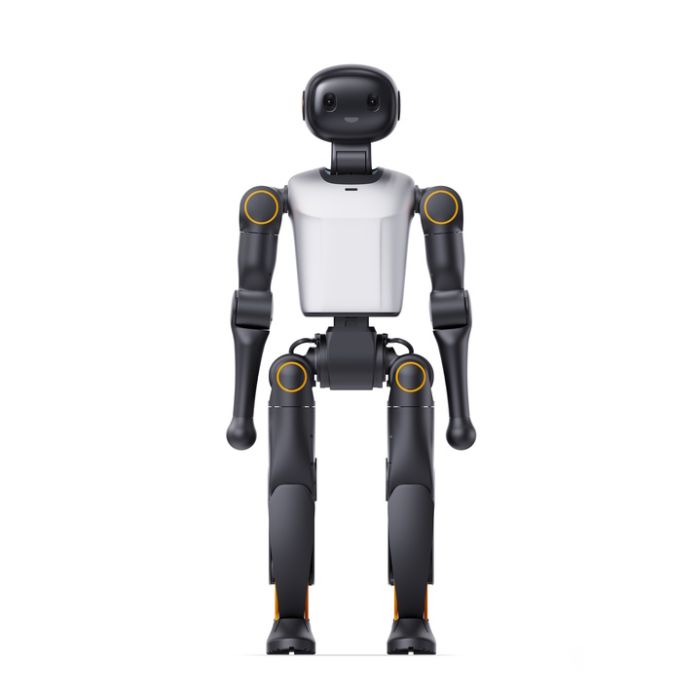
In stock
- BRAND:
- BOOSTER ROBOTICS
- MODEL:
- BOOSTER K1
- ORIGIN:
- China
- Warranty:
- 12 MONTHS
- AVAILABILITY:
- SUBJECT TO AVAILABILITY
- SKU:
- Booster-K1
Booster K1 EDU Humanoid Robot
Every robotics student eventually meets the same moment: code that walked flawlessly in simulation is loaded onto a real machine, and the floor turns out to be far less forgiving than the physics engine. How a teaching platform handles that moment decides whether students learn from it or give up on it. The Booster K1 EDU Humanoid Robot is built for exactly that crossing. It is a bipedal humanoid with onboard AI computing, depth vision and an open development stack, and a body that has already proved itself in competitive play, so the step from virtual model to physical walking becomes a lesson rather than a setback.
Robots Middle East supplies the Booster K1 EDU Humanoid Robot to schools, universities, research centres and technology programmes across the Middle East. Robots Middle East prepares each quotation, arranges delivery to the customer's site and remains the point of contact for technical support after the robot arrives, so institutions deal with a single partner from the first enquiry to the first walking demonstration.
Background
Booster Robotics and the K1 family
Booster Robotics develops humanoid robots intended for developers, educators and researchers rather than for display alone. The K1 family is offered in several versions, which the manufacturer names Geek, Education and Professional. This page covers the Education version, the EDU, which pairs the shared K1 body with an onboard computing module and a software package aimed at teaching and research. The K1 platform has a notable competitive record: it finished as both champion and runner-up in the RoboCup 2025 KidSize competition, an event in which humanoid robots play football autonomously and must withstand falls, collisions and repeated recoveries.
An introductory embodied development platform
Booster Robotics positions the K1 as an introductory embodied development platform. Embodied AI is the field in which perception, decision-making and control are tested on a physical body moving through the real world, rather than on data alone. Humanoid platforms of this kind are typically used to teach locomotion, balance, computer vision and human-robot interaction, and to give researchers a shared hardware base on which algorithms can be compared. The word introductory matters here: the K1 EDU is sized and specified to be approachable for a teaching laboratory, while still supporting secondary development, firmware upgrades and integration with established robotics tools.
Technical Specifications
| Specification | Value |
|---|---|
| Positioning | Introductory Embodied Development Platform |
| Height | ~95cm |
| Weight | ~19.5kg |
| Total DoFs | 22 |
| DoFs per leg | 6 |
| DoFs per arm | 4 |
| Head DoFs | 2 |
| Knee range | 0°~127° |
| Ankle range | P-50°~20°, R±20° |
| Max peak joint torque | 60N·m |
| Joint encoder | Dual Encoder |
| Compute module | NVIDIA Jetson Orin NX with 8 GB RAM |
| AI performance | 117 TOPS |
| Camera | Stereo Depth Camera |
| IMU | 9-axis IMU |
| Audio | Circular 3-Mic Array + speaker |
| Battery | 5Ah |
| Battery life | 80min (walking 0.4m/s) |
| Wi-Fi 6 | Supported |
| Bluetooth 5.2 | Supported |
| Expansion port | Gigabit Ethernet |
| Buttons | Power×1, Interaction×3 |
| Language model | Doubao LLM included, free for 6 months |
| Secondary development | Supported |
| Firmware upgrade | Supported |
Specifications are as published by the manufacturer and are confirmed against the datasheet at quotation.
The manufacturer has not published the payload, the IP rating, the charging time, the operating temperature range, the width and depth dimensions or the power consumption; Robots Middle East confirms these at quotation.
How does the Booster K1 EDU take code from simulation to the real floor?
The software side of the K1 EDU is designed around the workflow most robotics courses already teach. The robot is ROS-compatible, supports secondary development, provides interfaces for the robot model and works with simulation environments such as Isaac Sim. In practice, this means a student or researcher can build and test a behaviour against a virtual model of the robot, then run it on the physical machine using the same framework.
The hardware is what makes that transfer instructive. Each leg has 6 degrees of freedom and each joint uses a dual encoder, giving the controller precise feedback on joint position. A 9-axis IMU reports the orientation of the body, which balance and gait controllers depend on, and a peak joint torque of 60N·m gives the legs the strength to recover from disturbances. When something goes wrong between simulation and reality, these sensors give students the data to understand why, which is precisely the skill that embodied AI demands.
Durability matters as well. A robot that learns to walk will fall, often. The K1 platform's RoboCup 2025 KidSize results, achieved in a sport built on contact and recovery, show a body made for that kind of use, which is reassuring for any department planning to put the machine in front of a full cohort.
What does the EDU version offer for onboard AI?
The defining feature of the Education version is its onboard computer: an NVIDIA Jetson Orin NX with 8 GB RAM, delivering 117 TOPS of AI performance. This allows perception, inference and control to run locally on the robot rather than on a tethered workstation, so students can experiment with neural networks for vision, speech or motion directly on the machine that moves.
The sensor suite supports that work. A stereo depth camera gives the robot a three-dimensional view of its surroundings, suitable for obstacle detection, object recognition and navigation exercises. A circular 3-mic array with a speaker opens up voice interaction, and access to the Doubao LLM is included for six months, giving classes a ready way to explore conversational AI on a physical robot. Wi-Fi 6, Bluetooth 5.2 and a Gigabit Ethernet expansion port provide connectivity for data logging, remote development and additional peripherals.
The Education package also includes documentation, a hardware manual, ROS drivers, sample projects, a charger, a power supply, a 5 Ah battery, a remote control and a carrying case. Sample projects and drivers shorten the time between unpacking and the first working lesson, which matters to teaching staff working to a term timetable.
Who is the Booster K1 EDU Humanoid Robot for?
The K1 EDU suits universities and technical colleges that teach robotics, mechatronics or artificial intelligence and want a single humanoid platform that serves both undergraduate laboratories and postgraduate projects. Secondary schools and STEM centres running advanced programmes will find its introductory positioning and included sample projects a practical entry point. Research groups working on locomotion, perception or human-robot interaction can use it as an easy-to-handle test body, given its height of around 95cm and weight of around 19.5kg. Robot football teams preparing for competitions such as RoboCup will recognise the platform's record in the KidSize league.
Booster Robotics also offers the K1 in other versions. Institutions comparing the Booster K1 GEEK Edition Humanoid Robot or the Booster K1 Professional Humanoid Robot with the EDU are invited to ask Robots Middle East for a side-by-side comparison of the versions.
What is the Booster K1 EDU Humanoid Robot used for?
- Teaching bipedal locomotion: students study gait, balance and fall recovery on a real walking body.
- Simulation-to-reality research: behaviours developed in Isaac Sim are tested and refined on the physical robot.
- Computer vision exercises: the stereo depth camera supports object recognition, mapping and obstacle avoidance projects.
- Conversational AI and interaction: the microphone array, speaker and included language model enable voice-driven applications.
- Robot football and competitions: teams develop autonomous play on a platform with a RoboCup KidSize record.
- ROS curriculum delivery: courses teach ROS-based development on hardware that ships with ROS drivers and sample projects.
Pricing and Availability
Robots Middle East supplies the Booster K1 EDU Humanoid Robot on a quotation basis, so that each offer reflects the configuration, quantity and destination an institution actually requires. Delivery, customs clearance and technical support are arranged together with the quotation. Educational and research buyers planning a laboratory, a course or a competition team are welcome to send their requirements, and a tailored quotation can be requested through the enquiry form available on this page.
Frequently Asked Questions
Does the Booster K1 EDU support ROS?
Yes. The K1 EDU is ROS-compatible, and ROS drivers are included in the package alongside documentation and sample projects.
Can I simulate the robot before running code on it?
Yes. The robot provides interfaces for the robot model and is compatible with simulation environments such as Isaac Sim.
What computer does the EDU version use?
The Education version carries an NVIDIA Jetson Orin NX with 8 GB RAM, delivering 117 TOPS of AI performance for local perception and control.
How long does the battery last?
The Education version uses a 5Ah battery with a battery life of 80min when walking at 0.4m/s.
What is included with the robot?
The Education package includes documentation, a hardware manual, ROS drivers, sample projects, a charger, a power supply, a 5 Ah battery, a remote control and a carrying case.
Is the robot durable enough for student use?
The K1 platform finished as champion and runner-up in the RoboCup 2025 KidSize competition, a contact sport in which robots fall and recover repeatedly.
Where can I buy the Booster K1 EDU Humanoid Robot and what does it cost?
Robots Middle East supplies the Booster K1 EDU Humanoid Robot across the Middle East. The cost depends on configuration, quantity and destination, so Robots Middle East provides it in a tailored quotation requested through this page.
Summary
The hardest lesson in robotics is the one that happens when simulated success meets a real floor. The Booster K1 EDU Humanoid Robot is designed to make that lesson productive: ROS compatibility and Isaac Sim support on one side, and on the other a competition-proven body with dual-encoder joints, a 9-axis IMU, stereo depth vision and 117 TOPS of onboard AI performance. Its introductory positioning keeps it approachable for teaching, while its open development stack leaves room for serious research. For institutions in the Middle East ready to move their students from the screen to the floor, with Robots Middle East handling quotation, delivery and support, this page is the starting point.