
Booster T1 With Dexterous Hands Humanoid Robot
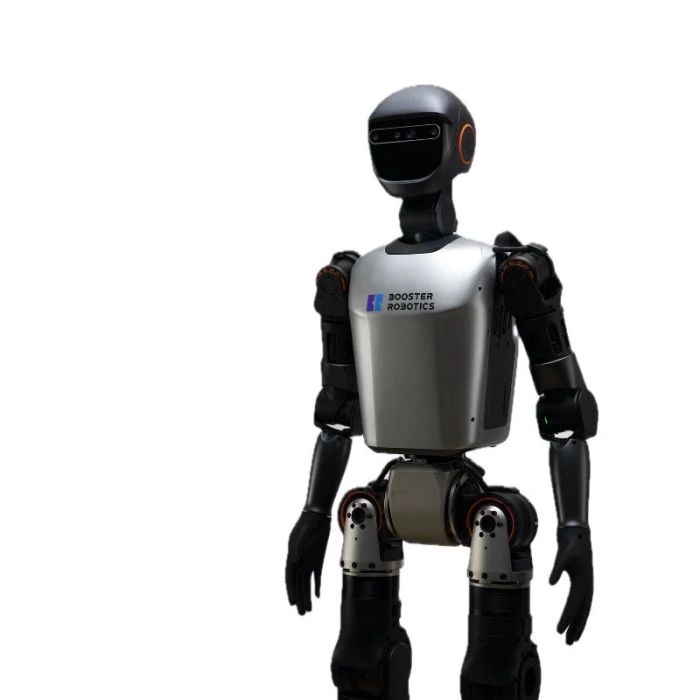
In stock
- BRAND:
- BOOSTER ROBOTICS
- MODEL:
- BOOSTER T1 WITH DEXTEROUS HANDS
- ORIGIN:
- China
- Warranty:
- 12 MONTHS
- AVAILABILITY:
- SUBJECT TO AVAILABILITY
- SKU:
- Booster-T1-Dexterous-Hands
- Buy 2 for AED 185,258.60 each and save 0%
Booster T1 With Dexterous Hands Humanoid Robot
In humanoid research, the most stubborn distance is often the last few centimetres between a fingertip and an object. A robot can cross a room, keep its balance on uneven ground and turn to face a table, yet still fail at the moment it has to close its fingers around something. The Booster T1 with Dexterous Hands Humanoid Robot is the member of the T1 family designed for that final stretch. It combines a full bipedal body with seven-degree-of-freedom arms that end in two six-degree-of-freedom dexterous hands. The result is a single platform on which locomotion, reaching and fine manipulation can be studied together rather than in separate rigs.
Robots Middle East supplies the Booster T1 with Dexterous Hands to universities, research institutes, innovation centres and robotics teams across the Middle East. Our team prepares each quotation and coordinates delivery to the customer's site. We also provide support after the robot arrives, so that a laboratory can move from unpacking to its first experiments with a clear point of contact.
Background
Booster Robotics and the T1 family
Booster Robotics develops humanoid robots intended for developers, researchers and competition teams. The T1 is offered in four versions that share one body and differ mainly in what is mounted at the end of the arms. The T1 Basic carries no end effector. The T1 Standard lists an end effector as optional. The T1 Gripper adds grippers, and the Dexterous hand version, described on this page, adds articulated hands. The platform's credentials come from competition. At RoboCup 2025 in Brazil, teams using Booster robots took the top two places in both the AdultSize and KidSize divisions, a result that speaks to the maturity of the company's bipedal hardware.
Where the dexterous hand version sits
Within the family, the progression is easy to read in the joint count: 23 degrees of freedom for the Basic and Standard versions, 31 for the Gripper version and 41 for the Dexterous hand version. The Standard, Gripper and Dexterous hand versions share the same lower-body and head arrangement: six degrees of freedom per leg, one at the waist and two in the head. The additional joints of this version sit in the arms and hands. The Booster T1 with Dexterous Hands is therefore not a different robot from its siblings. It is the same walking platform, extended as far as the family goes towards human-like manipulation.
Technical Specifications
| Specification | T1 Basic | T1 Standard | T1 Gripper | T1 Dexterous hand |
|---|---|---|---|---|
| Total degrees of freedom | 23 | 23 | 31 | 41 |
| End effector | None | Optional | Gripper | Dexterous hand |
| Leg degrees of freedom | — | 6 DOF per leg | 6 DOF per leg | 6 DOF per leg |
| Waist degrees of freedom | — | 1 | 1 | 1 |
| Head degrees of freedom | — | 2 | 2 | 2 |
| Arm degrees of freedom | — | — | — | 7 DoF per arm |
| Hand degrees of freedom | — | — | — | 6 DoF per hand (two hands) |
| Weight | — | — | — | About 30kg |
| Joint encoder | — | — | — | Dual Encoder |
| Battery | — | — | — | 10.5 Ah |
| Included item | — | — | — | Remote Control |
Specifications are as published by the manufacturer and are confirmed against the datasheet at quotation. The manufacturer has not published the payload, IP rating, hand grip force, hand weight, operating temperature, battery voltage or maximum speed; these are confirmed at quotation.
What does the dexterous hand version add over the T1 Gripper?
The T1 Gripper and the Dexterous hand version share the same legs, waist and head. They differ in what happens at the end of the arm. The Gripper version reaches 31 degrees of freedom, while the Dexterous hand version reaches 41. The difference comes from two hands with six degrees of freedom each, mounted on arms with seven degrees of freedom each. A gripper is well suited to grasping work where the object can be approached in a predictable way. An articulated hand opens a different set of questions: how fingers should be shaped around an irregular object, how a grasp can be adjusted once the object is held, and how a learned hand policy transfers from simulation to hardware.
For a research group, the choice is mainly about the questions it intends to ask. If the work treats grasping as a means to an end, for example in navigation or task-planning studies, the simpler end effector may be enough. If the hand itself is the subject of study, the dexterous version gives the group a body on which to pursue it.
Why do degrees of freedom matter in a humanoid hand?
Each degree of freedom is an independent axis of motion that a controller can command. In a humanoid, additional joints in the arm let the hand approach an object from more angles and around more obstacles. Additional joints in the hand let the robot form more than one kind of grasp. A seven-degree-of-freedom arm offers one more axis than is strictly needed to place a hand in position and orientation. That redundancy is what allows a controller to keep the elbow clear of a shelf edge, or to change posture without moving the hand. On the Booster T1 with Dexterous Hands, the Dual Encoder joint arrangement supports the precise state feedback that this kind of whole-body control depends on.
Who is the Booster T1 with Dexterous Hands for?
The clearest fit is a research laboratory working on dexterous manipulation, embodied AI or whole-body control. In this kind of work, the interaction between legs, torso, arms and fingers is the object of study rather than a side issue. University departments that teach humanoid robotics at an advanced level will also find value in a platform on which students can progress from balance and gait to grasping without changing hardware.
Innovation centres and corporate research groups exploring humanoids for future service or handling roles can use the robot to prototype manipulation behaviours and to show what an articulated hand makes possible. Competition teams that also run manipulation research may value having both strands on one body.
Some buyers will be better served by a sibling version. A team whose work is mainly locomotion, perception or robot football does not need articulated hands and may prefer the T1 Basic or the T1 Standard. A group that needs reliable grasping without finger-level control may find the T1 with Grippers more suitable. Buyers comparing platforms more widely can browse our Bipedal Humanoids category.
What is the Booster T1 with Dexterous Hands used for?
- Dexterous manipulation research: developing and testing grasp strategies for objects of varied shape on real hardware.
- Embodied AI: training and validating learned policies that link perception, locomotion and hand control in one body.
- Simulation-to-reality transfer: measuring how well hand and arm controllers trained in simulation perform on a physical humanoid.
- Whole-body control: studying how balance is maintained while the arms reach and the hands apply effort.
- Advanced teaching: giving postgraduate students a platform that covers bipedal walking and articulated manipulation together.
- Demonstration and outreach: showing visitors and partners what a humanoid with human-like hands can do in a controlled setting.
Pricing and Availability
Robots Middle East supplies the Booster T1 with Dexterous Hands on a quotation basis, so that each order reflects the configuration, documentation and support your project requires. Delivery, customs clearance and after-sales support are arranged together with the quotation. To begin, please share your intended application and site details with our team using the quotation request available on this page.
Frequently Asked Questions
How many degrees of freedom does the Booster T1 with Dexterous Hands have?
It has 41 degrees of freedom. This includes two seven-degree-of-freedom arms and two six-degree-of-freedom dexterous hands.
How does it differ from the other T1 versions?
The Basic and Standard versions have 23 degrees of freedom, and the Gripper version has 31. The Dexterous hand version, with 41, is the only one of the four fitted with articulated hands.
How much does the robot weigh?
The robot weighs about 30kg.
What battery does it use?
The robot uses a 10.5 Ah battery.
What is included with the robot?
A remote control is included with the robot.
Has the Booster platform been proven in competition?
Yes. At RoboCup 2025 in Brazil, teams using Booster robots took the top two places in both the AdultSize and KidSize divisions.
Where can I buy the Booster T1 with Dexterous Hands and what does it cost?
You can order it from Robots Middle East, which supplies it across the Middle East. The cost depends on your configuration and delivery requirements and is set out in a tailored quotation, which you can request from this page.
Summary
The last few centimetres between fingertip and object are where many humanoid projects stall. The Booster T1 with Dexterous Hands is built to let researchers work in that space without giving up a walking body. It shares its legs, waist and head with the Standard and Gripper versions. To these it adds seven-degree-of-freedom arms and two six-degree-of-freedom hands, for a total of 41 degrees of freedom, on a platform whose lineage has succeeded at RoboCup. For laboratories, universities and innovation teams across the Middle East that want to study reaching and grasping as seriously as balance, and to source the robot, quotation and support through Robots Middle East, this page is the starting point.
Specifications
General
Physical
Connectivity
Software
What's included
Robot Accessories:
- Remote Control
- Charger
- Robot Vertical Stand
- Robot Transport Case