
Casbot W1 Wheeled Humanoid Robot
In stock
- BRAND:
- CASBOT
- PART #:
- W1
- ORIGIN:
- China
- AVAILABILITY:
- SUBJECT TO AVAILABILITY
- SKU:
- Casbot-W1
Casbot W1 Wheeled Humanoid Robot
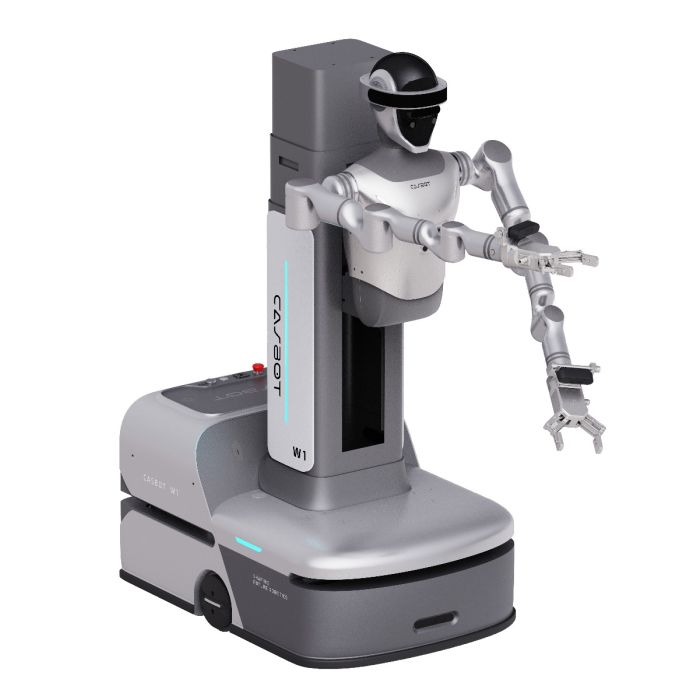
A conventional industrial arm is bolted to the floor, and every part it handles has to be brought to it by conveyor, trolley or a member of staff. The Casbot W1 Wheeled Humanoid Robot reverses that arrangement: here the manipulator travels to the task. Two arms ride on a mobile base fitted with adjustable lift mechanics, so one machine can take an item from a low tote, scan it at a counter and set it down on a higher shelf without the surrounding cell being rebuilt for it. For operations that have outgrown fixed automation but cannot justify redesigning a building, that reversal is the whole argument.
Robots Middle East supplies the Casbot W1 to businesses, research institutions and system integrators across the Middle East. Our team prepares the quotation, coordinates delivery to your site and remains your point of contact for support once the robot is in service, so a single regional partner accompanies the project from the first enquiry to routine operation.
Background
CASBOT and its manufacturer
CASBOT is the brand under which Beijing Zhongke Huiling Robotics Technology Co., Ltd. develops its humanoid robots. The W1 sits alongside other CASBOT products, including bipedal humanoids and dexterous robotic hands, which gives buyers a family of platforms from one manufacturer rather than a single isolated model. Within that family, the W1 is the platform that trades legs for wheels and places its emphasis on handling work.
A humanoid organised around its arms
Much of the attention in humanoid robotics goes to walking, yet a great deal of practical work in warehouses, shops and factories involves reaching, grasping and placing at a fixed station. A wheeled base removes the balancing problem that legged robots must solve continuously, and leaves the engineering effort for the upper body. The W1 combines mobile navigation with dual-arm manipulation for embodied AI tasks, meaning that perception, decision-making and physical action are handled by one system. Its adjustable lift mechanics let the arms work at different heights, which matters wherever goods are stored across several levels.
Technical Specifications
| Specification | Value |
|---|---|
| Manufacturer | CASBOT / Beijing Zhongke Huiling Robotics Technology Co., Ltd. |
| Product type | Wheeled humanoid robot platform with mobile navigation and dual-arm manipulation |
| Degrees of freedom, overall | 20 |
| Degrees of freedom, hands | 7 per arm |
| Height | 112-210 cm |
| Max speed | 4.3 km/h |
| Weight | ~260 kg |
| Runtime per charge | ~4–5 hours |
| Compute | Industrial PC (i9 CPU + NVIDIA 4060 GPU) |
| Connectivity | 4G, Bluetooth 5.2, Ethernet, Wi-Fi 6 |
| Cameras | RGB-D structured light units + stereo vision |
| Perception suite | RGB-D vision, LiDAR, tactile and force sensors, IMU |
| Grippers | 3-finger grippers |
| Operating system | ROS-compatible with proprietary robotics stack |
| Main structural material | Alloy + engineering plastics |
| Motor technology | Industrial electric servos |
| Lift | Adjustable lift mechanics on the mobile base |
Specifications are as published by the manufacturer and are confirmed against the datasheet at quotation.
The manufacturer has not published the payload per arm, the IP rating, the battery capacity, the charging time, the overall dimensions, the drive and wheel configuration, the LiDAR model or the contents of the box; each of these is confirmed with you at quotation.
What makes the Casbot W1 different from a bipedal humanoid?
The difference begins at the floor. A bipedal humanoid has to keep its balance with every step and every reach, and that constant correction shapes its whole design. The W1 stands on a mobile base instead, so stability comes from the platform rather than from active balancing, and the robot can commit its attention to the work in front of it. With a weight of ~260 kg, it is a substantial machine built for a stable working posture rather than for agility.
The second difference is vertical range. Rather than bending at the knees or the waist to reach low or high, the W1 uses adjustable lift mechanics to raise and lower its working position, with a height of 112-210 cm. For tasks that move between a low bin and an upper shelf, this gives the arms a controlled platform at each level.
The third difference is the balance between travel and handling. The W1 moves at up to 4.3 km/h and runs for ~4–5 hours per charge, figures that suit a robot which travels between stations and then spends most of its time manipulating. A legged platform remains the better choice where stairs, steps or uneven ground are part of the route, and that is where CASBOT's bipedal models come into the conversation.
How does the Casbot W1 perceive and act on its surroundings?
Handling objects reliably depends on seeing them clearly and feeling how they respond. The W1 carries RGB-D structured light units together with stereo vision for depth perception, LiDAR for sensing the space around it, tactile and force sensors for contact, and an IMU for tracking its own motion. Together these give the robot a picture of where an item is, how far away it sits and what happens when the gripper makes contact.
Processing takes place on an industrial PC with an i9 CPU and an NVIDIA 4060 GPU, which allows perception and planning to run on the robot itself. The 3-finger grippers carry out the physical work, and the arms provide 7 degrees of freedom each, within 20 degrees of freedom overall. Industrial electric servos drive the joints, and the structure is built from alloy and engineering plastics.
For integration, the W1 runs a ROS-compatible environment alongside CASBOT's proprietary robotics stack. That matters to development teams who already work in ROS and want to bring their own tools to the platform. Connectivity covers 4G, Bluetooth 5.2, Ethernet and Wi-Fi 6, so the robot can join a site network by cable or wirelessly and stay reachable where local networks are limited.
Who is the Casbot W1 for?
Logistics operators form the first natural audience: distribution centres and fulfilment sites where items must be picked, sorted, scanned and placed at stations of differing heights. Retailers are a second group, particularly those exploring automation for stockrooms and shelf work, where a robot must move between locations and handle goods at several levels. Manufacturers with line-side handling tasks, such as presenting parts to a workstation or moving items between processes, make up a third.
Research institutions, universities and system integrators are a further segment. The ROS compatibility, the on-board GPU and the broad sensor suite make the W1 a platform for developing and testing embodied AI applications in realistic handling scenarios, before those applications are rolled out to a client site.
Not every project suits a wheeled base. Where the research focus is legged locomotion, or the route includes stairs and uneven ground, the Casbot 02 Bipedal Humanoid Robot and the Casbot Mini Bipedal Humanoid Robot are the bipedal platforms in the same family. Teams whose work centres on grasping and finger-level manipulation may also wish to review the Casbot Handle L1 Dexterous Robotic Hand. To compare the W1 with other platforms of its type, see our Wheeled Humanoids range, or the wider Humanoids category.
What is the Casbot W1 used for?
- Order picking: retrieving items from totes and shelves at different heights for fulfilment.
- Sorting: separating goods by destination, type or condition at a sorting station.
- Scanning: presenting items to a scanner or reading labels as part of inventory and dispatch checks.
- Shelf work in retail: placing products on display or stockroom shelves across several levels.
- Line-side handling: moving parts and materials between workstations in manufacturing workflows.
- Embodied AI development: building and testing perception and manipulation software on a ROS-compatible platform.
Pricing and Availability
Robots Middle East supplies the Casbot W1 on a quotation basis, prepared around your intended application, site and integration needs. Delivery, customs clearance and after-sales support are arranged as part of that quotation, so you receive a complete picture of the project before any commitment. To begin, please share your use case and location with our team; the quotation request form is available on this page.
Frequently Asked Questions
How many degrees of freedom does the Casbot W1 have?
The W1 has 20 degrees of freedom overall, with 7 degrees of freedom per arm listed for the hands.
Can the Casbot W1 work at different heights?
Yes. Its mobile base is paired with adjustable lift mechanics so that the arms can work at different heights, and its height is 112-210 cm.
How long does the Casbot W1 run on one charge?
The runtime per charge is ~4–5 hours, which suits shift-based handling work between stations.
What computing hardware does the robot use?
The W1 uses an industrial PC with an i9 CPU and an NVIDIA 4060 GPU, which allows perception and planning to run on board.
Is the Casbot W1 compatible with ROS?
Yes. It runs a ROS-compatible environment together with CASBOT's proprietary robotics stack, which suits teams that already develop in ROS.
Which sensors does the Casbot W1 use?
The W1 combines RGB-D structured light units and stereo vision with LiDAR, tactile and force sensors and an IMU. Together they support navigation between stations and careful handling at each one.
Where can I buy the Casbot W1 Wheeled Humanoid Robot and what does it cost?
You can obtain the Casbot W1 through Robots Middle East, which supplies it across the Middle East. The cost depends on your configuration, delivery location and support requirements, so it is provided in a tailored quotation that you can request on this page.
Summary
Fixed automation asks the workplace to arrange itself around the robot; the Casbot W1 asks the robot to fit into the workplace. A mobile base, adjustable lift mechanics and two arms with 3-finger grippers let it reach the job at the height the job sits, while RGB-D and stereo vision, LiDAR, tactile and force sensing and on-board GPU computing give it the awareness to handle items with care. ROS compatibility and broad connectivity keep it open to integration. For organisations in the Middle East considering mobile manipulation for logistics, retail or manufacturing, and for teams developing embodied AI, Robots Middle East can prepare a quotation that covers delivery, customs and support, and this page is the starting point.