
Dexforce W1 Core General Purpose Embodied Intelligence Wheeled Humanoid Robot
In stock
- BRAND:
- DEXFORCE
- PART #:
- W1 Core
- ORIGIN:
- China
- AVAILABILITY:
- SUBJECT TO AVAILABILITY
- SKU:
- DexForce-W1-Core
Dexforce W1 Core General Purpose Embodied Intelligence Wheeled Humanoid Robot
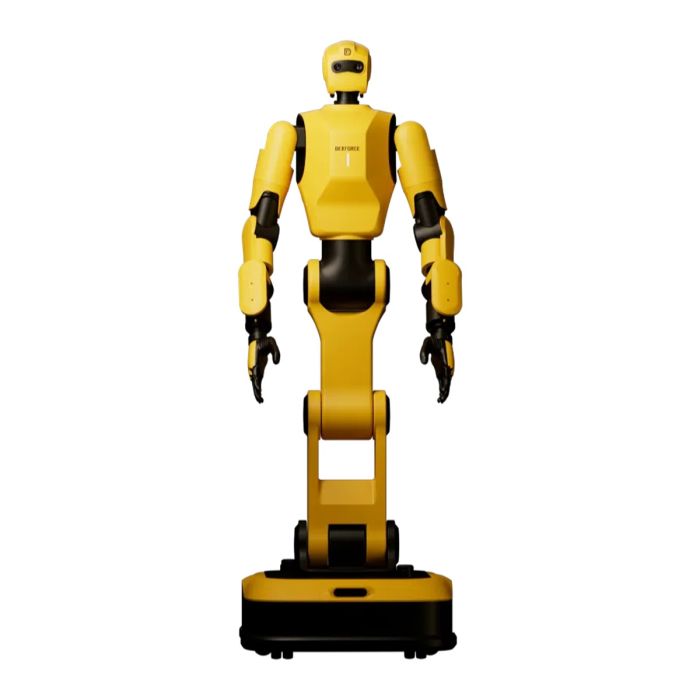
Buying a humanoid robot is usually treated as a single decision, taken all at once. With the Dexforce W1 Core General Purpose Embodied Intelligence Wheeled Humanoid Robot, it is closer to a sequence of considered choices: which end-effector each arm should carry, whether the wrists need cameras of their own, and how much computing power should sit behind the head. Beneath those choices lies a constant platform. It is an upper-body humanoid built for stationary operation, with arms of 7 DOF each, a binocular head and motion control running at 1kHz. What changes from one installation to the next is how fully that platform is equipped for the work in front of it, and that is where a well-prepared specification earns its keep.
Robots Middle East supplies the W1 Core to research institutions, universities, system integrators and businesses across the Middle East. Each quotation we prepare is built around the configuration your project requires, and Robots Middle East remains your point of contact for delivery, set-up questions and after-sales support throughout the region.
Background
DexForce Technology and the W1 family
The W1 Core is developed by DexForce Technology Co., Ltd., a robotics manufacturer based in Shenzhen, China. DexForce offers its W1 platform in two versions. The W1 Pro has a full-body form factor; the W1 Core has an upper-body form factor and is intended for stationary operation. The two share the W1 name and the general-purpose embodied intelligence brief, yet they answer different questions about how a robot should be deployed.
Embodied intelligence is the field that gives artificial intelligence a physical body to act through. Rather than reasoning only over text or images, an embodied system perceives a real environment, moves within it and learns from the outcome of what it does. Humanoid forms are popular in this field because the world of benches, shelves, counters and tools has been shaped around the human body, so a robot with a comparable reach and viewpoint can work in those spaces with fewer changes to the surroundings.
An upper body engineered for work at a fixed station
The W1 Core concentrates its engineering where stationary tasks make their demands: in the head, the torso and the arms. The head carries 6cm Baseline Humanoid Binocular Vision paired with a Large-Model Binocular Algorithm, giving the robot a stereo view of its workspace from a position close to human eye level. The torso adds articulation of its own, with 2 DOF at the neck, 2 DOF at the waist and 2 DOF at the leg, so the robot can turn its gaze, lean and adjust its posture rather than relying on the arms alone.
Each arm has 7 DOF, arranged as 3 at the shoulder, 1 at the elbow and 3 at the wrist. That redundant arrangement mirrors the human arm and allows the robot to approach an object from more than one angle. High-frequency motion control runs at 1kHz, and the standard computing package is a Single-PC Architecture rated at ≥150 TOPS.
Technical Specifications
| Specification | Value |
|---|---|
| Form factor | Upper-Body |
| Dimensions (L×W×H) | 682mm*550mm*1636mm |
| Weight | 110kg |
| Torso DOF | Neck: 2 DOF; Waist: 2 DOF; Leg: 2 DOF |
| DOF of single arm | 7 DOF (Shoulder: 3; elbow: 1; wrist: 3) |
| Max payload (single arm) | 10kg |
| Arm repeatability (without hand) | ±0.5 mm |
| End-effector type | Standard: 2-Finger Gripper; Optional: Dexterous Hand |
| Head vision | 6cm Baseline Humanoid Binocular Vision + Large-Model Binocular Algorithm |
| Wrist vision | Standard: N/A; Optional: Supports RGBD Cameras on both wrists |
| Computing & AI power | Standard: Single-PC Architecture (≥150 TOPS); Optional: Dual-PC Architecture (≥300 TOPS) |
| High-frequency motion control | 1kHz |
| Application type | Stationary Operation |
| Typical industries | Data Collection & Training, Research & Education, Commercial Services, Industrial Manufacturing |
| Manufacturer | DexForce Technology Co., Ltd., Shenzhen, China |
Specifications are as published by the manufacturer and are confirmed against the datasheet at quotation.
The manufacturer has not published the battery life, the battery capacity, the power consumption, the connectivity, the IP rating, the operating temperature, the details of the wheeled chassis or the contents of the box; each of these is confirmed with you at quotation.
What can the W1 Core be configured with?
The configurable elements of the W1 Core fall into three areas, and each one changes what the robot is able to do rather than merely how it looks.
The first is the end-effector. As standard, each arm finishes in a 2-Finger Gripper, which suits picking, placing and holding parts with simple geometry. A Dexterous Hand is available as an option for projects that call for in-hand manipulation, tool use or grasps that a parallel gripper cannot achieve. The arm repeatability of ±0.5 mm applies to the arm without a hand fitted, which is worth bearing in mind when a project depends on fine positioning at the fingertip.
The second is wrist vision. The standard configuration has no wrist cameras, leaving perception to the binocular head. As an option, the W1 Core supports RGBD Cameras on both wrists, adding close-range depth views at the point of contact. For grasping research and for the recording of manipulation demonstrations, that second viewpoint can make a considerable difference to the quality of the data.
The third is computing. The Single-PC Architecture rated at ≥150 TOPS is standard, and a Dual-PC Architecture rated at ≥300 TOPS is available for teams that intend to run heavier models on the robot itself. Choosing between them is largely a question of how much inference you expect the robot to perform locally.
How does the W1 Core differ from the W1 Pro?
The essential difference lies in form factor. The Dexforce W1 Pro General Purpose Embodied Intelligence Wheeled Humanoid Robot has a full-body form factor, whereas the W1 Core has an upper-body form factor and is intended for stationary operation. The W1 Core is therefore the version to consider when the work comes to the robot: a test station, a teaching laboratory, a service counter or a production cell where the robot is positioned once and then works within reach of its arms.
Choosing the version that matches the deployment avoids paying, in complexity and commissioning effort, for capabilities a project will not use. Robots Middle East can prepare quotations for both versions side by side so that the comparison rests on facts rather than on assumptions.
Who is the W1 Core for?
The W1 Core has four typical industries, and each corresponds to a distinct group of buyers. Data collection and training teams need a consistent physical platform on which human operators or scripted routines can generate manipulation data for model training. Universities and research institutes need a humanoid that students and researchers can study, programme and extend, with configuration options that allow a laboratory to begin modestly and grow. Operators in commercial services are exploring humanoids for tasks at fixed points of contact with the public. Manufacturers are evaluating humanoid manipulation for stations where tasks change too often to justify dedicated automation.
Buyers whose project calls for a full-body form factor should look at the W1 Pro instead. Those comparing the W1 family with other platforms will find the wider range in our Wheeled Humanoids category.
What is the W1 Core used for?
- Manipulation data collection: recording repeatable demonstrations at a fixed station to build training datasets for embodied AI models.
- Model training and evaluation: testing learned policies on real hardware to see how they perform outside simulation.
- University teaching: giving students hands-on experience of humanoid kinematics, stereo vision and robot programming.
- Research in grasping and dexterity: studying in-hand manipulation when the optional Dexterous Hand and wrist RGBD cameras are fitted.
- Commercial service stations: trialling humanoid assistance at counters, displays and other fixed points of customer contact.
- Industrial workstations: evaluating flexible, human-like manipulation for assembly, handling and inspection tasks at a production cell.
Pricing and Availability
The W1 Core is supplied on quotation, because its final specification depends on the end-effector, wrist vision and computing options you select. Robots Middle East prepares each quotation around your intended application and the configuration you choose. Delivery, customs clearance and after-sales support are arranged together with your quotation. To begin, please share your application and preferred configuration through the quotation request for the W1 Core, available on this page.
Frequently Asked Questions
Is the W1 Core intended to move around a site?
The W1 Core is intended for stationary operation. Please raise any requirement for repositioning when you request a quotation.
Which end-effector is fitted as standard?
A 2-Finger Gripper is standard on each arm. A Dexterous Hand is available as an option.
How much can each arm carry, and how precisely?
The maximum payload of a single arm is 10kg. Arm repeatability is ±0.5 mm for the arm without a hand.
How much computing power does the robot have?
The standard Single-PC Architecture is rated at ≥150 TOPS. The optional Dual-PC Architecture is rated at ≥300 TOPS.
Does the W1 Core have cameras on its wrists?
Not in the standard configuration, which relies on the 6cm baseline binocular head. As an option, it supports RGBD Cameras on both wrists.
What are the battery life and IP rating?
These belong to the details listed beneath the specification table. Robots Middle East provides them with your quotation.
Where can I buy the W1 Core and what does it cost?
Robots Middle East supplies the W1 Core across the Middle East. The cost depends on the configuration you choose, so please request a quotation and we will respond with a proposal prepared for your project.
Summary
The W1 Core rewards a buyer who thinks of a humanoid as a platform to be specified rather than a finished object to be bought off the shelf. Its fixed elements are clearly defined: an upper-body form with arms of 7 DOF each, articulation at the neck, waist and leg, a 6cm baseline binocular head and 1kHz motion control, all intended for stationary work. Its variable elements, from the Dexterous Hand and wrist RGBD cameras to the Dual-PC Architecture, let a laboratory, a service operator or a manufacturer equip it for the task at hand. For buyers who want the full-body form, the W1 Pro is the sibling to compare. For a configuration of the W1 Core prepared by Robots Middle East, this page is the starting point.