
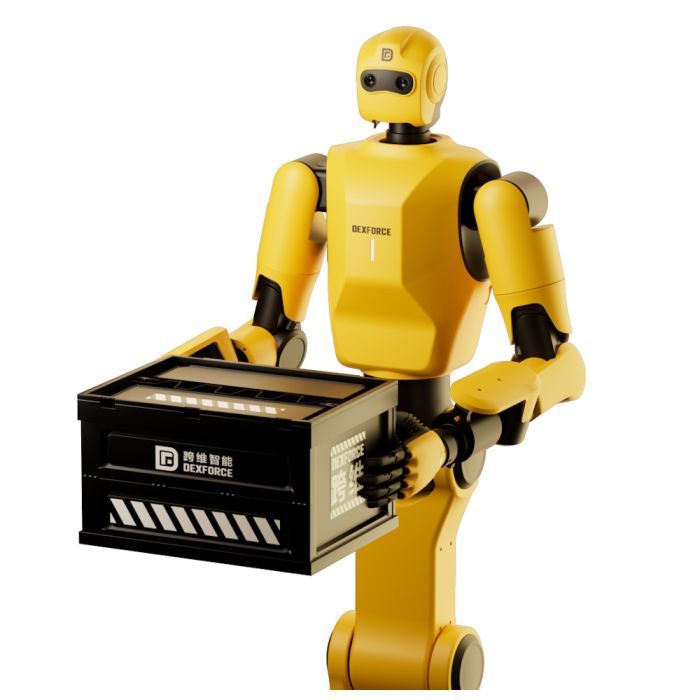
Dexforce W1 Pro General Purpose Embodied Intelligence Wheeled Humanoid Robot
In stock
- BRAND:
- DEXFORCE
- PART #:
- W1 Pro
- ORIGIN:
- China
- AVAILABILITY:
- SUBJECT TO AVAILABILITY
- SKU:
- DexForce-W1-Pro
Dexforce W1 Pro General Purpose Embodied Intelligence Wheeled Humanoid Robot
Many embodied-AI teams end up assembling their robotics bench from separate parts: a mobile base for mapping, a fixed arm bolted to a table for grasping, a workstation in the corner for training, and a great deal of integration work to make them speak to one another. The Dexforce W1 Pro General Purpose Embodied Intelligence Wheeled Humanoid Robot folds that bench into a single body. Two seven-joint arms, a neck, a waist and a leg section, binocular head vision and a Laser SLAM chassis share one EtherCAT industrial ring network and one onboard computing system. The machine that learns a task is the same machine that drives across the room and carries it out.
Robots Middle East supplies the W1 Pro to universities, research centres, system integrators and corporate innovation teams across the Middle East. Robots Middle East prepares the quotation for the configuration you require, arranges delivery to your site and supports the platform once it is in your hands, so one point of contact covers the robot from the first specification discussion to day-to-day operation.
Background
One platform, several configurations
DEXFORCE presents the W1 as a family rather than a single fixed machine. The sources name the W1 Pro and the W1 Core, and the W1 Pro itself is built in two chassis forms: a differential chassis that gives the full body 34 degrees of freedom, and an omnidirectional chassis that raises the total to 40. Around that core the buyer chooses the working ends of the robot. The end effector can be a dexterous hand or a two-finger gripper; the arm can be humanoid or industrial-like; the mobile base can be differential or omnidirectional; and a dual-PC configuration is also offered. This modularity matters because embodied-intelligence projects rarely stay still. A laboratory that begins with simple pick-and-place may later move to fine dexterous manipulation, and a platform that accepts different hands and arms protects that investment.
Wheeled humanoids as a class trade legged locomotion for stability and endurance. With a rolling base, the engineering effort can be spent on the upper body, perception and control, which is where most research and applied tasks actually happen. You can compare the wider class in our Wheeled Humanoids category.
From simulation to the real world
The software side of the W1 Pro is built around a Sim2Real VLA pipeline, with massive data generated and trained online through EmbodiChain. Vision-language-action models learn to map what a robot sees and is told into what it does, and they need very large volumes of training data; generating that data in simulation is far faster than collecting it by hand. The difficulty has always been the transfer back to physical hardware, and that is where the W1 Pro's body is designed to help. Total system computing power is ≥ 300 TOPS, full-body joints are controlled in real time at 1000Hz, force control works to a precision of 0.1N, and every joint sits on an EtherCAT industrial ring network. Together these give a learned policy a responsive, predictable body in which to run.
Technical Specifications
| Specification | Value |
|---|---|
| Dimensions (L×W×H) | 682mm*550mm*1636mm |
| Weight | 110kg |
| Full-body DOF (differential chassis) | 34 |
| Full-body DOF (omnidirectional chassis) | 40 DOF for the full body |
| Single arm DOF | 7 DOF (Shoulder: 3; elbow: 1; wrist: 3) |
| Max payload (single arm) | 10kg |
| Arm repeatability (without hand) | ±0.5 mm |
| Torso DOF | Neck: 2 DOF, Waist: 2 DOF, Leg: 2 DOF |
| Chassis DOF | 8 DOF for omnidirectional chassis, 2 DOF for differential chassis |
| Movement mode | Differential (Optional: Omnidirectional) |
| Straight-line speed | Max 1.5m/s, Rated 1.2m/s |
| Navigation method | Laser SLAM |
| Navigation LiDAR | 2 pcs (Diagonally mounted on chassis) |
| Head vision | 6cm Baseline Humanoid Binocular Vision + Large-Model Binocular Algorithm |
| Battery life | ≥8H Continuous Power Supply (Wired) |
| Battery capacity | 40 Ah; Optional: LiFePO4 Battery (40 Ah) |
| Computing power | Total system computing power ≥ 300 TOPS |
| Control frequency | 1000Hz real-time control of full-body joints |
| Force control precision | 0.1N |
| Industrial network | EtherCAT industrial ring network |
| Optional components | Dexterous hand / two-finger gripper; humanoid / industrial-like robotic arm; differential / omnidirectional mobile chassis; dual-PC configuration |
| Software engine | Sim2Real VLA Pipeline: Massive data online gen & training (via EmbodiChain) |
Specifications are as published by the manufacturer and are confirmed against the datasheet at quotation.
The manufacturer has not published the IP rating, charging time, operating temperature, package contents, Wi-Fi and Bluetooth support or noise level; these are confirmed at quotation.
Differential or omnidirectional: which W1 Pro chassis should you choose?
The chassis is the most consequential choice in a W1 Pro order, because it changes how the whole robot moves through a space. The differential chassis has 2 degrees of freedom and brings the full body to 34. It drives forwards and turns, much like a conventional mobile robot, and it is the standard movement mode. It suits environments with clear aisles and predictable routes, where the robot travels to a station and then works with its arms.
The omnidirectional chassis has 8 degrees of freedom and brings the full body to 40. It allows the base to move in any direction without first turning, which becomes valuable in tight laboratories, crowded service areas and workcells where the robot must sidestep to reach a shelf or line up precisely with a bench. For manipulation research, an omnidirectional base also lets whole-body policies use the chassis as part of the reach, rather than treating it purely as transport.
Both forms share the same navigation stack: Laser SLAM supported by two LiDAR units mounted diagonally on the chassis, and a straight-line speed of Max 1.5m/s with a rated 1.2m/s. The decision therefore rests on the geometry of your space and on how far your research or application relies on fine positioning of the base.
What makes the W1 Pro suited to precise manipulation?
Manipulation is where a wheeled humanoid earns its place, and the W1 Pro's figures point in that direction. Each arm has 7 degrees of freedom, split as three at the shoulder, one at the elbow and three at the wrist, the same redundant layout that lets a human arm reach around obstacles while keeping the hand oriented. Arm repeatability without the hand is ±0.5 mm, and a single arm carries up to 10kg. Force control works to 0.1N, which is the kind of sensitivity needed for tasks such as inserting, wiping or handling fragile items, where position alone is not enough.
Perception is handled by a 6cm baseline humanoid binocular vision system in the head, paired with a large-model binocular algorithm. A baseline close to human eye spacing gives depth perception at the working distance of the arms, and a neck with 2 degrees of freedom lets the robot direct its gaze at the task. A waist and leg section, each with 2 degrees of freedom, extend the reachable workspace upwards and downwards. With 1000Hz full-body control over EtherCAT, all of these joints can be co-ordinated as one system.
Who is the Dexforce W1 Pro for?
The W1 Pro is first of all a platform for embodied-AI research. University laboratories and corporate research groups training vision-language-action models will find the Sim2Real pipeline, the onboard computing power and the precise, force-sensitive arms a coherent foundation for experiments that must eventually leave simulation.
System integrators form a second group. The choice of hands, arms, chassis and a dual-PC configuration lets an integrator shape the robot to a client's process, whether that is a pilot in a warehouse, a laboratory automation cell or a service setting. Organisations exploring customer-facing deployments can also see related machines in our Retail Robots category.
Innovation centres, technology showcases and advanced engineering programmes are a third group, where a humanlike robot that can both navigate and handle objects demonstrates what embodied intelligence can do in practice.
Buyers weighing the W1 Pro against its sibling, the Dexforce W1 Core General Purpose Embodied Intelligence Wheeled Humanoid Robot, are welcome to ask Robots Middle East for both datasheets so the two can be compared against the requirements of your project.
What is the Dexforce W1 Pro used for?
- Embodied-AI research: training and testing vision-language-action policies on a body built for simulation-to-reality transfer.
- Dexterous manipulation studies: exploring grasping and fine handling with a dexterous hand or a two-finger gripper.
- Mobile manipulation: combining Laser SLAM navigation with two-arm tasks performed at different stations.
- Laboratory automation pilots: moving samples, operating equipment and repeating bench procedures under force control.
- Service and retail trials: evaluating how a humanlike robot can fetch, carry and present items in customer-facing spaces.
- Education and demonstration: teaching robotics, perception and control on a full-body platform in universities and innovation centres.
Pricing and Availability
The W1 Pro is supplied on quotation, because the final configuration depends on your choice of chassis, arm type, end effector and computing setup. Robots Middle East will discuss your application, recommend a configuration and confirm the specifications in writing. Delivery, customs clearance and after-sales support are arranged together with the quotation. To begin, please share your project details using the quotation request available on this page.
Frequently Asked Questions
How many degrees of freedom does the W1 Pro have?
The full body has 34 degrees of freedom with the differential chassis and 40 with the omnidirectional chassis. Each arm has 7, and the neck, waist and leg each have 2.
How much can each arm carry?
A single arm has a maximum payload of 10kg, with a repeatability of ±0.5 mm measured without the hand.
How does the robot navigate?
The W1 Pro uses Laser SLAM with two LiDAR units mounted diagonally on the chassis. Its straight-line speed is Max 1.5m/s, with a rated speed of 1.2m/s.
What kind of vision system does it use?
The head carries a 6cm baseline humanoid binocular vision system combined with a large-model binocular algorithm, giving stereo depth perception at arm's length.
Which end effectors can be fitted?
The W1 Pro can be configured with a dexterous hand or a two-finger gripper, and with a humanoid or industrial-like robotic arm.
What computing and control does it offer?
Total system computing power is ≥ 300 TOPS, full-body joints are controlled in real time at 1000Hz over an EtherCAT industrial ring network, and force control precision is 0.1N. A dual-PC configuration is available as an option.
Where can I buy the Dexforce W1 Pro and what does it cost?
You can buy the W1 Pro from Robots Middle East, which supplies it across the Middle East. The cost depends on the configuration you select, so Robots Middle East provides it in a tailored quotation.
Summary
Where many teams still stitch together a mobile base, a fixed arm and a separate training workstation, the Dexforce W1 Pro offers them as one co-ordinated machine. Two seven-joint arms with force control to 0.1N, binocular head vision, a flexible torso and a Laser SLAM chassis run on a single EtherCAT network with ≥ 300 TOPS of computing power, and a Sim2Real pipeline links what is learned in simulation to what the robot does on the floor. A choice of chassis, arms and hands lets the platform follow a project as it grows. For laboratories, integrators and innovation teams in the region ready to replace a patchwork bench with one embodied-intelligence platform, this page is the starting point.