
Elephant Robotics myBuddy 280 Pi (4010100014)
In stock
- BRAND:
- ELEPHANT ROBOTICS
- MODEL:
- MYBUDDY 280 PI
- PART #:
- 4010100014
- ORIGIN:
- China
- AVAILABILITY:
- SUBJECT TO AVAILABILITY
- SKU:
- Elephant-Robotics-4010100014
Elephant Robotics myBuddy 280 Pi (4010100014)
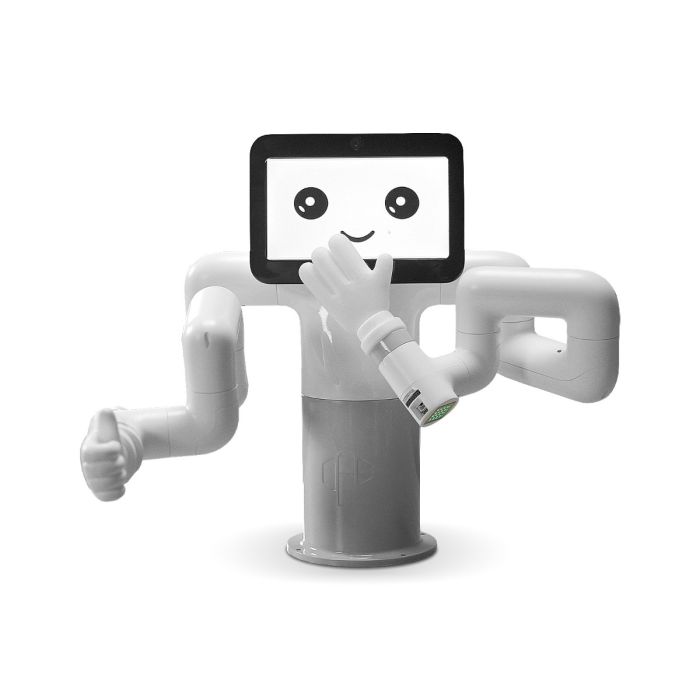
Most robots in a teaching laboratory are judged by what their arms can do. The people standing around them tend to judge them by something else: whether the machine appears to be paying attention. The Elephant Robotics myBuddy 280 Pi (4010100014) is built for both audiences. Its compact torso carries a pair of arms for manipulation, a 7-inch interactive display that serves as a face, and two 2-million-pixel HD cameras that let it locate objects, read QR codes and recognise the people in front of it. Perception, interaction and motion can therefore be studied on a single desktop platform rather than across three separate rigs, which changes how a course, a research project or a public demonstration can be planned.
Robots Middle East supplies the myBuddy 280 Pi to universities, schools, research groups and innovation centres across the Middle East. Robots Middle East prepares the quotation, arranges delivery to your site and provides support once the robot is in use, including guidance on which package suits your work. The manufacturer's wider range is gathered in our Elephant category.
Background
Elephant Robotics and its desktop lineage
Elephant Robotics is best known for compact collaborative robots intended for education, development and light automation, a line that includes the myCobot arms. These machines are designed to sit on a bench, connect to an ordinary computer and be programmed by students and engineers without the infrastructure an industrial cell requires. The myBuddy carries that philosophy into a humanoid format: instead of one arm on a base, it presents a torso with arms, a face and eyes, so that the questions a learner explores move from single-arm reach to coordination, perception and interaction with people.
Raspberry Pi at the centre
The "Pi" in the name points to the controller. A Raspberry Pi 4 single board computer, with 2GB or 4GB RAM, drives the display and communicates with the ESP32 modules that sit closer to the joints. Because the main computer is a familiar Linux-capable board, the robot arrives with a built-in ROS development environment, including RVIZ and MOVEIT cases, and the robot's URDF configuration documents are open. Users can therefore build on the published model, modify it for their own experiments and carry their work into simulation and motion planning without reverse-engineering the machine first.
Technical Specifications
| Specification | Value |
|---|---|
| Degrees of freedom | 13 |
| Working radius (single arm) | 280mm |
| Maximum payload (single arm) | 250g |
| Repeatability | 0.5MM |
| Display | 7-inch interactive display screen |
| Cameras | Two 2-million-pixel HD cameras |
| Camera functions | 45-degree lower camera: area location positioning, object and QR code recognition; second camera: face and body recognition |
| Interfaces | 3.3V I/O ports and Lego ports |
| Controller | Raspberry Pi 4 (2GB or 4GB RAM) single board computer, communicating with ESP32 modules |
| Power supply | 24V/9.2A |
| Weight | 3 kg |
| Life span | 500 hours |
| Operating system compatibility | Android, Windows, macOS, Linux |
| Programming | myBlockly, ROS, Python |
| ROS support | Built-in ROS development environment with RVIZ and MOVEIT cases; open URDF configuration documents |
| Accessories | Suction pump, grippers and other accessories |
| Package options | myBuddy; myBuddy+G Shape Base; myBuddy+Left Hand; myBuddy+Right Hand; myBuddy+Left & Right Hand |
| In the box | myBuddy 280 cobot, power supply with DC connector, user manual |
Specifications are as published by the manufacturer and are confirmed against the datasheet at quotation.
The manufacturer has not published the dimensions, the IP rating, the operating temperature, the noise level, the joint speed or its own net weight figure; these are confirmed at quotation.
What can the cameras on the myBuddy 280 Pi do?
Vision is where this robot departs from a typical desktop arm. The two 2-million-pixel HD cameras are given distinct jobs. The lower camera is set at 45 degrees, looking down towards the working area, and supports area location positioning together with object and QR code recognition. That is the camera a student uses to teach the robot where a block sits on the table, which marker identifies which bin, and how an image coordinate becomes a target for the arm.
The second camera faces the people around the robot and can achieve face and body recognition. Paired with the 7-inch interactive display, it allows the robot to respond to a visitor, follow a person's presence or present information on its screen while it works. For a course in human–robot interaction, this means the sensing, the response and the visible feedback all live on the same machine. For a vision course, it means two quite different recognition problems, one about objects and one about people, can be taught on one platform and compared directly.
Which myBuddy package should I choose?
The sources name five packages, and the choice depends on how the robot will be mounted and whether expressive hands matter to your work. The base myBuddy package is the robot itself, supplied with the power supply with DC connector and the user manual. The myBuddy+G Shape Base package adds a base for mounting, which suits labs that want a fixed, repeatable installation on a bench.
The hand packages, myBuddy+Left Hand, myBuddy+Right Hand and myBuddy+Left & Right Hand, add hands capable of gestures described as yeah, point, praise and grab. For demonstrations, reception roles and interaction research, gestures are a large part of what makes a humanoid legible to an audience, and the paired option keeps both sides symmetrical. Where the work is mainly manipulation, the suction pump and grippers may serve better than hands. Robots Middle East confirms the exact contents of each package with the quotation.
Who is the myBuddy 280 Pi for?
University departments teaching robotics, mechatronics or computer vision are the clearest fit. The open URDF documents and the built-in ROS environment with RVIZ and MOVEIT cases give lecturers a ready path from simulation to a physical robot, and the 13 degrees of freedom offer far more material for kinematics and motion planning than a single arm.
Schools and STEM programmes benefit from the graded programming route. Younger learners can start with myBlockly, move on to Python as their confidence grows, and reach ROS when they are ready, all without changing hardware. Compatibility with Android, Windows, macOS and Linux means the robot fits whatever computers a classroom already uses.
Research groups studying human–robot interaction, social robotics or assistive behaviour will value the combination of a face-like display, face and body recognition and gesturing hands. Innovation centres, museums and exhibition teams can use the same features to give visitors a robot that responds to them rather than one that simply repeats a motion. Buyers whose tasks call for a different form, such as a heavier industrial arm or a mobile platform, can compare options across our Robot Store.
What is the myBuddy 280 Pi used for?
- ROS teaching: students work through RVIZ and MOVEIT cases on a physical humanoid with an open URDF model.
- Machine vision courses: object, QR code and face recognition exercises run on the robot's own cameras.
- Dual-arm coordination: learners plan motions in which both arms share a workspace and a task.
- Human–robot interaction research: display, recognition and gestures support studies of how people respond to a robot.
- Exhibitions and reception: the robot greets visitors, gestures and shows information on its screen.
- Maker and prototyping projects: the 3.3V I/O ports and Lego ports connect sensors, accessories and custom builds.
Pricing and Availability
Robots Middle East supplies the myBuddy 280 Pi on quotation, so that the package, the controller memory option and any accessories are matched to your project before you commit. Delivery, customs and support are arranged with the quotation. To begin, tell us which package interests you and how the robot will be used, and our team will prepare a formal offer; the quotation request is available on this page.
Frequently Asked Questions
How many degrees of freedom does the myBuddy 280 Pi have?
The robot has 13 degrees of freedom. This gives considerably more scope for motion planning and coordination exercises than a single desktop arm.
What is the reach and payload of each arm?
A single arm has a working radius of 280mm and a maximum payload of 250g. Repeatability is 0.5MM.
Which programming options are supported?
The robot can be programmed with myBlockly, ROS and Python. It includes a built-in ROS development environment with RVIZ and MOVEIT cases, and its URDF configuration documents are open.
Which computers can I use with it?
The robot is compatible with Android, Windows, macOS and Linux. On board, a Raspberry Pi 4 with 2GB or 4GB RAM controls the display and communicates with the ESP32 modules.
Can I fit grippers or a suction pump?
Yes. The myBuddy works with multiple accessories, including a suction pump and grippers, and provides 3.3V I/O ports and Lego ports for expansion.
What is included in the box?
The package contains the myBuddy 280 cobot, a power supply with DC connector and a user manual. Optional packages add the G Shape Base or left, right, or left and right hands.
Where can I buy the Elephant Robotics myBuddy 280 Pi and what does it cost?
You can buy it from Robots Middle East, which supplies the robot across the Middle East. The cost depends on the package and accessories you choose, so please request a quotation through this page.
Summary
A robot earns attention in a classroom or an exhibition hall when it seems to notice the world around it, and earns its place in a curriculum when that noticing can be programmed. The myBuddy 280 Pi combines both: arms with 13 degrees of freedom for manipulation, two HD cameras for objects and people, a 7-inch display that gives it a face, and a Raspberry Pi 4 running an open ROS environment. From myBlockly in a school to MOVEIT in a university laboratory, it lets learners and researchers work on perception, interaction and motion together. For a quotation from Robots Middle East, with the right package, delivery and support arranged for your site, this page is the starting point.