
Fourier ExoMotus M4 Lower-Limb Exoskeleton Rehabilitation Robot
In stock
- BRAND:
- FOURIER
- PART #:
- ExoMotus M4
- ORIGIN:
- China
- Warranty:
- 12 MONTHS
- AVAILABILITY:
- SUBJECT TO AVAILABILITY
- SKU:
- Fourier-ExoMotus-M4
Fourier ExoMotus M4 Lower-Limb Exoskeleton Rehabilitation Robot
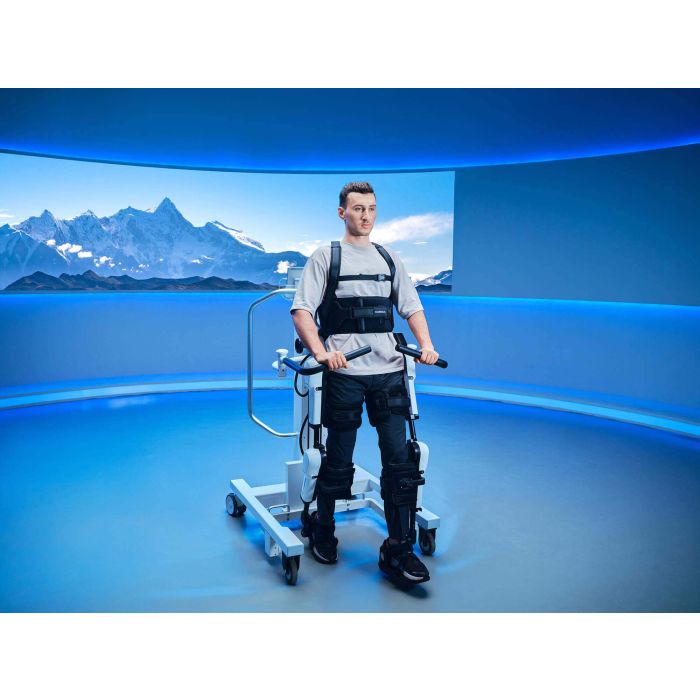
In many hospitals, walking practice and daily life happen in different places. The gait laboratory sits at the end of a corridor, and getting a patient there becomes an obstacle of its own. The Fourier ExoMotus M4 Lower-Limb Exoskeleton Rehabilitation Robot starts from a different question: what if the training device could travel to the patient and then walk with them on ordinary floors? It pairs a wearable exoskeleton with a balance support frame on four low-friction wheels. The frame is sized to pass through hospital entrances and into conventional 1,000kg lifts, so overground walking can take place on real surfaces and gentle inclines rather than on a fixed track.
Robots Middle East supplies the ExoMotus M4 to hospitals, rehabilitation centres, specialist clinics and research institutions across the Middle East. Each quotation is prepared for the facility concerned. Robots Middle East arranges delivery, customs clearance and after-sales support, and acts as your point of contact from the first enquiry to clinical use.
Background
Fourier and its rehabilitation lineage
Fourier is a robotics company that built its reputation in rehabilitation technology before broadening into other fields of robotics. Its rehabilitation range covers the upper limb, the ankle, cycling-based training and biomechanical assessment. The ExoMotus line is the part of that range that addresses walking itself. The M4 also connects to EXOPS™, the Exoskeleton & Robotics Open Platform System. This open platform lets suppliers plug directly into the Fourier ecosystem and build better solutions around the device. For an institution that expects its rehabilitation technology to evolve, this openness carries real weight.
Overground walking inside a support frame
The M4 combines two ideas that are often separated: an exoskeleton that guides the legs, and a frame that holds the person securely while they move. Its ergonomic design incorporates a built-in balance support frame, which gives a comfortable and secure setting for gait training. A body-weight support frame and a built-in chair widen the range of patients who can use the device. The chair also gives the patient a place to rest without leaving the system. With the M4, people with lower-limb impairments can carry out everyday ambulatory tasks such as standing and walking on flat terrain and gentle inclines, which raises their overall activity level.
Technical Specifications
| Specification | Value |
|---|---|
| Device dimensions (L x W x H) | 84 cm x 112 cm x 150 cm (±5cm) |
| User weight | Below or equal to 100 kg |
| User height | 150 cm - 190 cm |
| Weight of support frame | 100 kilograms |
| Weight of exoskeleton | 40 kilograms |
| Wheels | 4 low-friction wheels |
| Frame outer width | Meets the entry requirements of conventional 1,000kg elevators and hospital entrances |
| Materials | Steel, aluminium, fabric and plastic |
| Control | Tablet |
| Average setup time | Five minutes |
| Training modes | Overground walking, on-the-spot marching, assistive modes |
| Adjustable training parameters | Stride length, speed, guidance force |
| Real-time monitoring | Gait pattern, joint angles, step count |
| Reporting | Automated reports with quantifiable rehabilitation data |
| Patient support | Body-weight support frame and built-in chair |
| Open platform | EXOPS™ (Exoskeleton & Robotics Open Platform System) |
Specifications are as published by the manufacturer and are confirmed against the datasheet at quotation.
The manufacturer has not published the battery capacity, battery life, walking speed, joint torque, joint range of motion, power supply, connectivity, IP rating, the contents of the box or the certifications; these details are confirmed at quotation.
How does the ExoMotus M4 fit into a busy hospital?
A gait device earns its place through the sessions it makes possible, not through the space it occupies. Three features of the M4 work together to make sessions happen more often. The first is mobility within the building. The frame rolls on four low-friction wheels, and its outer width meets the entry requirements of hospital entrances and conventional 1,000kg lifts. The device can therefore be moved between floors and wards instead of staying in a single room. With the support frame at 100 kilograms and the exoskeleton at 40 kilograms, the system is built to be stable around the patient yet still movable by staff.
The second is preparation time. The average setup time is five minutes, so more of each appointment goes to walking and less to adjustment. The third is control. Therapists operate the device from a tablet, which keeps their attention on the patient rather than on the machinery. In a department where therapist hours are the scarcest resource, these three points matter as much as any single specification.
What can therapists adjust and measure with the ExoMotus M4?
Rehabilitation is rarely a matter of one setting suiting everyone. The M4 lets the therapist personalise stride length, speed and guidance force across its training modes: overground walking, on-the-spot marching and assistive modes. A patient in the early stage of recovery can work with more guidance on the spot. As confidence and control improve, the same patient can move to overground walking with the guidance reduced.
Measurement completes the picture. During training the M4 monitors the gait pattern, joint angles and step count in real time, and it produces automated reports with quantifiable rehabilitation data. These reports give clinicians an objective record to discuss with patients and families. They also support multidisciplinary team reviews and provide a consistent basis for audit or research.
Who is the Fourier ExoMotus M4 for?
The M4 is designed for institutions that run structured gait rehabilitation and want to bring it closer to everyday walking. Typical buyers include:
- Rehabilitation hospitals and neurorehabilitation units that treat people with lower-limb impairments.
- General hospitals with inpatient therapy services.
- Private physiotherapy centres offering intensive programmes.
- University and hospital research groups that value the EXOPS™ open platform and the quantifiable data the device records.
Patient suitability is defined by the published user range of 150 cm - 190 cm in height and a user weight below or equal to 100 kg. Your clinical team should review this range against its own caseload before ordering.
For departments whose main need lies elsewhere in the body, other devices in the Fourier range may be a better match. The Fourier ArmMotus M2 Pro Upper Limb Rehabilitation Robot addresses the upper limb, and the Fourier AnkleMotus Ankle Joint Rehabilitation Equipment concentrates on the ankle joint. The wider selection can be browsed under Fourier and in our Medical Robots category.
What is the Fourier ExoMotus M4 used for?
- Overground gait training: walking on flat floors with the exoskeleton guiding the legs and the frame providing balance support.
- On-the-spot marching: stepping practice in place for patients who are not yet ready to walk forward.
- Assistive walking: assistive modes for patients who need more help from the device to complete a step.
- Incline practice: walking on gentle inclines to prepare for the slopes found in daily life.
- Progress documentation: real-time gait, joint-angle and step-count data with automated reports for clinical records.
- Research and integration: development work through the EXOPS™ open platform within the Fourier ecosystem.
Pricing and Availability
The ExoMotus M4 is supplied on a quotation basis. Your quotation reflects your facility, the intended clinical use and any requirements raised by your team. Delivery, customs and support are arranged together with the quotation by Robots Middle East. Please also use the quotation stage to raise the details the manufacturer has not published, such as power supply, certifications and box contents. To begin, request your quotation through the form available on this page.
Frequently Asked Questions
Which patients can use the ExoMotus M4?
The device is intended for individuals with lower-limb impairments who are between 150 cm - 190 cm tall and weigh below or equal to 100 kg. Clinical suitability for each patient remains a decision for the treating team.
Can the ExoMotus M4 move between wards and floors?
Yes. It rolls on four low-friction wheels, and the outer width of the balancing support frame meets the entry requirements of conventional 1,000kg lifts and hospital entrances.
How long does it take to prepare a session?
The average setup time is five minutes.
How is the device controlled?
Therapists operate the ExoMotus M4 from a tablet. From there they adjust stride length, speed and guidance force across the overground walking, on-the-spot marching and assistive modes.
What data does the ExoMotus M4 record?
During training it monitors the gait pattern, joint angles and step count in real time. It also produces automated reports with quantifiable rehabilitation data.
Can patients rest during a session?
Yes. A built-in chair is incorporated alongside the body-weight support frame, so a patient can sit without leaving the device.
Where can I buy the Fourier ExoMotus M4 and what does it cost?
You can buy it from Robots Middle East, which supplies it across the Middle East. The cost depends on your facility and requirements and is set out in a tailored quotation, which you can request on this page.
Summary
The ExoMotus M4 is built on the idea that walking practice should not be confined to one room at the end of a corridor. A wheeled balance support frame sized for hospital doors and lifts brings the device to the patient. A body-weight support frame and built-in chair widen access, and an exoskeleton with adjustable stride length, speed and guidance force lets therapists match each session to the person in front of them. Real-time monitoring and automated reports turn each session into measurable progress, and EXOPS™ keeps the system open to further development. For hospitals and rehabilitation centres in the Middle East that want to bring gait training closer to everyday walking, with Robots Middle East handling supply and support, this page is the starting point.