
Fourier ArmMotus M2 Pro Upper Limb Rehabilitation Robot
In stock
- BRAND:
- FOURIER
- PART #:
- ArmMotus M2 Pro
- ORIGIN:
- China
- Warranty:
- 12 MONTHS
- AVAILABILITY:
- SUBJECT TO AVAILABILITY
- SKU:
- Fourier-ArmMotus-M2-Pro
Fourier ArmMotus M2 Pro Upper Limb Rehabilitation Robot
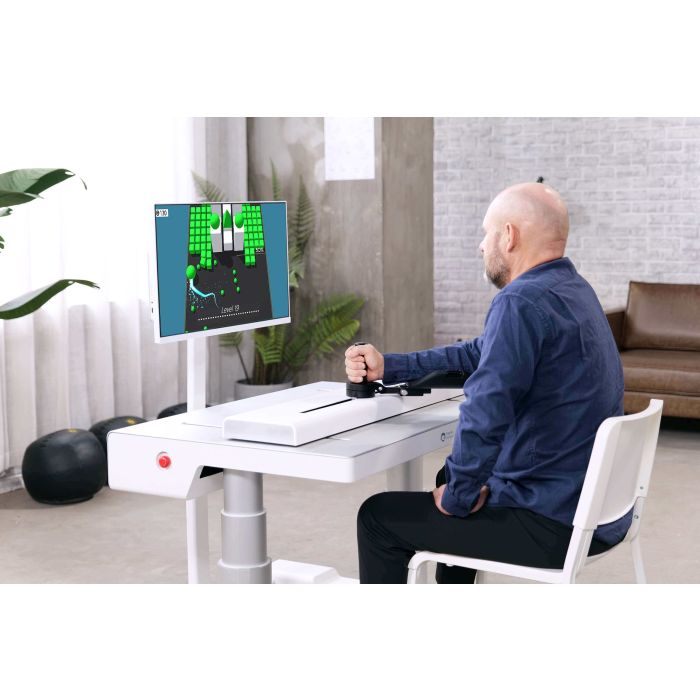
In many rehabilitation gyms the patient adapts to the equipment: a transfer out of the wheelchair, a lean towards a fixed table, a reach limited by the furniture. The Fourier ArmMotus M2 Pro Upper Limb Rehabilitation Robot reverses that order. Its training surface is raised or lowered on a dual lifting column, its wide chassis lets a wheelchair come in close, and once the hand rests on the end-effector, motors, sensors and haptic feedback guide, assist or resist movement at the shoulder and elbow. The sections below explain how that design serves therapists and patients, and how it fits into a wider therapy programme.
Robots Middle East supplies the ArmMotus M2 Pro to hospitals, rehabilitation centres, university clinics and research groups across the Middle East. Our team prepares your quotation, coordinates delivery to your facility and remains your point of contact for support after installation. Your clinical and procurement staff therefore deal with one regional partner, from the first enquiry through to daily use on the ward.
Background
Fourier Intelligence and its rehabilitation range
The ArmMotus M2 Pro was developed by Fourier Intelligence. It belongs to the M2 family, a name the manufacturer uses collectively for the Fourier M2 and the ArmMotus M2 Pro. The company's rehabilitation range covers several parts of the body, from the Fourier AnkleMotus Ankle Joint Rehabilitation Equipment to the Fourier ExoMotus M4 Lower-Limb Exoskeleton Rehabilitation Robot. This allows a department to plan upper and lower limb therapy around a single manufacturer. The complete line-up is listed on our Fourier page, and the wider selection of clinical systems can be found under Medical Robots.
An end-effector workstation for the shoulder and elbow
The M2 is a robotic, height-adjustable workstation designed for upper limb rehabilitation. It is an end-effector device: rather than controlling each joint individually, it guides movement through the user's hand and forearm. Motors, sensors and haptic feedback enable controlled movement in two planes, while the patient takes part in interactive, game-based exercises. The device is aimed at people with upper limb impairments affecting the shoulder and elbow. As part of a broader rehabilitation approach, it can also support postural stability and trunk control.
Technical Specifications
| Specification | Value |
|---|---|
| Device type | Robotic, height-adjustable workstation for upper limb rehabilitation |
| Mechanism | End-effector; guides movement through the user's hand and forearm |
| Motion | Controlled movement in two planes |
| Actuation and feedback | Motors, sensors and haptic feedback |
| Therapy modes | Passive, assistive, active and resistive |
| Target joints | Shoulder and elbow; also supports postural stability and trunk control within a broader programme |
| Training surface | Ultra-thin Training Platform |
| Height adjustment | Adjustable Dual Lifting Column |
| Safety | Infrared Safety Protection |
| Chassis | Wide Chassis for wheelchair access |
| Training content | Extensive library of interactive games for goal-directed tasks |
| Training combinations | Motor control with cognitive training; isometric with dynamic strength training; single joint with activities of daily living (ADL) training; unilateral with bilateral arm training |
Specifications are as published by the manufacturer and are confirmed against the datasheet at quotation. The manufacturer has not published the dimensions, weight, power requirements, workspace range, maximum output force, connectivity, included accessories, display size or certifications; Robots Middle East confirms these with you at quotation.
How does an end-effector robot differ from an arm exoskeleton?
Upper limb rehabilitation robots generally follow one of two approaches. An exoskeleton is strapped along the arm and aligned with each joint, so it can drive or measure the shoulder, elbow and wrist one by one. An end-effector device works from the far end of the limb: the patient holds or rests on a single interface, and the robot shapes the path of the hand, with the proximal joints following that path. The ArmMotus M2 Pro takes the second approach, guiding movement through the hand and forearm.
In practice, this affects the routine of a session. Setting up an end-effector device is usually a matter of positioning the patient and the forearm rather than fitting a frame to the body, which can make it easier to move one patient after another through the same station. The trade-off is that the robot governs the hand's trajectory rather than each joint angle. Therapists who need isolated control of individual joints will plan around that. Those working on reaching, shoulder and elbow coordination and functional arm movement will find that the end-effector model suits the task.
What do the four therapy modes change in a session?
The M2 provides passive, assistive, active and resistive modes, so that therapy can be matched to the patient's ability and adjusted as they progress. In passive mode the robot moves the arm, which helps a patient with very limited voluntary movement. Assistive mode lets the patient start the movement while the robot supplies the support still needed. Active mode leaves the work to the patient within the guided exercise. Resistive mode opposes the movement to build strength.
Because all four modes run on the same workstation, a patient can stay on one device from the early stages of recovery through to strengthening, while the therapist changes the level of challenge rather than the equipment. The game library is designed to support that progression: it motivates users to complete the intensive, repetitive, goal-directed tasks on which motor relearning depends. The training combinations widen the scope further. A session can pair motor control with cognitive work, isometric with dynamic strength training, single joint exercises with ADL tasks, and unilateral with bilateral arm training.
Who is the Fourier ArmMotus M2 Pro for?
The clearest fit is the neurological rehabilitation unit, where patients with shoulder and elbow impairments need a high volume of structured, repeatable practice and where many arrive in wheelchairs. The wide chassis and the adjustable dual lifting column are relevant to that group, since the workstation can be brought to the patient rather than the patient being transferred to it.
Occupational therapy departments will value the ADL and cognitive pairings, which link arm movement to everyday tasks and attention. Musculoskeletal and orthopaedic services can use the resistive and strength-training combinations as recovery advances. Research groups studying upper limb motor recovery have a consistent, game-based protocol across four therapy modes on one station.
Departments building a wider upper limb programme may wish to compare the M2 Pro with the Fourier ArmMotus EMU 3D Upper Limb Rehabilitation Robot, a related Fourier model with its own specification page. Robots Middle East can set out both options in a single quotation so that your team can choose the device that best matches its caseload.
What is the Fourier ArmMotus M2 Pro used for?
- Post-stroke arm recovery: repetitive, goal-directed shoulder and elbow practice through interactive games.
- Early-stage passive therapy: robot-guided movement for patients with very limited voluntary control.
- Progressive strengthening: moving from assistive to active and resistive modes as ability improves.
- Cognitive-motor training: combining motor control tasks with cognitive challenges in the same session.
- Activities of daily living: linking single joint exercises to functional ADL training.
- Bilateral coordination: alternating unilateral and bilateral arm training, alongside work on postural stability and trunk control.
Pricing and Availability
The ArmMotus M2 Pro is supplied on quotation, because configuration, software, installation and staff training differ from one facility to the next. Robots Middle East prepares a quotation tailored to your clinic or hospital and its patient caseload. Delivery, customs clearance and after-sales support are arranged together with the quotation. To begin, please use the quotation request available on this page.
Frequently Asked Questions
Is the ArmMotus M2 Pro an exoskeleton?
No. It is an end-effector device that guides movement through the user's hand and forearm rather than controlling each joint individually.
Which joints does it address?
It is designed for upper limb impairments affecting the shoulder and elbow. As part of a broader rehabilitation approach, it can also support postural stability and trunk control.
What therapy modes are available?
There are four: passive, assistive, active and resistive. This allows therapy to be adjusted to each patient's level of ability and progress.
Can patients train from a wheelchair?
Yes. The M2 Pro has a Wide Chassis for wheelchair access and an Adjustable Dual Lifting Column to set the height of the training platform.
How does the device keep patients engaged?
It offers an extensive library of interactive games built around goal-directed tasks, which motivate users to complete intensive and repetitive practice.
What safety features does the M2 Pro include?
The M2 Pro is equipped with Infrared Safety Protection. Robots Middle East can walk your team through its role in daily use during handover and training.
Where can I buy the Fourier ArmMotus M2 Pro and what does it cost?
You can buy it from Robots Middle East, which supplies facilities across the Middle East. The cost depends on configuration, installation and training, so it is given in a personal quotation that you can request on this page.
Summary
The ArmMotus M2 Pro is built on a simple idea: the equipment should adapt to the patient. A dual lifting column, an ultra-thin platform and a wide chassis bring the workstation to someone seated in a wheelchair. An end-effector design, with motors, sensors and haptic feedback, then guides the shoulder and elbow through two planes. Four therapy modes and a library of goal-directed games let that one station follow a patient from passive movement to resisted strength work, with cognitive, ADL and bilateral training along the way. Robots Middle East accompanies that journey from the first enquiry to support on the ward. For a rehabilitation team that wants arm therapy to start where the patient already is, this page is the starting point.