
Genisom L1-W Ultra Compact Industrial Grade Wheeled Quadruped Robot Dog
In stock
- BRAND:
- GENISOM
- PART #:
- L1-W
- ORIGIN:
- China
- AVAILABILITY:
- SUBJECT TO AVAILABILITY
- SKU:
- Genisom-L1-W
Genisom L1-W Ultra Compact Industrial Grade Wheeled Quadruped Robot Dog
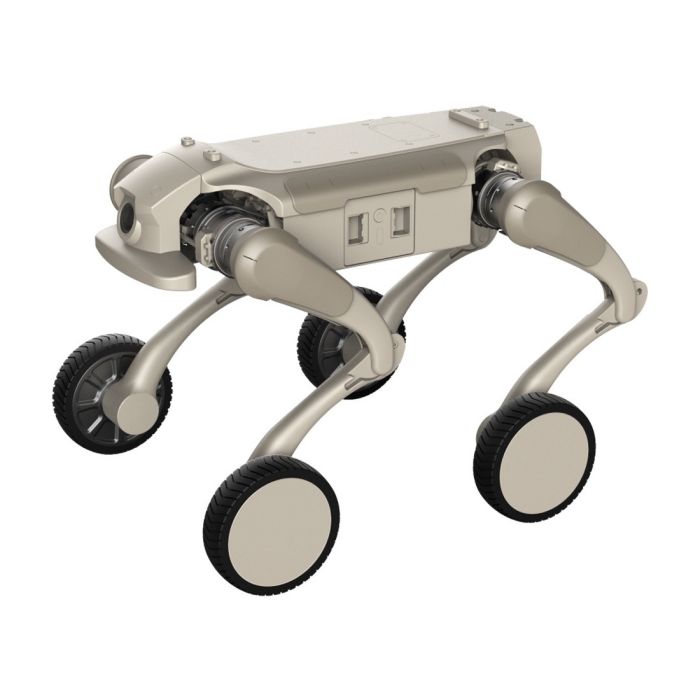
Inspection rounds are judged by the clock as much as by the data they bring back. A patrol that crawls along a smooth corridor at walking pace wastes minutes it will need later, at the stairwell, the cable tray or the raised threshold that an ordinary wheeled cart cannot cross. The Genisom L1-W Ultra Compact Industrial Grade Wheeled Quadruped Robot Dog answers both halves of that problem with one body. It has wheels at the ends of four articulated legs, so it can run the long, flat stretches of a route quickly and then step or lift itself over whatever lies in the way. The manufacturer quotes a maximum speed of 5.5m/s and a 60cm high obstacle crossing ability. That pairing turns travel time into checkpoint time.
Robots Middle East sells the Genisom L1-W to industrial operators, security integrators, universities and research groups across the Middle East. Our team prepares your quotation and arranges delivery to your site. We also provide support once the robot is in service. Before you commit, we are glad to discuss the expansion modules, interfaces and software access your application calls for, so that the platform arrives ready for the work you have in mind.
Background
The GENISOM L1 family
The L1-W belongs to GENISOM's L1 family, a line of compact quadruped robots offered in several versions: the Genisom L1, the Genisom L1-W, the Genisom L1 EDU and the Genisom L1 Maker. Each version addresses a different kind of buyer. The figures on this page belong to the L1-W alone and should not be read across to its siblings, nor theirs to it. Within the family, the L1-W is the version built around the wheel-foot concept, and its full name carries the industrial grade designation that signals its intended working environment.
Wheel-foot locomotion
Legged robots excel on broken ground, steps and clutter, but every stride costs time and energy on a surface that a wheel would cross with ease. Wheeled platforms behave the other way round: they are efficient and fast until the floor changes level. The wheel-foot design of the L1-W combines high-speed navigation with obstacle-crossing capabilities. The same machine can therefore roll along a warehouse aisle and then use its legs to deal with a kerb, a ramp edge or a step. For the people planning a deployment, this means fewer compromises in route design. It also means fewer points on the route where a human operator must step in and carry the robot past an obstacle.
Technical Specifications
| Specification | Value |
|---|---|
| Locomotion | Wheel-foot design combining high-speed navigation with obstacle crossing |
| Obstacle crossing height (manufacturer) | 60cm |
| Maximum speed (manufacturer) | 5.5m/s |
| Max speed (reseller datasheet) | 3.7 m/s (limit 5 m/s) |
| Standing size (L×W×H) | ~63 × 44 × 45.5 cm |
| Prone size (L×W×H) | ~69 × 58 × 14.5 cm |
| Weight (with battery) | ~20 kg |
| Battery capacity | 5Ah, 43.2V |
| Runtime | 1‑2 hours |
| Range | 9 km |
| Continuous payload | ~10 kg (limit ~12 kg) |
| Stair-climbing height | >16 cm |
| Slope capability | Standard 30°, limit 40° |
| Operating temperature | 0°C – 40°C (limit -20°C – 50°C) |
| Protection rating | IP54 |
| Expansion interfaces | Ethernet, USB, SBUS, UART, Power |
| SDK | Full SDK access with open motion, video stream and status interfaces |
| Supported expansion modules | High-compute boards, perception modules, positioning modules, 4G modules |
Specifications are as published by the manufacturer and its distribution partners, and are confirmed against the datasheet at quotation.
No source publishes the battery charging time, the contents of the box or the onboard compute, and the manufacturer's own page gives no dimensions; Robots Middle East confirms each of these with your quotation.
How does the wheel-foot design change an inspection round?
On a typical industrial route, most of the distance is unremarkable floor, and most of the difficulty sits at a handful of transitions. A walking robot pays for the easy distance at walking pace. A wheeled robot covers it quickly but may be stopped by a single step. The L1-W is designed to do both. The manufacturer gives a maximum speed of 5.5m/s. A reseller datasheet lists 3.7 m/s with a limit of 5 m/s. The figure that applies to your configuration is stated in the quotation.
Where the route turns difficult, the robot relies on its legs. It offers a 60cm high obstacle crossing ability and a stair-climbing height of more than 16 cm. Its slope capability is 30° as standard, with a limit of 40°. For patrol planning, the energy figures matter as much: a 5Ah, 43.2V battery, a runtime of 1‑2 hours and a range of 9 km. Together they describe a platform intended to complete a meaningful circuit on a single charge, rather than one that must be shuttled between sections of a site.
The compact body supports this. Standing, the robot measures ~63 × 44 × 45.5 cm; prone, it measures ~69 × 58 × 14.5 cm and weighs ~20 kg with its battery. Narrow aisles, plant rooms and service corridors therefore remain within reach. The robot can also be lifted by two people when it needs to be moved between buildings or loaded into a vehicle.
Can the Genisom L1-W carry and run your own equipment?
A mobile robot earns its place through what it carries. The L1-W takes a continuous payload of ~10 kg, with a limit of ~12 kg, which leaves room for cameras, gas sensors, communications equipment or a research instrument. Expansion interfaces include Ethernet, USB, SBUS, UART and Power. The platform supports high-compute boards, perception modules, positioning modules and 4G modules, so an integrator can assemble the sensing and connectivity a particular site demands rather than accept a fixed configuration.
On the software side, the robot offers full SDK access with open motion, video stream and status interfaces. Developers can command movement, take the camera feed into their own applications and monitor the robot's condition from an existing control system. For research groups, this openness is often the deciding factor. For industrial users, it means the L1-W can report into the dashboards and alarm systems already in use.
Environmental limits deserve careful attention in this region. The robot carries an IP54 protection rating. Its standard operating temperature is 0°C – 40°C, with a limit of -20°C – 50°C. Midday conditions outdoors in much of the Gulf can exceed the standard band during summer, so outdoor routes are best scheduled for cooler hours or kept to shaded and conditioned areas. Our team can help you plan around this when we prepare the quotation.
Who is the Genisom L1-W for?
The L1-W suits organisations whose routes mix long, smooth distances with occasional obstacles. Facility and plant operators can use it for repeated inspection rounds through warehouses, utility buildings and process areas. Security integrators will find a compact patrol platform that moves quickly between checkpoints and carries its own cameras and communications. Engineering consultancies and system integrators gain an open base on which to build bespoke inspection solutions for their clients.
Universities and research laboratories form another natural audience, drawn by the SDK and the expansion interfaces. Buyers whose priority is teaching may wish to compare the education editions of the wheeled model, the Genisom L1-W EDU Wheeled Quadruped Robot and the Genisom L1-W EDU RoamerX Pro Wheeled Quadruped Robot; we confirm their configurations at quotation. Where a site offers little smooth floor to exploit, the GANGBENG L1 Series is also worth comparing. The wider range is available in our Wheeled Quadrupeds and Quadrupeds categories.
What is the Genisom L1-W used for?
- Facility inspection — scheduled rounds through plant rooms, warehouses and corridors, recording gauges and equipment status.
- Security patrol — moving quickly between checkpoints on a perimeter or inside large buildings while streaming video.
- Utility and energy sites — carrying sensors across substations and service areas where steps and raised thresholds interrupt the route.
- Research and development — serving as an open platform for locomotion, perception and autonomy studies through the SDK.
- Remote monitoring — operating with a 4G module to send status and video from locations without local network coverage.
- Payload trials — testing new sensors or instruments on a mobile base before committing to a larger fleet.
Pricing and Availability
Robots Middle East supplies the Genisom L1-W on a quotation basis, so that the configuration, modules and support package match your project. Delivery, customs and after-sales support are arranged together with your quotation. Please tell us about your site, your route and the equipment you intend to carry, and we will prepare an offer accordingly. To begin, use the quotation request available on this page.
Frequently Asked Questions
What is the maximum speed of the Genisom L1-W?
The manufacturer gives a maximum speed of 5.5m/s. A reseller datasheet lists 3.7 m/s with a limit of 5 m/s, and the applicable figure is stated in your quotation.
How high an obstacle can the Genisom L1-W cross?
The manufacturer states a 60cm high obstacle crossing ability. The stair-climbing height is more than 16 cm, and the slope capability is 30° as standard, with a limit of 40°.
How long does the Genisom L1-W run on one battery?
With its 5Ah, 43.2V battery, the robot has a runtime of 1‑2 hours and a range of 9 km. The charging time has not been published, so we confirm it at quotation.
Can the Genisom L1-W work outdoors?
It carries an IP54 protection rating. Its standard operating temperature is 0°C – 40°C, with a limit of -20°C – 50°C, which should be taken into account when planning summer routes in the region.
Can I develop my own software for the Genisom L1-W?
Yes. The robot offers full SDK access with open motion, video stream and status interfaces, alongside Ethernet, USB, SBUS, UART and Power expansion interfaces.
How much can the Genisom L1-W carry?
The continuous payload is ~10 kg, with a limit of ~12 kg. It supports high-compute boards, perception modules, positioning modules and 4G modules.
Where can I buy the Genisom L1-W and what does it cost?
You can buy the Genisom L1-W from Robots Middle East, which supplies it across the Middle East. Pricing depends on the configuration and modules you choose, so please request a quotation and we will prepare an offer for your project.
Summary
Every inspection or patrol route has its quiet stretches and its awkward corners. The Genisom L1-W is built so that neither one sets the pace. Its wheel-foot design lets it hurry along the smooth ground and climb over the obstacles, while a compact body, an open SDK and a range of expansion interfaces let it carry the equipment your task requires. For organisations in the Middle East that measure a robot by the minutes it saves and the data it returns, this page is the starting point.