
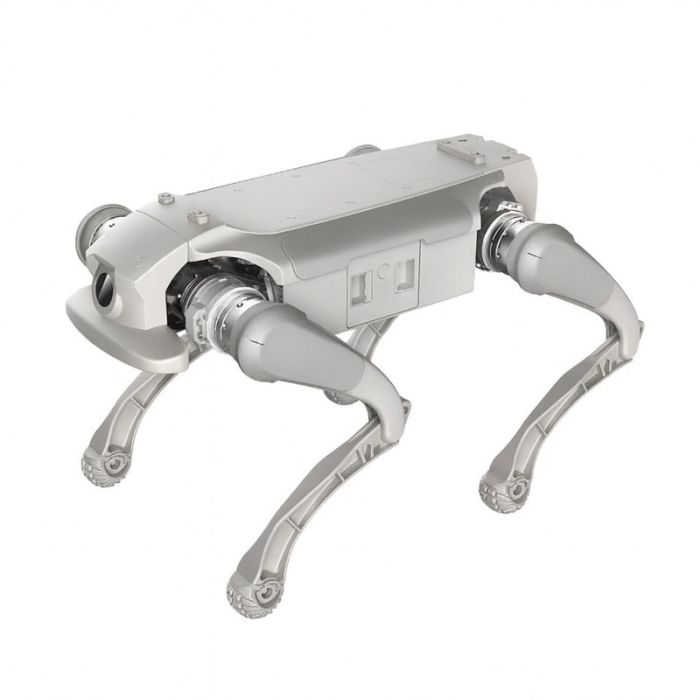
GENISOM AI GangBeng L1 Series Bionic Quadruped Robot
In stock
- BRAND:
- GENISOM
- PART #:
- L1
- ORIGIN:
- China
- AVAILABILITY:
- SUBJECT TO AVAILABILITY
- SKU:
- Genisom-L1
GENISOM AI GangBeng L1 Series Bionic Quadruped Robot
Picture a site survey in two layers: a drone holding position overhead while, on the ground below, a four-legged machine walks the route the drone has mapped, climbing steps, crossing a yard and stopping to look at whatever the camera has flagged. That division of labour, air and ground working as one system, is the idea that runs through the GENISOM AI GangBeng L1 Series Bionic Quadruped Robot. It is a compact legged robot, but its real character lies in how much it is designed to connect to: drones, computing cards, perception and positioning modules, and the software a development team chooses to write for it.
Robots Middle East supplies the GENISOM AI GangBeng L1 Series to organisations across the Middle East, from universities and research laboratories to industrial operators and integrators. Robots Middle East prepares each quotation, arranges delivery to the customer's site and provides support after handover, so that a project team deals with a single regional partner from the first enquiry onwards.
Background
GENISOM and the L1 Series
GENISOM develops bionic quadruped robots and builds the core of its machines in-house, most notably the joint modules that drive each leg. The L1 Series is a family rather than a single model: the sources name the L1, the L1 EDU, the L1-W and the L1 Maker. Each version shares the series' legged architecture and open development approach, while the EDU version adds onboard computing intended for teaching and research. By late December 2025 the company had reached 5,000 mass-production deliveries, which shows that the L1 platform is manufactured at scale rather than in small prototype batches.
Self-developed joints and Kirin alloy
At the heart of the robot are 12 fully self-developed high power density joint modules, delivering 48N·m of peak torque. The joints require no calibration, which shortens set-up and allows users to explore more demanding movements without a tuning routine beforehand. The joints are made from Kirin alloy, a material the company developed itself to combine light weight, high load capacity and durability. This combination brings the overall power output of the L1 close to the level of large four-legged robots, while keeping the body compact enough for indoor corridors and stairwells.
Technical Specifications
| Specification | Value |
|---|---|
| Standing size, L1 (L×W×H) | ~63 × 36 × 41.5 cm |
| Weight with battery, L1 | ~15 kg |
| Battery, L1 | 5Ah, 43.2V |
| Runtime, L1 | 1‑2 hours |
| Range, L1 | 6 km |
| Maximum speed, L1 | 3.7 m/s (limit 5 m/s) |
| Slope capability, L1 | Standard 30°, limit 40° |
| Continuous payload, L1 | ~8 kg (limit ~10 kg) |
| Stair-climbing height, L1 | >16 cm |
| Joint modules | 12 self-developed high power density joint modules |
| Peak joint torque | 48N·m |
| Joint material | Self-developed Kirin alloy |
| Protection level | IP54 |
| Operating temperature | 0-40℃ |
| Hardware interfaces | Ethernet, USB 3.0/2.0, 24V/12V power supply, etc. |
| Software interfaces | Motion, video stream and status interfaces; full software SDK openness |
| Perception | High-definition camera with AI monocular vision perception model |
| Expansion modules | High-performance computing cards, perception, positioning, 4G and long-range image transmission modules, etc. |
| Onboard computing, L1 EDU | NVIDIA Orin NX, up to 100 TOPS |
Specifications are as published by the manufacturer and are confirmed against the datasheet at quotation. The manufacturer has not published the charging time, the contents of the box, the noise level, the wireless connectivity or the camera resolution; these details are confirmed at quotation.
What sets the GangBeng L1 apart from a wheeled inspection platform?
A wheeled robot is efficient on smooth floors, but its route ends where the floor does. The L1 is built for the opposite case. It climbs steps of more than 16 cm and handles a standard slope of 30°, with a limit of 40°, so a single machine can move between levels of a building or across an inclined yard without a ramp being installed for it. Its IP54 protection and 0-40℃ operating temperature range allow it to work outdoors as well as in heated factory halls.
The second difference is openness. Many inspection robots are sold as closed systems with a fixed feature set. The L1 exposes motion, video stream and status interfaces through a fully open software SDK, and its Ethernet, USB 3.0/2.0 and 24V/12V power connections allow additional hardware to be mounted and powered from the robot itself. A team can therefore add a positioning module for outdoor navigation, a 4G module for remote operation, or a long-range image transmission module for sites where a local network is unavailable. The integrated high-definition camera and AI monocular vision perception model already identify and track targets, giving developers a working starting point rather than a blank chassis.
Finally, the L1 is designed to collaborate with drones. Together they form a full-chain cooperative system from air to ground and from mobility to operation, overcoming the efficiency limits of a single machine working alone. For inspection and response teams that already operate aerial platforms, this makes the L1 a ground-level partner rather than a separate tool.
What does the L1 EDU add?
The Genisom L1 EDU Quadruped Robot carries an NVIDIA Orin NX module, providing up to 100 TOPS of computing power on board. This matters for anyone who wishes to run perception, mapping or learning models on the robot itself rather than streaming data to an external computer. The standard L1 accepts high-performance computing cards as an expansion option; the EDU version arrives with that capability built in, which simplifies procurement for laboratories and teaching departments.
Who is the GENISOM AI GangBeng L1 for?
Industrial operators responsible for plant rooms, substations, warehouses and similar facilities will find the L1 suited to routine inspection rounds, particularly where stairs and uneven ground rule out wheeled platforms. Its compact body and continuous payload allow sensors or modules to be carried along routes that would otherwise require a person.
Security and emergency teams can use the L1 for patrol and for first observation of areas that are difficult or unsafe to enter, especially in combination with drones. Organisations planning such deployments may also wish to review our Emergency Response category.
Universities, research institutes and robotics teaching programmes form a further segment. Here the open SDK and standard interfaces are the main attraction, and for most of these buyers the L1 EDU, with its onboard NVIDIA Orin NX, will be the better fit. Teams whose research concerns wheeled-leg locomotion can look at the Genisom L1-W EDU Wheeled Quadruped Robot. A wider selection of platforms is available in our Research Robots category.
System integrators who build bespoke solutions for clients are the final group: the expansion options and open software allow the L1 to become the mobile base of a custom application.
What is the GENISOM AI GangBeng L1 used for?
- Facility inspection: walking routine rounds through plant rooms, stairwells and production areas while streaming video to operators.
- Security patrol: covering perimeters and yards, with the vision model identifying and tracking targets along the route.
- Air-to-ground operations: working alongside drones so that aerial overview and ground-level detail form one cooperative system.
- Remote observation: using 4G or long-range image transmission modules to send images from sites without local network coverage.
- Robotics education: giving students a real legged platform with open motion, video stream and status interfaces to programme.
- Research and development: serving as a mobile base for perception, positioning and computing modules in experimental projects.
Pricing and Availability
Robots Middle East prices the GENISOM AI GangBeng L1 Series by quotation, so that the version, expansion modules and project requirements are reflected accurately. Delivery, customs clearance and after-sales support are arranged together with the quotation. To discuss your application or to receive a formal offer, please use the quotation request available on this page.
Frequently Asked Questions
Can the GangBeng L1 operate outdoors?
Yes. The robot carries an IP54 protection level and is rated for an operating temperature of 0-40℃, which suits outdoor work as well as warm industrial interiors.
Can I programme the robot myself?
Yes. GENISOM provides full software SDK openness with motion, video stream and status interfaces, alongside Ethernet, USB 3.0/2.0 and 24V/12V power connections for additional hardware.
How much can the L1 carry?
The L1 has a continuous payload of ~8 kg, with a limit of ~10 kg.
How long does the L1 run on one battery?
The L1 has a runtime of 1‑2 hours from its 5Ah, 43.2V battery, with a range of 6 km.
Can it climb stairs?
Yes. The L1 climbs steps higher than 16 cm and handles slopes of 30° as standard, with a limit of 40°.
Does the L1 work with drones?
Yes. GENISOM designed the L1 for heterogeneous collaboration with drones, forming a cooperative system from air to ground.
Where can I buy the GENISOM AI GangBeng L1 and what does it cost?
Robots Middle East supplies the GENISOM AI GangBeng L1 Series across the Middle East. The cost depends on the version and configuration you choose, and we prepare a tailored quotation on request.
Summary
The GENISOM AI GangBeng L1 Series is at its strongest when it is treated as part of a system: a ground-level partner for drones, a mobile base for computing and perception modules, and an open platform for the software a team writes. Self-developed joints, Kirin alloy construction, IP54 protection and the ability to climb steps and slopes give it the physical reach; the open SDK and interfaces give it the flexibility. For organisations in the Middle East planning inspection, patrol, teaching or research with a legged robot, this page is the starting point.