
LimX Oli EDU Full-Size General Purpose Open Source Humanoid Robot
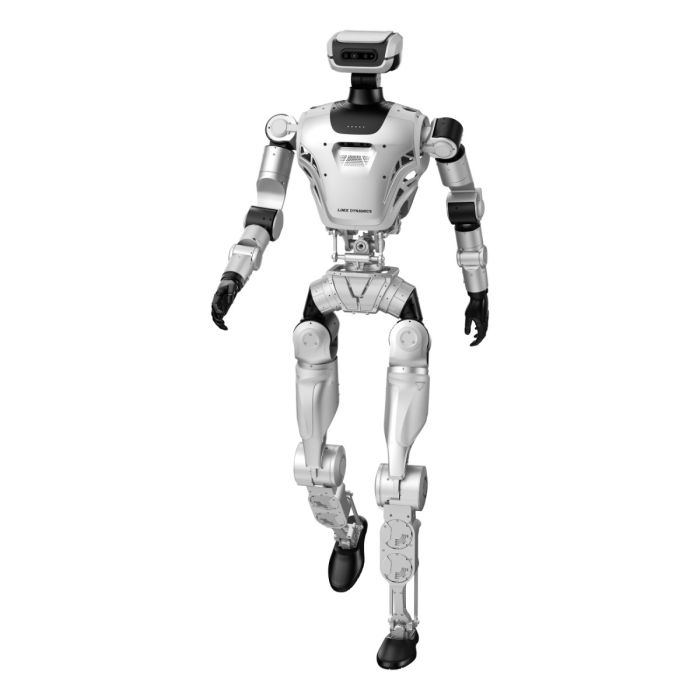
In stock
- BRAND:
- LIMX
- MODEL:
- OLI EDU
- ORIGIN:
- China
- Warranty:
- 12 MONTHS
- AVAILABILITY:
- ALLOW 2-4 WEEKS FOR DELIVERY
- SKU:
- LimX-Oli-EDU
LimX Oli EDU Full-Size General Purpose Open Source Humanoid Robot
A university telescope is rarely bought for a single experiment. A department acquires one because it expects to point it at questions nobody has yet thought to ask, and the instrument earns its place over years of theses, papers and teaching. The LimX Oli EDU Full-Size General Purpose Open Source Humanoid Robot deserves to be judged in the same way. It is a human-height, general-purpose humanoid from the Oli series, and its worth to a laboratory lies less in any one demonstration than in how many different projects a team can build on the same body over time: locomotion, manipulation, spoken interaction and the transfer of simulated behaviour onto real hardware.
Robots Middle East supplies the Oli EDU to universities, research institutes, schools and corporate innovation teams across the Middle East. Robots Middle East prepares each quotation, coordinates delivery to your site and remains your point of contact for support once the robot is in service, so that a laboratory can plan a multi-year programme with a single regional partner rather than a chain of intermediaries.
Background
LimX Dynamics and its legged-robotics lineage
The Oli series comes from LimX Dynamics, a Shenzhen-based company whose work centres on embodied intelligence and legged robotics. That focus matters when choosing a research platform. A company whose engineering grew out of legged locomotion approaches a humanoid as a balancing, walking machine first, and the brand's wider portfolio, which spans biped and multi-form robots as well as full-size humanoids, reflects that heritage. For a laboratory, it means the Oli EDU belongs to a family of machines designed around the same core problem: how a body with legs moves through, and acts within, a world that was not built for robots.
Where the EDU sits in the Oli series
The Oli series comes in three versions: Lite, EDU and Super. The EDU is the version whose name signals its audience, namely education and research. It shares the series' full-size format, and the series as a whole offers up to 31 degrees of freedom, giving more human-like postures and wider motion possibilities. Around that body, LimX Dynamics provides a development environment built on Python, compatibility with major simulation platforms and a self-developed voice interaction system. Taken together, these place the EDU as a platform to be programmed, studied and extended rather than a finished appliance.
Technical Specifications
| Specification | Value |
|---|---|
| Product type | Full-Size General-Purpose Humanoid Robot |
| Height | 165 cm / 5′5″ |
| Shoulder width | 55 cm / 21.7 in |
| Arm length | 70 cm / 27.6 in |
| Battery capacity | 9,500 mAh |
| Charger | 58.8 V / 10 A |
| Degrees of freedom (Oli series) | Up to 31 DoF |
| Voice interaction (Oli series) | Natural bilingual (Chinese and English) conversation and voice-based control |
| Simulation platforms (Oli series) | NVIDIA Isaac Sim, Mujoco, Gazebo, etc. |
| Software development (Oli series) | Supports Full Python Development |
Specifications are as published by the manufacturer and are confirmed against the datasheet at quotation.
The manufacturer has not published the ingress protection rating, the charge time, the combined payload of both arms, the operating temperature range, the walking speed in m/s, the shipping dimensions or the operating system; Robots Middle East confirms these at quotation.
Why does a human-sized humanoid matter for teaching and research?
A great deal of humanoid research can be carried out on smaller machines, and for many first projects that is the sensible choice. Yet some questions only become honest at human scale. A grasping study that targets a laboratory bench, a navigation experiment through a standard doorway or a human–robot interaction trial in which a participant stands face to face with the robot all depend on proportions close to a person's. The Oli EDU stands 165 cm tall, with a shoulder width of 55 cm and an arm length of 70 cm, so the reach envelope and the line of sight it presents are of the same order as those of the students who programme it.
That has consequences beyond the experiment itself. Results gathered on a human-scale body are easier to relate to real workplaces, which strengthens the case a research group makes to funders and industrial partners. In teaching, a robot of this size also changes the atmosphere of a class: safety planning, workspace layout and supervision become part of the curriculum, which is exactly the discipline a graduate will need when working with full-size machines in industry.
How does the Oli EDU support a simulation-to-hardware workflow?
Modern humanoid control is usually trained or tuned in simulation before it is trusted on a physical robot. The Oli series supports major simulation platforms, naming NVIDIA Isaac Sim, Mujoco and Gazebo, which means a team can develop in the environment it already uses rather than rebuilding its toolchain around a single vendor's simulator. Students familiar with one platform can work alongside colleagues who prefer another, and published methods from the wider research community are easier to reproduce.
The series also supports full Python development. Python is the common language of machine learning and of most university robotics teaching, so the gap between a course exercise and a working controller on the robot is narrower than it would be with a proprietary scripting layer. Add the bilingual voice interaction system, which supports natural conversation and voice-based control in Chinese and English, and the EDU becomes a platform on which perception, language and motion can be studied together rather than in separate laboratories.
Who is the LimX Oli EDU for?
The first audience is the university robotics or artificial intelligence department that wants a shared, long-term instrument for embodied AI. Doctoral candidates can pursue locomotion or whole-body control, master's students can run shorter projects on manipulation or speech, and undergraduate modules can use the same robot for supervised demonstrations. A second audience is the national or institutional research centre that needs a human-scale testbed for studies on assistance, service or human–robot interaction.
Schools and science centres with advanced STEM programmes form a third group, particularly where the Python environment lets older pupils write real code for a real machine. Corporate innovation teams evaluating humanoids for future deployment are a fourth: they can prototype behaviours and judge feasibility before committing to a larger programme.
Because the Oli series comes in three versions, buyers should compare the EDU with the LimX Oli Lite Full-Size General Purpose Humanoid Robot and the LimX Oli Super Full-Size General Purpose Humanoid Robot against their own requirements; Robots Middle East will gladly discuss which version best suits a given programme. Those exploring the wider field can also browse our Research Robots and Bipedal Humanoids categories.
What is the LimX Oli EDU used for?
- Locomotion research – developing and testing bipedal gait and balance controllers on a full-size legged body.
- Sim-to-real studies – training policies in NVIDIA Isaac Sim, Mujoco or Gazebo and measuring how they transfer to hardware.
- Manipulation experiments – studying reach and grasping at human scale on benches, shelves and workstations.
- Human–robot interaction – running trials that use bilingual conversation and voice-based control with participants.
- University teaching – giving robotics and AI students a Python-programmable humanoid for coursework and projects.
- Applied prototyping – letting innovation teams explore service and assistance scenarios before wider deployment.
Pricing and Availability
The Oli EDU is supplied on quotation, so that the configuration, the version and the support arrangements match the needs of your institution. Delivery, customs clearance and after-sales support are arranged together with the quotation by Robots Middle East. To begin, share a brief outline of your intended programme and the team who will use the robot; the request form is available on this page.
Frequently Asked Questions
How tall is the LimX Oli EDU?
The Oli EDU stands 165 cm / 5′5″ tall, with a shoulder width of 55 cm / 21.7 in and an arm length of 70 cm / 27.6 in.
Which simulation platforms does the Oli series support?
The Oli series supports major simulation platforms, including NVIDIA Isaac Sim, Mujoco and Gazebo.
Can the robot be programmed in Python?
Yes. The Oli series supports full Python development, which suits teaching and machine-learning workflows alike.
Which languages does the voice interaction system support?
The self-developed voice interaction system in the Oli series supports natural bilingual conversation and voice-based control in Chinese and English.
What battery and charger does the Oli EDU use?
The Oli EDU has a battery capacity of 9,500 mAh and uses a 58.8 V / 10 A charger.
Who manufactures the Oli EDU?
The robot is made by LimX Dynamics, a Shenzhen-based company focused on embodied intelligence and legged robotics.
Where can I buy the LimX Oli EDU and what does it cost?
You can buy the Oli EDU from Robots Middle East, which supplies it across the Middle East. Pricing is provided by quotation, which also covers delivery, customs and support; please submit a request through this page.
Summary
Like a well-chosen telescope, the Oli EDU is an instrument whose value accumulates. Its human-scale body gives experiments a realistic setting, its Python environment and support for leading simulators let a team bring existing methods straight to hardware, and its bilingual voice system opens the door to research that joins language with motion. Supplied, delivered and supported by Robots Middle East, it is a platform a department can grow into over many years of projects. For institutions ready to plan that programme, this page is the starting point.