
LimX Tron 1 Education Edition Multi-Modal Biped Robot
In stock
- BRAND:
- LIMX
- MODEL:
- TRON 1 EDUCATION EDITION
- ORIGIN:
- China
- AVAILABILITY:
- SUBJECT TO AVAILABILITY
- SKU:
- LimX-Tron-1-Edu
LimX Tron 1 Education Edition Multi-Modal Biped Robot
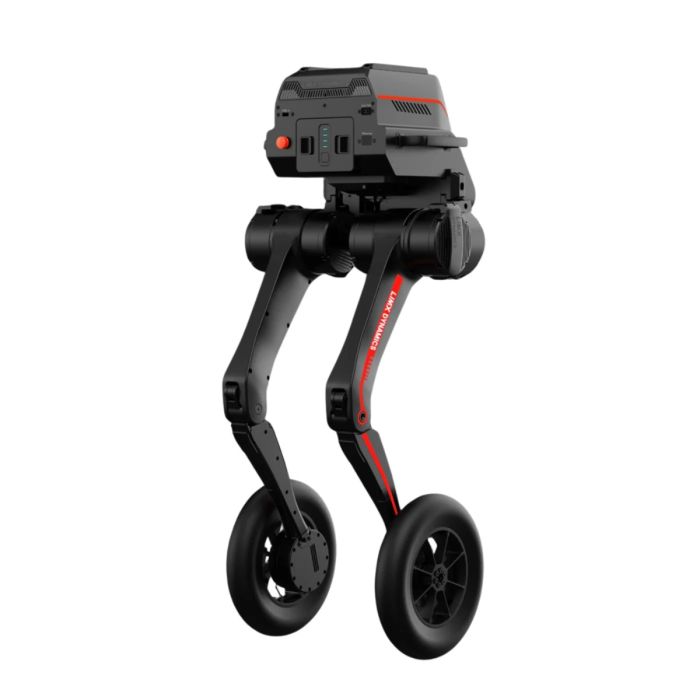
Research questions rarely stay still for the lifetime of a grant. A group that begins by studying balance on narrow contact points may, two terms later, want to know how the same controller copes once the robot can roll. Buying a new machine for every new question is how laboratories fill up with hardware that waits in a corner. The LimX Tron 1 Education Edition Multi-Modal Biped Robot takes a different route: one robot body whose foot-ends can be exchanged between wheeled, point-foot and sole configurations, and an onboard computer whose entire development process can be carried out in Python. The research question can move on, and the platform moves with it.
Robots Middle East supplies the TRON 1 Education Edition to universities, research institutes, schools and technology developers across the Middle East. Robots Middle East prepares each quotation, coordinates delivery to the country of use and remains your point of contact for support once the robot is in service. Who answers the telephone is settled before the first experiment begins.
Background
LimX Dynamics and its legged-robot range
LimX Dynamics develops legged and humanoid robots for research, education and work on embodied intelligence. The TRON 1 belongs to a wider family that includes the TRON 2 multi-form embodied robot and the Oli full-size humanoid line. Institutions can therefore begin with a compact biped and later progress to larger platforms from the same manufacturer. The sources name two versions of the TRON 1: the Standard Edition and the Education Edition presented on this page. The figures in this article belong to the Education Edition alone.
The Three-In-One foot-end concept
The defining idea of the TRON 1 Education Edition is its Three-In-One modular foot-end design, intended for multi-modal algorithm development. The robot is supplied with wheeled, point-foot and sole foot-ends, and they can be switched efficiently to form flexible combinations. When a foot-end is changed, the robot recognises the new hardware automatically and adapts its software accordingly. This matters in practice. A changeover becomes part of the lesson or the experiment, not a separate engineering task, and results from different locomotion modes can be compared on the same body, with the same mass distribution and the same computer.
Technical Specifications
| Specification | Value |
|---|---|
| Foot-end design | Three-In-One modular design for multi-modal algorithm development |
| Foot-end switching | Efficient switching of different foot-ends for flexible combinations; automatic hardware recognition and software adaptation |
| Dimensions | ≤ 392mm x 420mm x 845mm |
| Material | Aluminum Alloy + Industrial Plastic |
| Battery type | Ternary Lithium |
| Computer (CPU/Memory/Storage) | 12th Gen Intel i3/16G/512G |
| Peripheral expansion ports | USB 3.0 *1, GbE *1 |
| Operating environment | -5℃ to 40℃ (operates in favourable weather conditions) |
| Development | Compatible with full-process development in Python; C++ not required |
| Included in the box | Robot body, Wheeled, Point-Foot, Sole, Battery, Battery Charging Dock, Handheld Remote Controller, Haulage Rope, Roll Cage |
Specifications are as published by the manufacturer and are confirmed against the datasheet at quotation.
The manufacturer has not published the IP rating, camera resolution, joint degrees of freedom, wireless connectivity, noise level or battery weight; these details are confirmed at quotation.
What makes the TRON 1 Education Edition different from a fixed-foot biped?
A biped with permanently fitted feet answers one locomotion question well and others not at all. Point contacts suit research into dynamic balance. Flat soles suit stable standing and stepping. Wheels suit efficient travel across smooth floors. On a conventional platform, comparing these means comparing different robots, each with its own geometry, actuators and software stack. The resulting data are hard to separate from the differences between the machines themselves.
The TRON 1 Education Edition removes that variable. All three foot-ends are in the box, the body stays the same, and the robot recognises which foot-end has been fitted and adapts its software to match. A researcher can train a controller on point feet, fit the soles, and observe how the same policy or method behaves. A lecturer can show a class the trade-offs between walking and rolling in one session. The aluminium alloy and industrial plastic construction, together with a roll cage and haulage rope supplied in the box, also reflects a machine designed to be handled, reconfigured and occasionally caught during experiments. It is not built to stand behind glass.
Why does Python-only development matter in a teaching laboratory?
Much robotics software has historically been written in C++, and for many students that has been the first obstacle, before any question of control theory arises. The TRON 1 Education Edition is compatible with full-process development in Python, and C++ is not required. For a teaching programme, this means course time can be spent on locomotion, sensing and control, not on build systems and memory management.
The onboard computer, a 12th Gen Intel i3 with 16G of memory and 512G of storage, gives students a familiar x86 environment on the robot itself. Peripheral expansion through USB 3.0 and Gigabit Ethernet allows additional devices and a wired link to development workstations. Python is also the common language of machine learning, so the same environment carries a student from a first scripted motion through to data-driven methods without a change of toolchain.
Who is the TRON 1 Education Edition for?
University engineering and computer science departments are the most natural buyers. Research groups working on legged locomotion, reinforcement learning and embodied intelligence can use the foot-end changes to set up comparative studies on a single platform. Teaching faculties that run robotics modules gain a machine that undergraduates can program in Python from the outset, while postgraduates push the same hardware further.
Research institutes and corporate innovation laboratories across the region form a second group, particularly teams assessing legged mobility before they commit to larger systems. Advanced secondary schools and specialist STEM centres with experienced staff may also find the platform suited to competition preparation and demonstration work. Buyers should note that the published operating environment runs from -5℃ to 40℃ in favourable weather conditions, so in much of the Middle East the robot is best treated as an indoor and laboratory platform during the hotter months.
Institutions weighing the two editions should also review the LimX Tron 1 Standard Edition Multi-Modal Biped Robot; Robots Middle East will set out the differences between the editions in the quotation. Teams whose research calls for a full-size humanoid may look at the LimX Oli EDU Full-Size General Purpose Open Source Humanoid Robot, and those exploring other body forms at the LimX Tron 2 Multi-Form Embodied Robot. The wider selection is available under Research Robots and in the LimX range.
What is the TRON 1 Education Edition used for?
- Locomotion research: comparing point-foot, sole and wheeled movement on one body to isolate the effect of the contact mode.
- Reinforcement learning: training and testing control policies in Python on the onboard computer.
- University teaching: robotics and control modules in which students program a real biped without first learning C++.
- Algorithm benchmarking: evaluating balance and gait methods across foot-end configurations under the same hardware conditions.
- Sensor and peripheral integration: connecting additional devices through the USB 3.0 and GbE expansion ports for perception projects.
- Demonstration and outreach: showing visitors, sponsors and prospective students how one robot can both walk and roll.
Pricing and Availability
Robots Middle East supplies the TRON 1 Education Edition on a quotation basis, so that each offer reflects the configuration, destination and support arrangements your institution requires. Delivery, customs and support are arranged together with the quotation. If you would like confirmation of any specification, including those the manufacturer has not published, please include your questions with your enquiry and they will be answered in writing. To begin, a quotation request for the LimX Tron 1 Education Edition Multi-Modal Biped Robot is available on this page.
Frequently Asked Questions
Which foot-ends are supplied with the TRON 1 Education Edition?
The box contains wheeled, point-foot and sole foot-ends, together with the robot body, battery, battery charging dock, handheld remote controller, haulage rope and roll cage.
Does the robot need reconfiguring in software after a foot-end change?
The TRON 1 Education Edition provides automatic hardware recognition and software adaptation, so the robot identifies the fitted foot-end and adapts to it.
Do students need to know C++?
No. The robot is compatible with full-process development in Python, and C++ is not required.
What computer does the robot carry?
It carries a 12th Gen Intel i3 with 16G of memory and 512G of storage, with USB 3.0 and GbE ports for peripheral expansion.
Can the robot be used outdoors in the Middle East?
The published operating environment is -5℃ to 40℃ in favourable weather conditions. In the region, this generally makes it an indoor and laboratory platform, with outdoor sessions limited to suitable conditions.
How large is the robot?
Its dimensions are ≤ 392mm x 420mm x 845mm, and it is built from aluminium alloy and industrial plastic.
Where can I buy the LimX Tron 1 Education Edition and what does it cost?
You can buy it from Robots Middle East, which prepares an individual quotation covering the robot, delivery, customs and support. Please request your quotation through this page.
Summary
A research programme changes direction more often than a laboratory can replace its equipment, and the LimX Tron 1 Education Edition is designed for that reality. Its Three-In-One foot-end design lets one body walk on point feet, step on soles or roll on wheels, while automatic recognition keeps each changeover short. Python-only development and a 12th Gen Intel i3 computer on board keep the work focused on locomotion, not on toolchains. For universities and research teams across the Middle East that want a single platform able to follow their questions from term to term, with quotation, delivery and support from Robots Middle East, this page is the starting point.