
Noetix E1 EDU Embodied Intelligence Humanoid Robot
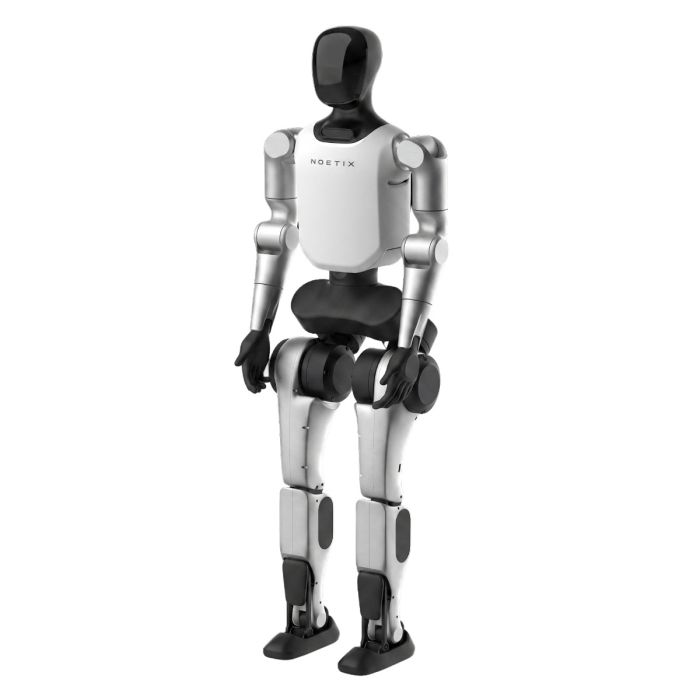
In stock
- BRAND:
- NOETIX
- MODEL:
- E1 EDU
- PART #:
- E1
- ORIGIN:
- China
- AVAILABILITY:
- SUBJECT TO AVAILABILITY
- SKU:
- Noetix-E1-EDU
Noetix E1 EDU Embodied Intelligence Humanoid Robot
Embodied intelligence is difficult to teach from a screen. An algorithm that balances flawlessly in simulation meets friction, latency and uneven floors the moment it is loaded into a real body, and that encounter is where students and researchers learn the most. The Noetix E1 EDU Embodied Intelligence Humanoid Robot is built to be that body: a full-size bipedal humanoid with depth sensing, an onboard NVIDIA Jetson Orin Nano Super module, large-model voice interaction and a modular frame that accepts a dexterous hand, LiDAR and other expansion kits. Because it is delivered with SDK documentation and technical support, a department can use one platform to study locomotion, perception, manipulation and spoken interaction side by side, rather than assembling a separate rig for each.
Robots Middle East supplies the Noetix E1 EDU to universities, schools, research centres and innovation programmes across the Middle East. Robots Middle East prepares each quotation around the configuration your team requires, arranges delivery to your site and supports the robot after installation, so that your staff and students can concentrate on the work the platform was acquired for.
Background
NOETIX and its humanoid range
NOETIX develops humanoid robots in several sizes and for several purposes. Alongside the E1 family, the range offered through this store includes the compact BUMI humanoids and the N2 EDU athlete humanoid, which gives institutions a choice of form factor when they plan a robotics programme. The E1 is also marketed as the Geek Pioneer E1, and it combines highly localised core components with large-model voice interaction and modular expansion, with in-depth customised development as an aim of the design. In practical terms, this places the E1 among the humanoids intended to be worked on and extended, not merely operated.
The EDU positioning
The sources name two versions: the E1 and the E1 EDU. The figures in this article belong to the E1 EDU, the configuration aimed at education and research. Its defining addition is software support: the manufacturer provides technical support and an SDK document with this version, which is what a teaching laboratory or research group needs in order to write its own behaviours and integrate its own algorithms. The hardware is designed to grow with a project, too. The arms and waist each have optional additional degrees of freedom, the standard five-fingered hand can be replaced with a dexterous hand, and the dexterous hand, LiDAR and other multi-functional expansion kits can be freely combined. A programme can therefore begin with one configuration and add capability as its curriculum or research questions mature.
Technical Specifications
| Specification | Value |
|---|---|
| Dimensions (standing, length x width x thickness) | 136 cm * 47 cm * 29 cm |
| Total degrees of freedom | 23-28 DoF |
| Single-arm degrees of freedom | 5 DoF (optional additional 2 degrees of freedom) |
| Waist degrees of freedom | 1 DoF (optional additional 1 degree of freedom) |
| Knee joint range | 0 - 135° |
| End effector | Five-fingered hand (with optional dexterous hand) |
| Computing power | 6+67 TOPS |
| High computing power module | NVIDIA Jetson Orin Nano Super |
| Sensing sensors | Depth camera, IMU |
| Power supply method | Lithium battery |
| Wireless connectivity | Wi-Fi 6, Bluetooth |
| Voice interaction | Intelligent voice large model with multi-round interaction and scenario-based command recognition |
| Expansion kits | Dexterous hand, LiDAR and other multi-functional kits, freely combinable |
| Software support | Technical support and SDK document |
Specifications are as published by the manufacturer and are confirmed against the datasheet at quotation.
The manufacturer has not published the IP rating, walking speed, battery voltage, charging time, operating temperature range, package contents, the operating systems supported by the SDK, the arm payload or the noise level; each of these is confirmed at quotation.
What does the modular design of the Noetix E1 EDU allow?
Many educational robots are fixed products: what arrives in the crate is what the course will use for its entire life. The E1 EDU takes a different approach. Its total of 23-28 DoF reflects a body whose articulation can be extended. Each arm carries 5 DoF with the option of 2 more, and the waist carries 1 DoF with the option of 1 more. For a manipulation course, those additional joints change what the arm can reach and how naturally it can position the hand; for a whole-body control project, an extra waist joint widens the range of postures the controller must coordinate.
The end effector follows the same logic. A five-fingered hand is the standard fitting, and a dexterous hand is available for work that demands finer grasping. LiDAR can be added to complement the depth camera and IMU, and these and other kits can be freely combined. For an institution, the benefit is planning freedom: a first cohort can concentrate on walking and interaction, while a later research phase adds sensing or dexterity without replacing the robot.
How does the Noetix E1 EDU handle computing and interaction?
Onboard processing is provided by an NVIDIA Jetson Orin Nano Super module, delivering 6+67 TOPS of computing power. Running perception and decision-making on the robot itself matters in teaching and research: experiments do not depend on a tethered workstation, and students can observe how models behave under the real constraints of an embedded system. Wi-Fi 6 and Bluetooth provide wireless links for development and control.
Interaction is handled by an intelligent voice large model that supports multi-round conversation and scenario-based command recognition. Rather than reacting to isolated keywords, the robot can carry an exchange across several turns and interpret instructions in the context of a given scenario. Combined with motion that includes dancing, jumping and walking on complex terrains, this lets a single platform demonstrate the full loop of embodied intelligence: hearing a request, understanding it, and acting on it physically.
Who is the Noetix E1 EDU for?
Universities and engineering faculties are the most natural buyers. Robotics, mechatronics, computer science and artificial intelligence departments can use the E1 EDU for coursework, final-year projects and postgraduate research, with the SDK document giving students a documented route into the robot's behaviour.
Research laboratories working on legged locomotion, whole-body control, human-robot interaction or large-model integration will value the combination of onboard computing, depth sensing and a modular body that can be reconfigured between studies. Secondary schools and STEM centres with established technology programmes can use the robot to make artificial intelligence tangible for older pupils, while innovation hubs and science centres may use its movement and conversation to engage visitors.
If your requirement is the standard E1 rather than the education configuration, the Noetix E1 Embodied Intelligence Humanoid Robot is listed separately, and Robots Middle East can set out the differences between the two in its quotation. Buyers comparing platforms more widely may also browse our Bipedal Humanoids and Research Robots categories.
What is the Noetix E1 EDU used for?
- Locomotion research — studying gait, balance and recovery on a full-size bipedal body that can walk on complex terrains.
- Embodied AI development — linking the large-model voice system to physical actions through the SDK.
- Manipulation studies — exploring grasping with the five-fingered hand or the optional dexterous hand and additional arm joints.
- Perception and mapping — combining the depth camera and IMU with an optional LiDAR kit for navigation experiments.
- University and school teaching — giving students a shared, documented platform for practical robotics and artificial intelligence coursework.
- Demonstrations and public engagement — presenting dance, movement and conversation at open days, exhibitions and innovation events.
Pricing and Availability
Robots Middle East supplies the Noetix E1 EDU on quotation, so that the offer reflects the configuration you need, including any optional arm and waist joints, the dexterous hand or LiDAR. Delivery, customs clearance and after-sales support are arranged together with the quotation. To begin, please share your intended application and preferred configuration through the quotation request available on this page.
Frequently Asked Questions
How many degrees of freedom does the Noetix E1 EDU have?
The E1 EDU has a total of 23-28 DoF. Each arm has 5 DoF with an optional additional 2, and the waist has 1 DoF with an optional additional 1.
What computing hardware does the robot use?
Its high computing power module is the NVIDIA Jetson Orin Nano Super, and its computing power is 6+67 TOPS.
Does the E1 EDU come with development tools?
Yes. The manufacturer provides technical support and an SDK document with the E1 EDU, giving your team a documented route to develop its own behaviours and integrate custom algorithms.
Can the robot be fitted with a dexterous hand?
A five-fingered hand is fitted as standard, and a dexterous hand is available as an option. It can be combined with other expansion kits such as LiDAR.
Which sensors does the Noetix E1 EDU carry?
The robot carries a depth camera and an IMU. LiDAR is available as an expansion kit.
How is the robot powered?
The E1 EDU runs on a lithium battery.
Where can I buy the Noetix E1 EDU and what does it cost?
The Noetix E1 EDU is available from Robots Middle East, which supplies it across the Middle East. Pricing is provided by quotation according to your configuration, so please submit a request through this page.
Summary
Embodied intelligence is learned where software meets a physical body, and the Noetix E1 EDU is designed to be that meeting point for classrooms and laboratories. A full-size bipedal frame with 23-28 DoF, an NVIDIA Jetson Orin Nano Super module, depth sensing, multi-round voice interaction and modular expansion give students and researchers a single platform that can grow from walking and conversation into dexterous manipulation and mapping. With SDK documentation, technical support and supply, delivery and after-sales service from Robots Middle East, institutions across the region can move their teaching beyond the screen, and for any team ready to take that step, this page is the starting point.