
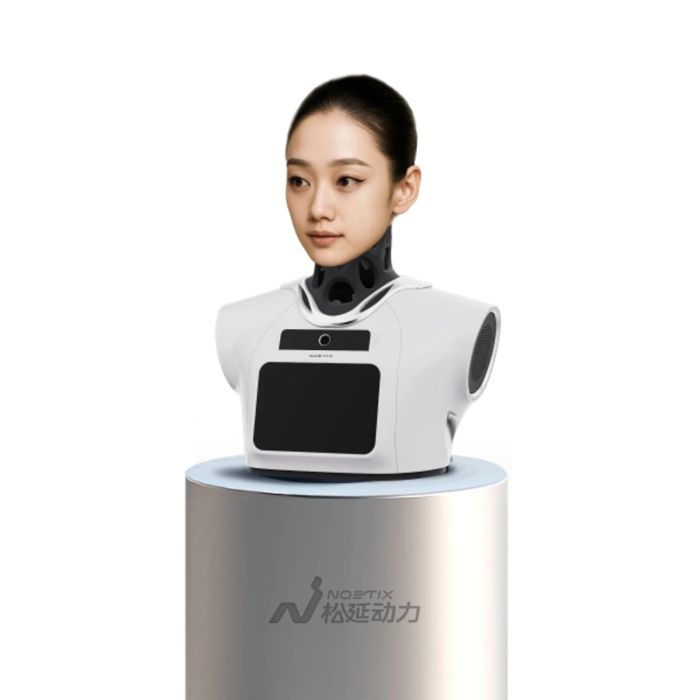
Noetix Xiaonuo Hobbs 3 Bionic Humanoid Robot
In stock
- BRAND:
- NOETIX
- MODEL:
- Xiaonuo / Hobbs 3
- PART #:
- Hobbs 3
- ORIGIN:
- China
- Warranty:
- 12 MONTHS
- AVAILABILITY:
- SUBJECT TO AVAILABILITY
- SKU:
- Noetix-Xiaonuo-Hobbs3
Noetix Xiaonuo Hobbs 3 Bionic Humanoid Robot
Visitors remember the face of a humanoid robot; the engineers who have to make one work remember what sits behind it. The Noetix Xiaonuo Hobbs 3 Bionic Humanoid Robot speaks to both audiences. It is built to stand in front of people, but its Standard configuration reads like a brief for a developer: an 8-core processor rated at 6 TOPS, a 7-inch HD screen, two USB-A 3.0 ports, SDK support and over-the-air software upgrades, all in a robot that weighs 10.4 kg. A lifelike humanoid is only as convincing as the software that drives it, and this is a platform designed to be programmed, extended and kept up to date rather than simply switched on and admired.
Robots Middle East sells the Noetix Xiaonuo Hobbs 3 Bionic Humanoid Robot and supplies it to organisations across the Middle East. Our team prepares each quotation, coordinates delivery to your site and remains your point of contact for technical questions and after-sales support once the robot is in service.
Background
NOETIX and its humanoid range
NOETIX builds humanoid robots across several formats, and the range offered through this store reflects that breadth. Alongside the Xiaonuo Hobbs 3 sit the Noetix HOBBS W1 Wheeled Humanoid Bionic Robot and the BUMI family of humanoids aimed at education and development. The Hobbs 3 belongs to the bionic side of the catalogue, alongside other machines in our Bionic Humanoids category, where the purpose of the robot is to present a human-like presence to the people it meets. Bionic humanoids of this kind are generally chosen where face-to-face engagement matters as much as the task itself: in public spaces, in research on how people respond to machines, and in demonstrations of what embodied artificial intelligence can do.
An open, updatable platform
What the specification emphasises is the robot's role as a computing platform. The Standard version carries basic computing rated at 8-core, 6 TOPS, which gives on-board processing headroom for the workloads typical of interactive robots. A 7-inch HD screen provides a visual interface, and two USB-A 3.0 ports allow peripherals to be connected. Crucially, the Hobbs 3 supports an SDK, so developers can write their own behaviours and applications, and OTA software upgrades, so the robot's software can be updated in the field without being returned to a workshop. Together these features describe a robot intended to evolve with the project it serves.
Technical Specifications
| Specification | Value |
|---|---|
| Version | Hobbs 3 (Standard) |
| Weight | 10.4 kg |
| Basic computing | 8-core, 6 TOPS |
| Screen / display | 7-inch HD |
| USB-A ports | 3.0 ×2 |
| SDK | Supported |
| Software upgrade (OTA) | Supported |
Specifications are as published by the manufacturer and are confirmed against the datasheet at quotation.
The manufacturer has not published the battery capacity, battery runtime, IP rating, operating temperature, noise level, power consumption or box contents; Robots Middle East confirms these details at quotation.
What does the on-board computing of the Hobbs 3 mean for developers?
An interactive humanoid has to perceive, decide and respond in the time a person expects a conversation partner to take. Every step of that loop places a demand on the processor, and the closer that processing sits to the robot, the less the experience depends on a network connection. The Hobbs 3 Standard is specified with 8-core, 6 TOPS basic computing, which indicates processing capacity on the robot itself rather than a design that relies entirely on external hardware.
For a development team, that has practical consequences. Applications can be built and tested directly on the robot through the supported SDK, and the two USB-A 3.0 ports offer a route for connecting additional devices during development or deployment. The 7-inch HD screen adds a second channel of communication: it can carry menus, status information or content that complements the robot's physical presence. Teams planning demanding workloads are welcome to discuss them with our engineers when requesting a quotation.
Why do SDK and OTA support matter for a bionic humanoid?
A robot that greets visitors in a lobby this year may be asked to run a different script, speak to a different audience or demonstrate a different capability next year. Without an SDK, the owner is limited to whatever behaviours the robot ships with; with one, the robot becomes a foundation on which in-house developers or integrators can build. The Hobbs 3 supports an SDK, which places it among platforms that can be shaped to a specific role.
OTA updates address the other half of the life cycle. Software for interactive robots is rarely finished at the point of delivery: improvements, fixes and new features arrive over time. Because the Hobbs 3 supports over-the-air software upgrades, those changes can be applied where the robot is installed. For organisations operating in the Middle East, often far from the manufacturer, the ability to update a robot in place rather than ship it for servicing is a meaningful operational advantage.
Who is the Noetix Xiaonuo Hobbs 3 for?
The first group of buyers is research. Universities and laboratories studying human-robot interaction, social robotics or embodied AI need a physical humanoid that they can program, and the combination of on-board computing and SDK support suits that work. The second group is experience and exhibition teams: museums, science centres, trade-show organisers and corporate visitor centres that want a human-like presence to draw and hold an audience.
The third group is developers and system integrators who build applications for clients and need a platform that can be customised and maintained over time; for them, OTA updates and USB connectivity simplify both integration and long-term care. Finally, innovation departments within larger organisations may use the robot to explore how a humanoid could fit into reception, guidance or customer-facing roles before committing to a wider programme. Buyers who are still comparing form factors, for instance a full bionic figure against a mobile platform, can review the wider Bionic Humanoids range, and our team will gladly discuss which model fits the intended deployment.
What is the Noetix Xiaonuo Hobbs 3 used for?
- Human-robot interaction research — studying how people perceive, trust and respond to a human-like machine.
- Embodied AI development — building and testing perception and dialogue software on physical hardware through the SDK.
- Exhibitions and trade stands — giving a stand or gallery a presence that invites visitors to stop and engage.
- Reception and visitor guidance — exploring how a humanoid can welcome guests and share information, supported by its on-board screen.
- Education and demonstrations — showing students and audiences how modern robotics and AI come together in one machine.
- Custom client applications — serving as a base for integrators delivering bespoke interactive experiences that can be updated over the air.
Pricing and Availability
Robots Middle East supplies the Noetix Xiaonuo Hobbs 3 Bionic Humanoid Robot on a quotation basis, so that each offer reflects the configuration, destination and support you require. Delivery, customs clearance and technical support are arranged with the quotation. When you contact us, please describe the intended application, the installation site and any software or integration needs, so that our team can prepare an offer that fits your project. A quotation request for the Noetix Xiaonuo Hobbs 3 is available on this page.
Frequently Asked Questions
How much does the Noetix Xiaonuo Hobbs 3 weigh?
The Hobbs 3 Standard weighs 10.4 kg.
What computing does the Hobbs 3 provide?
The Standard version is specified with basic computing rated at 8-core, 6 TOPS.
Can I develop my own applications for the robot?
Yes. The Hobbs 3 supports an SDK, so developers can build their own behaviours and applications for the robot.
Does the Hobbs 3 receive software updates?
Yes. The robot supports OTA software upgrades, so updates can be installed where the robot is in service.
What display and connectivity does it offer?
The Hobbs 3 Standard has a 7-inch HD screen and two USB-A 3.0 ports for connecting peripherals.
What is the battery life and IP rating of the Hobbs 3?
These figures are not yet available from the manufacturer. Our team will address them with you as part of the quotation.
Where can I buy the Noetix Xiaonuo Hobbs 3 and what does it cost?
You can buy the Noetix Xiaonuo Hobbs 3 Bionic Humanoid Robot from Robots Middle East, which supplies it across the Middle East. The cost depends on your configuration, destination and support requirements, so please request a quotation and our team will prepare a tailored offer.
Summary
A bionic humanoid wins attention with its face, but it earns its place through what runs behind that face. The Noetix Xiaonuo Hobbs 3 Bionic Humanoid Robot pairs its human-like presence with a developer-ready Standard configuration: 8-core, 6 TOPS computing, a 7-inch HD screen, two USB-A 3.0 ports, SDK support and OTA upgrades, in a 10.4 kg robot. That combination makes it a platform for research groups, exhibition teams, integrators and innovation departments that intend to shape and update their robot over time. Robots Middle East quotes, delivers and supports it across the region, and for anyone planning a humanoid deployment, this page is the starting point.