
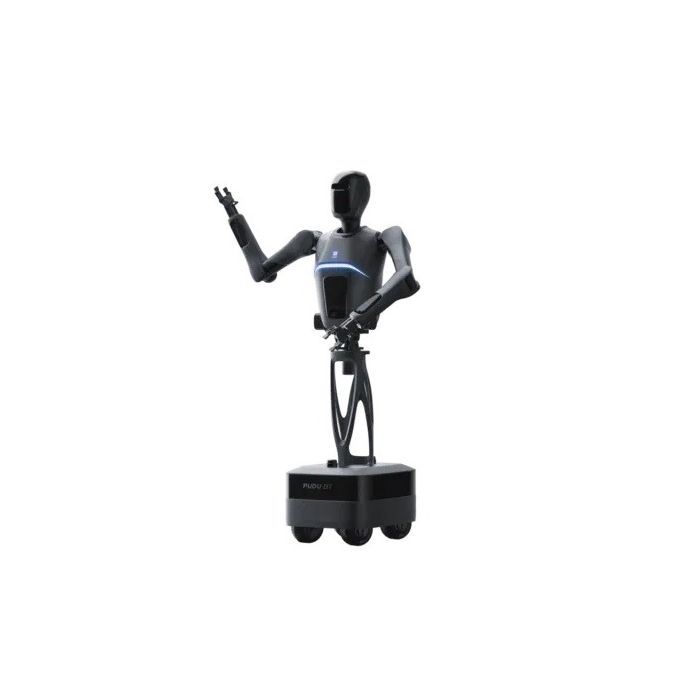
PUDU D7 Wheeled Humanoid Robot
In stock
- BRAND:
- PUDU ROBOTICS
- MODEL:
- D7
- ORIGIN:
- China
- AVAILABILITY:
- SUBJECT TO AVAILABILITY
- SKU:
- PUDU-D7
PUDU D7 Wheeled Humanoid Robot
Much of the work still undone in a modern facility sits within arm's length. Autonomous carts can already cross a warehouse floor, yet the tote still has to be lifted onto a rack, the lift still has to be called and the trolley still has to be pushed by someone with hands. The PUDU D7 Wheeled Humanoid Robot is PUDU ROBOTICS' answer to that gap: a semi-humanoid that carries a human-like upper body and robotic arms on a fully omnidirectional chassis, so that travelling, reaching and gripping belong to one machine rather than three. The name now covers two generations, the 2024 original and a 2026 industrial successor, and choosing between them is the first decision a buyer makes.
Robots Middle East sells the PUDU D7 and supplies it to organisations across the Middle East, from logistics and manufacturing sites to research and innovation teams. Robots Middle East prepares each quotation for the generation and configuration requested, arranges delivery within the region and supports the robot once it is in service.
Background
PUDU Robotics and Pudu X-Lab
PUDU Robotics describes itself as a global leader in service robotics, a reputation built largely on robots that deliver, guide and clean in restaurants, hotels and commercial buildings. The PUDU D7 marks a step beyond those single-purpose machines. It was developed by Pudu X-Lab, the company's research and development arm, and the 2024 model was presented as the company's first general embodied intelligent semi-humanoid robot. Embodied intelligence, in the general sense the industry uses, means a robot that perceives its surroundings and acts physically within them, rather than simply following a fixed route.
To manage that combination of thinking and doing, the first-generation D7 uses a hierarchical control system, described as high-level planning and low-level planning. The upper layer handles abstract, strategic tasks, while the lower layer looks after real-time, sensory-based actions, so the robot can decide what to do next while still reacting to what is directly in front of its arms.
From semi-humanoid to industrial platform
The 2026 PUDU D7 is a next-generation industrial semi-humanoid robot designed for manufacturing and industrial environments. It is powered by PuduFM 1.0, and with it the D7 moves beyond the traditional separation between navigation and manipulation: moving through a facility and handling objects are treated as one continuous task rather than two systems handing over to each other. The newer generation also supports fully autonomous battery swapping, intended for around-the-clock industrial operations, and it can autonomously push carts and transport materials across facilities.
Technical Specifications
| Specification | PUDU D7 (first generation) | PUDU D7 (next-generation industrial) |
|---|---|---|
| Product type | General embodied intelligent semi-humanoid robot | Industrial semi-humanoid robot for manufacturing and industrial environments |
| Design | Human-like upper body with robotic arms on a fully omnidirectional chassis | — |
| Height | 165 cm | — |
| Weight | 45 kg | — |
| Bionic arm reach | 65 cm | — |
| Degrees of freedom | 30; 50 with dexterous hand attachment | — |
| Arm lifting capacity | 10 kg | — |
| Payload capacity | — | Up to 14 kg (30.9 lbs) |
| Working height | — | Up to 2 m (6.6 ft) |
| Arm end-point precision | 0.1 mm | — |
| Movement | 360-degree omnidirectional | — |
| Maximum speed | 2 m/s | — |
| Slope stability | Up to 10 degrees | — |
| Battery | Exceeding 1 kWh | Fully autonomous battery swapping |
| Continuous operation | Over 8 hours | — |
| Control and AI | Hierarchical control (high-level and low-level planning) | PuduFM 1.0 |
| Developer | Pudu X-Lab | — |
Specifications are as published by the manufacturer and are confirmed against the datasheet at quotation. The manufacturer has not published the chassis dimensions, IP rating, charging time, connectivity, operating temperature range, contents of the box or compute platform details, nor further figures for the next-generation model, and Robots Middle East confirms these at quotation.
What does the 2026 PUDU D7 change compared with the first generation?
The two generations share a name and a concept, but they are aimed at different workplaces. The 2024 D7 is a general-purpose semi-humanoid: its bionic arms reach 65 cm, operate with 30 degrees of freedom, expand to 50 with a dexterous hand attachment and position their end point to 0.1 mm. Those figures describe a robot built for careful, varied handling in buildings designed for people, where calling a lift, carrying an item or sorting objects are everyday tasks.
The 2026 D7 is tuned for industry. It supports a payload of up to 14 kg (30.9 lbs) and works at heights of up to 2 m (6.6 ft), which lets it interact with high-rack storage systems. The first generation's 10 kg is an arm lifting figure and the newer model's 14 kg a payload capacity, so the two should be compared with care when a project depends on a specific load.
Endurance changes approach as well. The first generation relies on a battery exceeding 1 kWh for more than 8 hours of continuous operation, which covers a working shift. The 2026 model supports fully autonomous battery swapping instead, so the robot can keep working through consecutive shifts without waiting by a charger. Finally, PuduFM 1.0 joins navigation and manipulation into one model, and the newer D7 can push carts and move materials across a facility on its own.
Why does the PUDU D7 run on wheels rather than legs?
Legged humanoids attract attention, but most factories, warehouses, hospitals and office towers have level floors, ramps and lifts. On such surfaces a wheeled base is a practical choice: it keeps the upper body steady while the arms work and spends its energy on the task rather than on balance. The first-generation D7 makes the case in figures: 360-degree omnidirectional movement, a maximum speed of 2 m/s and stability on slopes of up to 10 degrees. Omnidirectional movement matters in narrow aisles and crowded lift lobbies, because the robot can line itself up with a shelf or a button panel without a three-point turn.
Who is the PUDU D7 for?
Logistics and warehouse operators form the clearest audience for the 2026 generation. Its 2 m working height, high-rack interaction, autonomous cart pushing and battery swapping are aimed squarely at facilities running around the clock, such as distribution centres serving the region's ports and free zones. Manufacturers moving materials between lines and stores fall into the same group, since the newer D7 was designed for manufacturing and industrial environments.
Operators of multi-storey buildings, including hotels, hospitals and corporate campuses, will find the first generation's elevator operation, item transport and sorting more relevant than industrial payload figures. Research institutions, universities and innovation teams exploring embodied intelligence will value the 2024 model's degrees of freedom, dexterous hand attachment and hierarchical control system as a platform for developing new tasks.
For buyers still comparing form factors, Robots Middle East also offers the wider range of Wheeled Humanoids, and can advise on which generation of the D7 fits a given site.
What is the PUDU D7 used for?
- Elevator operation — the first-generation D7 calls and uses lifts, linking floors in buildings designed around people.
- Item transport — carrying items between rooms, floors and work areas with an omnidirectional base.
- Sorting — handling and sorting objects with bionic arms that position their end point precisely.
- High-rack storage — the 2026 model works at heights of up to 2 m (6.6 ft) to interact with high-rack storage systems.
- Cart pushing — the 2026 model autonomously pushes carts and moves materials across a facility.
- Continuous industrial shifts — fully autonomous battery swapping on the 2026 model supports around-the-clock operations.
Pricing and Availability
Robots Middle East quotes the PUDU D7 on request, because the right offer depends on the generation, the hand configuration and the tasks the robot will perform. A short description of your site, its floors, racks and lifts, and the workflow you intend to automate allows the team to prepare an accurate proposal. Delivery, customs clearance and after-sales support are arranged with the quotation. To begin, send your requirements through the quotation request available on this page.
Frequently Asked Questions
What is the difference between the two PUDU D7 generations?
The 2024 D7 is a general embodied intelligent semi-humanoid suited to elevator operation, item transport and sorting. The 2026 D7 is an industrial semi-humanoid for manufacturing and industrial environments, with a 14 kg (30.9 lbs) payload, 2 m (6.6 ft) working height, autonomous battery swapping and PuduFM 1.0.
How long can the PUDU D7 operate?
The first generation runs continuously for more than 8 hours on a battery exceeding 1 kWh. The 2026 generation supports fully autonomous battery swapping for around-the-clock operation.
Can the PUDU D7 use lifts?
Yes, elevator operation is one of the tasks the first-generation D7 is built for, alongside item transport and sorting.
How much can the PUDU D7 lift?
The first generation's bionic arms lift 10 kg. The 2026 generation supports a payload of up to 14 kg (30.9 lbs).
What is PuduFM 1.0?
PuduFM 1.0 powers the 2026 PUDU D7. It moves beyond the traditional separation between navigation and manipulation, so the robot treats moving and handling as one task.
Can the PUDU D7 reach high shelves?
The 2026 generation operates at heights of up to 2 m (6.6 ft), which enables efficient interaction with high-rack storage systems. The first generation's bionic arm extends to 65 cm from a robot standing 165 cm tall.
Where can I buy the PUDU D7 Wheeled Humanoid Robot and what does it cost?
You can buy the PUDU D7 from Robots Middle East, which supplies it across the Middle East. The cost depends on the generation and configuration, so it is set out in a quotation prepared for your project.
Summary
The PUDU D7 tackles the work that sits within arm's length: the button, the shelf, the tote and the cart that wheeled robots alone cannot handle. The 2024 generation brings a human-like upper body, highly articulated bionic arms and an omnidirectional base to buildings designed for people, while the 2026 generation takes the same idea into industry with higher reach, a larger payload, autonomous battery swapping and PuduFM 1.0. Robots Middle East helps buyers across the region choose the right generation and brings it into service. For any organisation ready to close that last gap in its automation, this page is the starting point.