
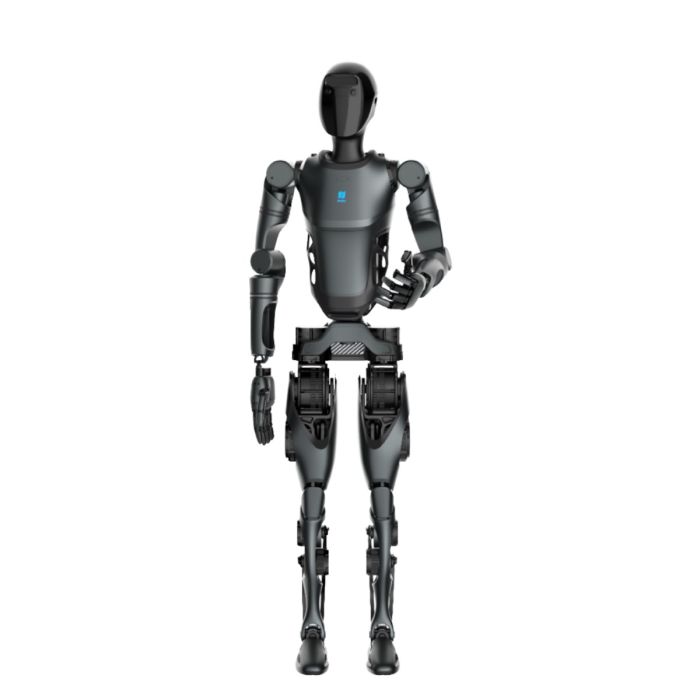
PUDU Robotics D9 Humanoid Robot
In stock
- BRAND:
- PUDU ROBOTICS
- PART #:
- D9
- ORIGIN:
- China
- AVAILABILITY:
- SUBJECT TO AVAILABILITY
- SKU:
- Pudu-Robotics-D9
PUDU Robotics D9 Humanoid Robot
If the PUDU Robotics D9 Humanoid Robot joined a project briefing, it would stand at roughly eye level with the people around the table. This is deliberate. At 170 cm and 65 kg, the D9 is built to adult proportions, so the corridors, staircases, workbenches and door handles of an ordinary building become its working environment rather than obstacles to engineer around. What makes it more than a walking mannequin is what sits behind those proportions: 42 degrees of freedom, a maximum joint torque of 352 N·m, 275 TOPS of computing power and the PUDU DH11 dexterous hand, whose tactile sensing regions let the robot feel what it grips.
Robots Middle East sells the PUDU Robotics D9 Humanoid Robot to universities, research laboratories, system integrators and enterprise innovation teams across the Middle East. Robots Middle East prepares each quotation for the project in question, arranges supply to the customer's site in the region and provides ongoing support. A humanoid programme can therefore move from evaluation to working trials with a single, accountable point of contact.
Background
PUDU Robotics and its move into humanoids
PUDU Robotics built its reputation on commercial service robots: machines that deliver, guide and clean in restaurants, hotels, offices and other public buildings. That experience matters for a humanoid. A company that has already put robots among members of the public understands deployment, maintenance and the practicalities of shared spaces. The D9 belongs to the company's research-led X-Lab line, where PUDU Robotics explores body forms beyond its wheeled service fleet, from quadrupeds to full-sized humanoids.
Embodied intelligence in an adult-sized body
The D9 is positioned as a platform for embodied intelligence, meaning artificial intelligence that learns and acts through a physical body rather than on a screen. Its design brings three capabilities together. The first is bipedal mobility, which reaches up to 2 m/s on flat surfaces and handles stairs and slopes. The second is a visual semantic navigation system that builds a real-time 3D semantic map, so the robot understands what the objects around it are as well as where they are. The third is multimodal perception: visual, tactile, force and auditory sensors feed AI models that support interaction with people and objects. Combining these in one adult-sized body is what separates the D9 from a laboratory arm or a wheeled base.
Technical Specifications
| Specification | Value |
|---|---|
| Height | 170 cm (66.93 inches) |
| Weight | 65 kg (143.30 pounds) |
| Leg length | Thigh 325 mm (12.80 inches); Calf 383 mm (15.08 inches) |
| Arm length | Arm 580 mm (22.83 inches); Hand 220 mm (8.66 inches) |
| Degrees of freedom | Total DOF 42; Single-leg DOF 6; Single-arm DOF 7 |
| Maximum joint torque | 352 N·m |
| Maximum payload | 20 kg (44.09 pounds); Single-arm 10 kg (22.05 pounds) (Testing Environment) |
| Dexterous hand (PUDU DH11) | 12 Tactile Sensing Regions; Active DOF 6; Passive DOF 5 |
| Sensors | RGB, RGBD, tactile sensors, IMU |
| Computing power | 275 TOPS |
| Battery | 15 Ah (0.72 kWh) |
| Maximum walking speed | Up to 2 m/s on flat surfaces |
| Terrain | Stairs, slopes and other challenging urban terrains |
| Navigation | Visual semantic navigation with real-time 3D semantic mapping |
Specifications are as published by the manufacturer and are confirmed against the datasheet at quotation.
The manufacturer has not published the battery runtime per charge, the charging time, the IP rating, the operating system, the connectivity options, the operating temperature range or the contents of the box; Robots Middle East confirms these at quotation.
What makes the PUDU D9 different from a wheeled service robot?
A wheeled service robot is efficient on level floors, but it depends on lifts, ramps and clear aisles. The D9 takes a different route. Its bipedal structure, with six degrees of freedom in each leg, lets it walk at speeds comparable to an adult's and climb stairs and slopes. A multi-storey building, a raised platform or an uneven outdoor path no longer marks the edge of its operating area.
Mobility is only half the argument. Each arm offers seven degrees of freedom, and the robot as a whole carries a maximum payload of 20 kg, with 10 kg per arm, measured in a testing environment. A service robot carries items on a tray; the D9 can reach, grasp and lift with its own limbs. The 275 TOPS of on-board computing power supports this. Perception, semantic mapping and motion control all compete for processing, and a humanoid that must balance while it manipulates needs headroom for both at once.
How does the DH11 hand change what the D9 can handle?
Most robotic grippers open and close. The PUDU DH11 dexterous hand pairs six active degrees of freedom with five passive ones, so the fingers can adapt their shape to an object instead of clamping it. Its 12 tactile sensing regions add a sense that cameras cannot provide: feedback on contact and pressure once the hand has closed. Together with the force sensors in the wider system, this lets developers work on grasps that must be firm enough to hold an object without damaging it. Delicate items, irregular shapes and tools designed for human hands all become realistic subjects for research and trials.
Who is the PUDU Robotics D9 Humanoid Robot for?
The D9 is aimed first at organisations that treat the humanoid itself as the subject of their work. University robotics departments and AI research centres can use its 42 degrees of freedom and multimodal sensor suite to study locomotion, manipulation and learning in the physical world. Corporate innovation teams evaluating humanoids for future operations will find a full-sized platform that moves through buildings as they already exist.
System integrators form a second group. They can build application-specific behaviour on top of the D9's navigation and manipulation capabilities for clients in sectors such as logistics, facilities and public-facing services. A third group comprises technology showcases, innovation hubs and visitor centres that want to demonstrate embodied intelligence with a robot of human scale.
Buyers who are still comparing body forms can browse the wider Bipedal Humanoids category, or review the PUDU D7 Wheeled Humanoid Robot alongside the D9. Robots Middle East can advise on which platform fits a given site and task.
What is the PUDU Robotics D9 Humanoid Robot used for?
- Embodied AI research: a full-sized body for training and testing models that perceive, decide and act in physical space.
- Dexterous manipulation studies: tactile and force feedback from the DH11 hand for work on grasping, handling and tool use.
- Multi-level navigation trials: walking routes that include stairs and slopes, guided by real-time 3D semantic mapping.
- Human–robot interaction: visual, auditory, tactile and force sensing for research into natural interaction with people.
- Material handling pilots: evaluating two-armed lifting and carrying within the published payload in realistic workspaces.
- Innovation showcases: demonstrating human-scale robotics to visitors, partners and students in exhibition and education settings.
Pricing and Availability
The PUDU Robotics D9 Humanoid Robot is supplied on quotation, so the offer can reflect your configuration, your intended application and the support your team requires. Delivery, customs and support are arranged with the quotation by Robots Middle East. The request form for a tailored quotation is available on this page.
Frequently Asked Questions
How tall and heavy is the PUDU Robotics D9 Humanoid Robot?
The D9 stands 170 cm (66.93 inches) tall and weighs 65 kg (143.30 pounds), proportions close to those of an adult.
How many degrees of freedom does the D9 have?
The D9 has 42 degrees of freedom in total, with 6 in each leg and 7 in each arm.
Can the D9 climb stairs?
Yes. The D9 navigates stairs, slopes and other challenging urban terrains, and it walks at up to 2 m/s on flat surfaces.
How much can the D9 carry?
The maximum payload is 20 kg (44.09 pounds) for the robot and 10 kg (22.05 pounds) per arm, as measured in a testing environment.
What sensors does the D9 use?
The D9 uses RGB and RGBD cameras, tactile sensors and an IMU, and it combines visual, tactile, force and auditory sensing for multimodal interaction. The PUDU DH11 hand adds 12 tactile sensing regions.
What battery does the D9 have?
The D9 carries a 15 Ah (0.72 kWh) battery. Robots Middle East confirms the operating details for your intended duty cycle at quotation.
Where can I buy the PUDU Robotics D9 Humanoid Robot and what does it cost?
You can buy the D9 from Robots Middle East, which supplies and supports it across the Middle East. The cost depends on your configuration and project requirements, so please request a quotation through this page.
Summary
The D9's adult proportions are more than a detail of appearance. They are the reason the robot can share a building, a staircase and a workbench with the people who already use them. On that human-scale frame, PUDU Robotics has assembled 42 degrees of freedom, 352 N·m of joint torque, 275 TOPS of computing power, semantic navigation and the tactile DH11 hand. The result is a platform for organisations that want to develop embodied intelligence in the real world rather than in simulation. Robots Middle East handles the quotation, delivery and support across the region. For any team ready to place a humanoid at eye level with its own staff, this page is the starting point.