
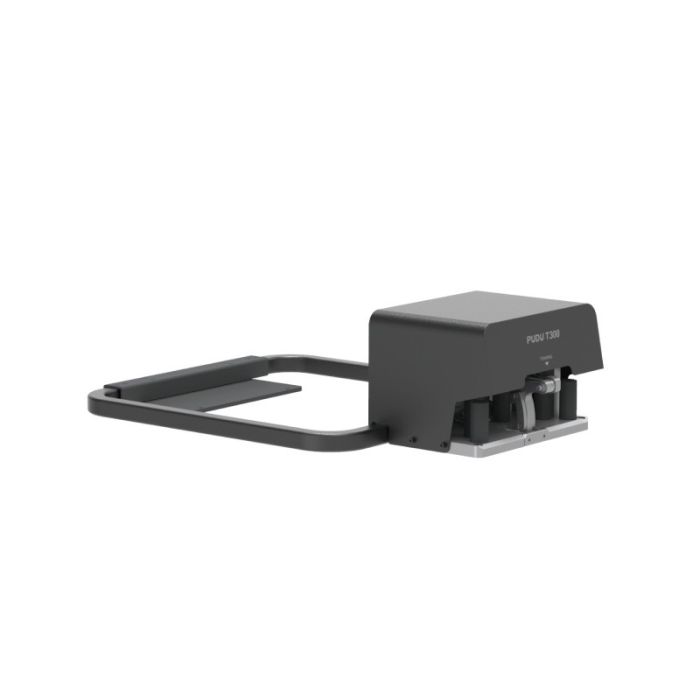
PUDU T300 Towing
In stock
- BRAND:
- PUDU ROBOTICS
- PART #:
- PUDU T300 Towing
- ORIGIN:
- China
- AVAILABILITY:
- SUBJECT TO AVAILABILITY
- SKU:
- PUDU-T300-Towing
PUDU T300 Towing
Most buyers of a mobile robot begin by asking how much it can carry. With the PUDU T300 Towing, the more useful question is how much it can pull. The answer is 400 kg, rolling on the carrier's own wheels behind the robot. This version of Pudu Robotics' T300 industrial autonomous mobile robot moves trolleys and carts between workstations, stores and docks. The carriers a facility already owns stay in the process, and the load does not have to be transferred onto a robot deck at every stop. It navigates with VSLAM and Lidar SLAM and complies with ISO 3691-4. It also belongs to a modular platform that shares its core with the other T300 versions.
Robots Middle East supplies the PUDU T300 Towing to manufacturers, logistics operators, healthcare facilities and other organisations across the Middle East. Our team prepares each quotation and matches the configuration to the site it will serve. We also arrange delivery and after-sales support for sites in the region, so that one partner is responsible for the robot from enquiry to everyday operation.
Background
Pudu Robotics and its step into industrial logistics
Pudu Robotics built its reputation on service robots for commercial spaces, such as delivery robots for restaurants and hotels and autonomous cleaning machines for large floors. The T300 carries that experience into factories and warehouses, where loads are heavier and routes are longer. Safety expectations there are shaped by industrial standards rather than hospitality norms. The wider range is collected in our Pudu category, which shows how the manufacturer's mobile platforms have moved from front-of-house tasks into back-of-house logistics.
One platform, several working modes
The T300 is built as a platform rather than a single fixed machine. Pudu describes modular accessories that give it delivery, lifting, towing and following capabilities. The sources name three versions: the PUDU T300 Standard, the PUDU T300 Lifting and the PUDU T300 Towing. The Towing version is defined by its towing capacity, and the navigation, safety and charging features of the platform sit underneath it. For a buyer, this means the decision is less about the robot itself and more about which module suits the way goods already move on site.
Technical Specifications
| Specification | T300 platform (not version-specific) | PUDU T300 Standard | PUDU T300 Lifting | PUDU T300 Towing |
|---|---|---|---|---|
| Towing capacity | — | — | — | 400 kg |
| Machine weight | — | 65 kg (143.3 lbs) | 81 kg 178.57 lbs | — |
| Machine dimensions | — | 83.5 cm x 50 cm x 135 cm (32.8 in x 19.6 in x 53.1 in) | — | — |
| Run-time (no load) | — | — | 12 h | — |
| Maximum speed | — | — | 1.2 m/s 3.94 ft/s | — |
| Navigation methods | VSLAM & Lidar SLAM | — | — | — |
| Safety sensors | LiDAR sensors and depth cameras | — | — | — |
| Battery capacity | 30Ah | — | — | — |
| Charging time | 2h (from 0% to 90%) | — | — | — |
| Charging and battery | Auto-charging and quick battery swap for 24/7 operations | — | — | — |
| Threshold crossing height | Maximum 20 mm (0.78in) | — | — | — |
| Groove crossing width | Maximum 35 mm (1.37 in) | — | — | — |
| Path clearance | Minimum 60cm(23.6 in) | — | — | — |
| Elevator integration | Elevator integration for multi-floor tasks | — | — | — |
| Safety standard | Complies with ISO 3691-4 | — | — | — |
| Modular accessories | Delivery, lifting, towing and following capabilities | — | — | — |
Specifications are as published by the manufacturer and are confirmed against the datasheet at quotation.
The manufacturer has not published the weight or dimensions of the towing attachment, the IP rating, the operating temperature for the towing version, a towing hitch compatibility list or the contents of the box; Robots Middle East confirms each of these at quotation.
What makes the T300 Towing different from the T300 Lifting?
Both versions move carriers, but they treat them differently. The Lifting version raises a load and carries it. The Towing version leaves the load on its own wheels and pulls it. That distinction decides how a site prepares for the robot. A lifting robot needs carriers it can position itself beneath. A towing robot needs carriers that can be hitched and that roll freely along the route.
The figures follow the same split. The 400 kg towing capacity belongs to the Towing version. The 81 kg machine weight, the 12 h no-load run-time and the 1.2 m/s maximum speed belong to the Lifting version alone and should not be read across to the Towing version. Where a project depends on cycle times, Robots Middle East works through the exact configuration being quoted with you.
The shared platform features apply to the T300 as a whole. These are the VSLAM and Lidar SLAM navigation, the LiDAR sensors and depth cameras for obstacle detection, and compliance with ISO 3691-4, the safety standard for driverless industrial trucks. They also include the floor tolerances: a maximum threshold of 20 mm, a maximum groove of 35 mm and a minimum path clearance of 60 cm.
How does the T300 Towing keep working across shifts and floors?
Internal transport rarely stops at the end of a single shift. The T300 platform supports auto-charging and a quick battery swap, and Pudu presents both as the basis for 24/7 operations. The battery capacity is 30Ah. A charge from 0% to 90% takes 2h, which lets operators plan charging windows around production rather than the other way round.
Many facilities in the region spread storage, production and dispatch across more than one level. The platform's elevator integration is built for multi-floor tasks, so a towing route does not have to end at the lift door. Combined with SLAM navigation, this lets one robot serve a route that a person with a trolley would otherwise walk several times a day.
Who is PUDU T300 Towing for?
The clearest fit is a site that already moves goods on wheeled carts and wants to keep them. Manufacturers feeding parts to assembly lines, warehouses shuttling picked orders to packing, and distribution centres returning empty carriers to the start of the flow all fall into this group. For these operations, towing automates the walk without changing the carrier.
Hospitals and large hospitality or commercial facilities form a second group. They move linen, supplies and waste on trolleys through long corridors and between floors, and elevator integration matters there. Operations managers who answer to safety officers will value the ISO 3691-4 compliance when preparing their risk assessment.
Not every site suits towing. Where loads should ride on the robot itself, the PUDU T300 Standard is the more natural starting point. Where carriers are designed to be raised from beneath, the PUDU T300 Lifting suits better. Robots Middle East can compare all three against your floor plan before you commit to a version.
What is PUDU T300 Towing used for?
- Line-side supply: pulling carts of components from the store to assembly stations on a repeating route.
- Work-in-progress transfer: moving part-finished goods between process areas without a forklift.
- Warehouse order flow: towing picked orders from picking zones to packing and dispatch.
- Empty carrier returns: bringing used trolleys back to the start of the loop so that staff remain at their stations.
- Hospital logistics: transporting linen, supplies and waste trolleys between departments and floors.
- Multi-floor transport: using elevator integration to link storage and production on different levels.
Pricing and Availability
Robots Middle East prices the PUDU T300 Towing by quotation, because the right configuration depends on your carriers, routes and operating hours. Send us a short description of the site, the carts you use and the flows you want to automate, and we will prepare a proposal for the configuration that suits them. Delivery, customs and support are arranged together with the quotation. To begin, use the quotation request available on this page.
Frequently Asked Questions
How much can the PUDU T300 Towing pull?
The towing capacity of the PUDU T300 Towing is 400 kg.
How does the robot navigate?
The T300 platform uses VSLAM and Lidar SLAM navigation. LiDAR sensors and depth cameras handle obstacle detection.
Which safety standard does it meet?
The T300 complies with ISO 3691-4, the international safety standard for driverless industrial trucks and their systems.
Can it run around the clock?
The platform supports auto-charging and a quick battery swap for 24/7 operations. Charging from 0% to 90% takes 2h.
Can it work across several floors?
Yes, the T300 offers elevator integration for multi-floor tasks. Robots Middle East reviews lift compatibility as part of the site assessment.
Will it work with our existing carts?
Hitch compatibility depends on the carriers you use. Robots Middle East therefore checks your carts against the towing attachment during quotation.
Where can I buy the PUDU T300 Towing and what does it cost?
You can buy it from Robots Middle East, which supplies and supports it across the Middle East. The cost depends on the configuration and the project scope, so request a quotation on this page for a tailored proposal.
Summary
The PUDU T300 Towing changes the question a buyer asks, from how much a robot can carry to how much it can pull. With a towing capacity of 400 kg and SLAM navigation, it keeps the carts a facility already relies on and takes over the repetitive journeys between them. ISO 3691-4 compliance, auto-charging, quick battery swap and elevator integration shape it for continuous, multi-floor work. Details such as the IP rating and hitch compatibility are agreed project by project. For any organisation in the Middle East that wants its trolleys to move without someone pushing them, this page is the starting point.