
Paxini TORA ONE Multi-Dimensional Tactile Wheeled Humanoid Robot
In stock
- BRAND:
- PAXINI
- PART #:
- TORA-ONE
- ORIGIN:
- China
- AVAILABILITY:
- SUBJECT TO AVAILABILITY
- SKU:
- Paxini-TORA-ONE
Paxini TORA ONE Multi-Dimensional Tactile Wheeled Humanoid Robot
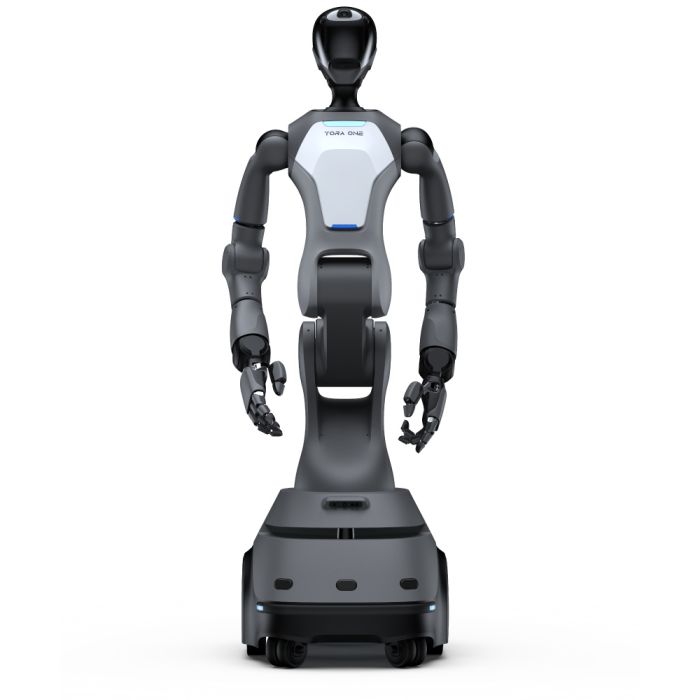
A shelf, a workbench and a parts bin rarely sit at the same height. A robot that cannot change its own stature spends much of its working day reaching for things it was never built to reach. The Paxini TORA ONE Multi-Dimensional Tactile Wheeled Humanoid Robot tackles that problem from two directions. Its deformable body folds at the waist to stand at 1.46 m and extends to 1.86 m. Its hands carry a dense skin of tactile sensors. The machine can therefore adjust both where it works and how firmly it holds what it finds there. It is a humanoid upper body on a navigating wheeled chassis, intended for tasks in which reach, touch and mobility all matter at once.
Robots Middle East supplies the Paxini TORA ONE to research institutions, system integrators and enterprises across the Middle East. Robots Middle East prepares each quotation, coordinates delivery to your site and provides the support that follows commissioning. Your project team has one point of contact from the first enquiry to routine operation.
Background
PAXINI and touch as a design principle
PAXINI builds its robotics around tactile perception. The company presents TORA ONE as the first multidimensional tactile humanoid robot in the embodied AI industry. It describes the robot's dexterous hand as the industry's first to integrate multidimensional tactile sensing and AI vision in a single dual-modal design. The emphasis is deliberate. In embodied AI, a robot learns to act in the physical world rather than only in simulation, and knowing what contact feels like is as valuable as knowing what an object looks like. A grasp that is checked by touch can be corrected while it is happening, rather than after something has slipped or been crushed.
The VTLA model and the dual-modal hand
The intelligence of TORA ONE is built on what PAXINI calls the VTLA-Model: Visual-Tactile-Language-Action. The name describes the chain the robot follows. It sees a scene and feels the objects it touches. It interprets instructions expressed in language and turns the result into action. The hardware gives that model rich input. Each hand has four fingers and 16 DOF, of which 13 are active and 3 passive, driven by coreless motors. Across the robot, 2280 ITPU multi-dimensional tactile sensing units deliver 6840 channels of tactile signal, and fingertip force is controlled to 0.01N. A camera in each hand adds a close view of what the fingers are doing, which supplies the visual half of the dual-modal design.
Technical Specifications
| Specification | Value |
|---|---|
| Product type | The First Multidimensional Tactile Humanoid Robot in Embodied AI industry |
| Height | Deformable structure, waist folded 1.46 m, extended 1.86 m |
| Body degrees of freedom (excluding dexterous hands) | 21 |
| Bimanual degrees of freedom | 32 |
| Fingers on each hand | 4 |
| Dexterous hand degrees of freedom (single hand) | 16 DOF (13 active + 3 passive) |
| Dexterous hand drive mode | Coreless motor |
| Fingertip force control | 0.01N high-precision force control |
| Tactile perception | 2280 ITPU multi-dimensional tactile sensing units |
| Number of tactile signals | 6840 channels |
| Visual capacity | 5 RGB cameras (3 in head + 1 in each hand) + 2 RGBD cameras (1 in head + 1 in chassis) |
| Single arm straight-arm load capacity (including dexterous hand) | Rated 5 kg |
| Maximum moving speed | 0.6 m/s |
| Maximum turning speed | 0.4 rad/s |
| Repeatability accuracy | 1.5 cm |
| Absolute accuracy | 3 cm |
| Heading angle error | 3 degrees |
| Obstacle crossing height | 2 cm |
| Ditch width | 2 cm |
| Climbing angle | 7 degrees |
| Navigation method | Laser SLAM autonomous navigation |
| Environment detection | SLAM navigation and LIDAR system, 5 HD cameras and 2 depth cameras, 360-degree all-around environment depth detection |
| AI model | VTLA-Model: Visual-Tactile-Language-Action |
| Charging time | 6 h |
| Endurance | 8 h |
Specifications are given as published by the manufacturer and are confirmed against the datasheet at quotation.
The manufacturer has not published the weight, the footprint dimensions, the power consumption, the onboard compute, the IP rating, the connectivity, the operating temperature or the contents of the box; each of these is confirmed at quotation.
How do touch and vision work together on the TORA ONE?
Cameras are good at finding an object and estimating its shape. They are far less reliable at judging how hard to squeeze it, whether it is beginning to slip, or whether a lid has seated properly. TORA ONE divides that labour. Five RGB cameras locate targets and map the surroundings: three in the head and one in each hand. Two RGBD cameras help with the same work, one in the head and one in the chassis. Once the fingers make contact, the tactile array takes over the fine judgement. It reports on 6840 channels and supports fingertip force control to 0.01N. The VTLA model combines both streams with language instructions, so a request to pick a particular item can be planned by sight and carried out by feel.
For a buyer, this widens the range of objects the robot can sensibly be asked to handle. Soft packaging, delicate components and irregularly shaped items are where vision-only grasping tends to struggle. They are also where a robot with a sense of touch has the most to offer.
What does the folding waist mean in day-to-day work?
Most wheeled manipulators have a fixed working envelope, and the site has to be arranged around it. TORA ONE's deformable structure spans 1.46 m folded to 1.86 m extended, so a single robot can address a low tote and a high shelf without a separate lift. The robot has 21 body degrees of freedom, excluding the hands, and 32 bimanual degrees of freedom. Together with the folding waist, they support two-handed work across a broader band of heights. Each arm is rated for a straight-arm load of 5 kg, including the dexterous hand.
The chassis is designed for prepared indoor floors. It moves at up to 0.6 m/s and turns at up to 0.4 rad/s. It crosses obstacles of 2 cm and ditches of 2 cm, and climbs inclines of 7 degrees. Laser SLAM autonomous navigation, backed by LIDAR and 360-degree depth detection, gives a repeatability accuracy of 1.5 cm, an absolute accuracy of 3 cm and a heading angle error of 3 degrees. An endurance of 8 h and a charging time of 6 h form the basis for planning the robot's duty cycle.
Who is the Paxini TORA ONE for?
The clearest fit is the embodied AI research community. This includes university laboratories, corporate research groups and national innovation programmes that need a complete platform combining mobility, two-handed manipulation and rich tactile data. Teams developing grasping algorithms will value the density of tactile signal and the close-range hand cameras. Teams working on language-driven robotics will find a ready framework in the VTLA model.
System integrators and enterprises running pilots in logistics, retail, light manufacturing and facility services form a second group. For them, the adjustable height and autonomous navigation matter as much as the hands. They can trial one machine across several stations before committing to a wider roll-out. Technology showrooms and visitor centres in the region may also see value in a humanoid that demonstrates touch-aware handling in front of an audience.
PAXINI also names a second version, the PaXini TORA DOUBLE ONE Lightweight Humanoid Robot. Buyers comparing the two can ask Robots Middle East to set the published figures side by side. Teams that need tactile manipulation on an existing arm, rather than a full mobile humanoid, may find a standalone hand such as the Paxini DexH13 Dexterous Robot Hand (DexH13) more appropriate. The wider ranges are listed under Wheeled Humanoids and Humanoids.
What is the Paxini TORA ONE used for?
- Embodied AI research: a complete platform for training and testing visual-tactile-language-action models in real environments.
- Tactile manipulation studies: dense fingertip sensing and fine force control for work on grasp stability and slip detection.
- Multi-level picking: the folding waist lets one robot reach low bins and higher shelves in the same task sequence.
- Handling delicate items: touch-guided grasping for soft, fragile or irregular objects that challenge vision-only systems.
- Service and demonstration: autonomous navigation and humanoid form suit showrooms, laboratories and visitor-facing settings.
- Data collection: synchronised camera and tactile streams for building datasets that improve manipulation learning.
Pricing and Availability
Robots Middle East supplies the Paxini TORA ONE on a quotation basis, so that each offer reflects your configuration, your site and the scope of your project. Delivery, customs clearance and support are arranged together with the quotation. To begin, please share your intended application and location. The team will confirm the datasheet figures and the specifications the manufacturer has not published. A quotation for the Paxini TORA ONE can be requested through the enquiry form available on this page.
Frequently Asked Questions
How tall is the Paxini TORA ONE?
The robot has a deformable structure. It stands at 1.46 m with the waist folded and 1.86 m when extended.
How much tactile sensing does the TORA ONE have?
It carries 2280 ITPU multi-dimensional tactile sensing units producing 6840 channels of tactile signal. Fingertip force control reaches 0.01N.
How does the TORA ONE navigate?
It uses laser SLAM autonomous navigation with a LIDAR system and 360-degree depth detection. Its repeatability accuracy is 1.5 cm and its absolute accuracy 3 cm.
How long does it operate between charges?
The manufacturer states an endurance of 8 h and a charging time of 6 h.
How much can each arm carry?
Each arm has a rated straight-arm load capacity of 5 kg, including the dexterous hand.
What AI model does the TORA ONE use?
It runs on PAXINI's VTLA-Model: Visual-Tactile-Language-Action. The model links what the robot sees and feels with language instructions and physical action.
Where can I buy the Paxini TORA ONE and what does it cost?
Robots Middle East supplies the Paxini TORA ONE across the Middle East. Pricing is provided by quotation, according to your configuration and delivery location. You can request it through the form on this page.
Summary
The Paxini TORA ONE is built for the reality that work is spread across different heights and different kinds of object. Its folding waist adjusts where the robot can reach. Its tactile hands, with thousands of sensing channels and fine fingertip force control, adjust how it holds what it reaches. Laser SLAM navigation carries it between stations, and the VTLA model ties sight, touch and language together. For research teams and enterprises in the Middle East exploring touch-aware humanoid manipulation, Robots Middle East handles quotation, delivery and support, and this page is the starting point.