
Pudu Flashbot Arm (FlashBot Arm)
In stock
- BRAND:
- PUDU ROBOTICS
- PART #:
- FlashBot Arm
- ORIGIN:
- China
- AVAILABILITY:
- SUBJECT TO AVAILABILITY
- SKU:
- Pudu-FlashBot-Arm
Pudu Flashbot Arm (FlashBot Arm)
Ask the operations manager of any building that already runs a delivery robot where the hidden cost lies, and the answer is seldom the robot itself. It is the member of staff who is called away to summon the lift, hold a door or tap a card at a reader so that the machine can carry on. The Pudu Flashbot Arm (FlashBot Arm) is designed to take that escort off the route. It joins an enclosed, dual-door delivery compartment to two liftable robotic arms fitted with PUDU DH11 dexterous hands, so that the robot can press lift buttons, swipe access cards and open doors for itself, in the building as it stands today, with no costly modifications needed.
Robots Middle East supplies the FlashBot Arm to hotels, healthcare facilities, corporate offices and other organisations across the Middle East. Our team prepares each quotation around your site, arranges delivery to your premises and remains your point of contact for support once the robot is in service, so that a single partner accompanies the project from first enquiry to daily operation.
Background
Pudu Robotics and Pudu X-Lab
Pudu Robotics is a service robot manufacturer whose machines are widely used for delivery and cleaning in hospitality, retail and commercial buildings. The FlashBot Arm was developed by Pudu X-Lab, the group's unit for more advanced robot concepts; you will find it alongside related machines in our X-Lab category, while the wider Pudu range is presented on its own page. Where earlier delivery robots from the industry were built to travel and carry, this project set out to add a further capability: physical interaction with an environment designed for human hands.
A delivery body with a humanoid upper half
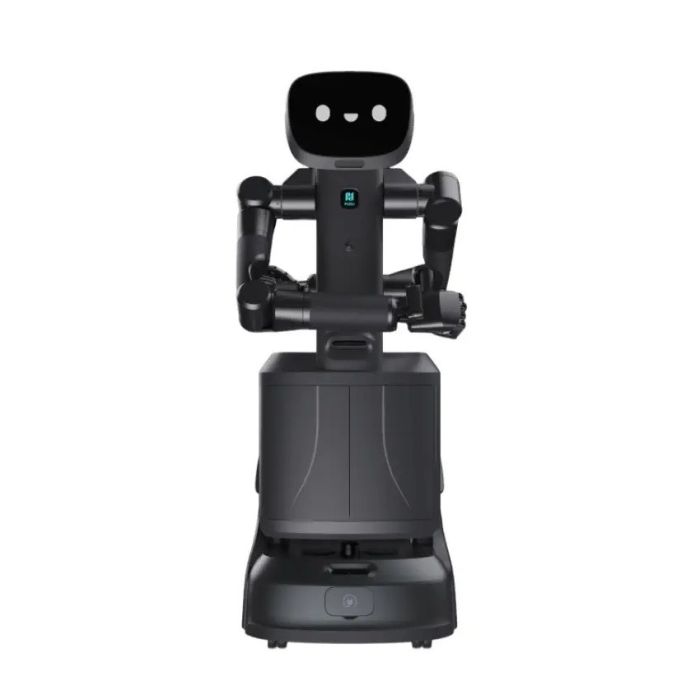
Pudu describes the FlashBot Arm as an innovative design combining specialised delivery capabilities with humanoid manipulation. The lower half is a wheeled delivery platform on an independent suspended chassis, carrying an enclosed compartment with a spacious dual-door design intended to meet safe delivery requirements. The upper half carries two robotic arms that can be lifted, each with seven degrees of freedom, and each ending in a PUDU DH11 dexterous hand with six active and five passive degrees of freedom, which supports precise operations. Perception comes from RGBD cameras, LiDAR, panoramic cameras and pressure-sensitive skin, giving the robot dynamic awareness of its surroundings. The result is a machine that moves like a delivery robot and works with its hands in the manner of a member of staff.
Technical Specifications
| Specification | Value |
|---|---|
| Developer | Pudu X-Lab |
| Machine dimensions | 539*515*1440mm(21.22*20.28*56.7 inches) |
| Weight | 70 kg |
| Capacity | 15kg(33.07 pounds) |
| Working duration | 8h (None load) |
| Mapping method | VSLAM + Lidar SLAM |
| Minimum width of path | 65 cm(25.59 inches) |
| Display screen | 10.1 inch Touch Screen |
| DOF of single arm and hand | Arm: 7 Hand: 6 Active + 5 Passive |
| Maximum reach range of both arms | 1600*2000*1600mm(63*78.7*63 inches) |
| Arms | Two liftable robotic arms, maximum operating diameter of 2 metres |
| Hands | PUDU DH11 dexterous hands |
| Sensors | RGBD cameras, LiDAR, panoramic cameras, pressure-sensitive skin |
| Chassis | Independent suspended chassis |
| Compartment | Enclosed, dual-door design |
| Connectivity | Ethernet, Wi‑Fi |
| Charging | Automatic return to the charging station when the battery is low |
| Fleet operation | Multi-robot collaboration with optimised task allocation and intelligent avoidance |
Specifications are as published by the manufacturer and are confirmed against the datasheet at quotation.
Pudu has not published the IP rating, the maximum speed, the battery capacity, the operating system or the contents of the box; Robots Middle East confirms these details at quotation.
What makes the FlashBot Arm different from a conventional delivery robot?
A conventional delivery robot is, in essence, a mobile container. It navigates well and carries reliably, but every barrier between the starting point and the recipient must be solved by something other than the robot: a networked lift, a motorised door, an integrated access system or a person standing by. Each of those solutions has a price, and in an occupied hotel, hospital or office tower the disruption of retrofitting is often as significant as the cost.
The FlashBot Arm approaches the problem from the opposite direction. Rather than asking the building to adapt, it uses its dual hands to press lift buttons, swipe access cards and open doors, exactly as a person would. The seven-degree-of-freedom arms and the DH11 hands give it the dexterity for these tasks, while the combined reach of both arms, published as 1600*2000*1600mm, allows it to work with controls mounted at the heights people normally use. Because the arms can be lifted, the robot can adjust its working height to the task in hand.
The pressure-sensitive skin is equally important. A robot that touches its environment must also sense contact, and the inclusion of this sensing layer alongside the cameras and LiDAR reflects a design intended for shared spaces rather than closed industrial cells. In short, the difference is not a faster or larger delivery robot, but a delivery robot that no longer depends on someone else to open the way.
How does the FlashBot Arm find its way through a building?
Navigation combines visual SLAM with LiDAR SLAM, so the robot builds and maintains its map from both camera and laser data. Panoramic cameras and RGBD cameras add depth and wide-angle perception, which supports the dynamic environmental awareness Pudu highlights for busy indoor spaces. The robot requires a minimum path width of 65 cm, a figure facility teams can check against corridors, doorways and lift cars during site planning.
The independent suspended chassis is designed to keep the platform steady as it travels, which matters when the compartment is carrying goods up to its rated capacity. When the battery runs low, the robot returns to its charging station automatically, so routine operation does not depend on staff remembering to plug it in. Where several units share a site, multi-robot collaboration provides optimised task allocation and intelligent avoidance in crowded environments, allowing a fleet to divide work sensibly rather than queuing at the same lift.
Who is the FlashBot Arm for?
The clearest fit is any organisation whose deliveries cross floors and controlled doors. Hotels can send amenities and orders to guest floors without assigning a porter to ride the lift. Hospitals and clinics can move supplies, documents and samples between departments while keeping staff at the bedside. Corporate offices and mixed-use towers, where access cards control lift lobbies and secure floors, can route internal mail and parcels without granting the robot a special integration into the security system.
A second group consists of facility managers in leased or historic buildings, where structural changes to lifts and doors are impractical or not permitted. For them, a robot that uses the existing controls removes the main obstacle to automation. A third group comprises innovation teams, universities and corporate research departments evaluating embodied AI in real service settings; the FlashBot Arm offers a working platform in which navigation and manipulation operate together. Buyers whose interest lies more broadly in humanoid and legged platforms are welcome to compare the other machines in our X-Lab category, and Robots Middle East will gladly advise on which design matches your site.
What is the FlashBot Arm used for?
- Hotel room service: carrying orders and amenities from the front desk or kitchen to guest floors, calling the lift itself.
- Hospital logistics: moving supplies and documents between wards and departments in an enclosed, dual-door compartment.
- Office mail and parcels: distributing internal post across floors served by card-controlled lift lobbies.
- Secure-area deliveries: swiping an access card to enter restricted floors or rooms without a human escort.
- Multi-floor fleet operation: sharing tasks among several units with optimised allocation and avoidance in crowded areas.
- Embodied AI pilots: giving research and innovation teams a platform that combines autonomous navigation with dexterous manipulation.
Pricing and Availability
The FlashBot Arm is supplied on a quotation basis, as the right configuration depends on your building, your routes and the number of units you plan to deploy. Robots Middle East reviews your requirements, confirms the published specifications against the current datasheet and prepares a proposal tailored to your site. Delivery, customs and support are arranged together with the quotation. To begin, simply share a brief outline of your premises and the tasks you have in mind; the quotation request is available on this page.
Frequently Asked Questions
Can the FlashBot Arm use a lift without any integration?
Yes. It presses lift (elevator) buttons with its dual hands, so no costly modifications to the lift system are needed.
How much can the FlashBot Arm carry?
The published capacity is 15kg(33.07 pounds), carried in an enclosed compartment with a dual-door design.
How long does it operate between charges?
Pudu publishes a working duration of 8h (None load). When the battery is low, the robot returns to its charging station automatically.
How narrow a corridor can it pass through?
The minimum path width is 65 cm(25.59 inches), which should be checked against doorways and lift cars during site planning.
Which sensors does the robot use?
It is equipped with RGBD cameras, LiDAR, panoramic cameras and pressure-sensitive skin, and it maps its environment using VSLAM + Lidar SLAM.
Can several FlashBot Arm units work in the same building?
Yes. Multi-robot collaboration provides optimised task allocation and intelligent avoidance in crowded environments.
Where can I buy the Pudu Flashbot Arm (FlashBot Arm) and what does it cost?
You can buy it from Robots Middle East, which supplies it across the Middle East. The cost depends on your configuration and deployment, so please request a quotation and our team will prepare a proposal for your site.
Summary
Most delivery robots still rely on a quiet human helper at every lift and door, and that dependency limits how far automation can really reach. The FlashBot Arm is built to retire that role: two liftable arms with DH11 dexterous hands, an enclosed dual-door compartment, combined visual and LiDAR mapping, pressure-sensitive skin and automatic recharging make it a robot that both carries the goods and opens the way. For hotels, healthcare facilities, offices and innovation teams across the Middle East that want automation without rebuilding their premises, Robots Middle East can scope, supply and support the deployment, and this page is the starting point.