
Pudu PUDU T300 Conveyor-D
In stock
- BRAND:
- PUDU ROBOTICS
- PART #:
- PUDU T300 Conveyor-D
- ORIGIN:
- China
- AVAILABILITY:
- SUBJECT TO AVAILABILITY
- SKU:
- Pudu-PUDU-T300-Conveyor-D
Pudu PUDU T300 Conveyor-D
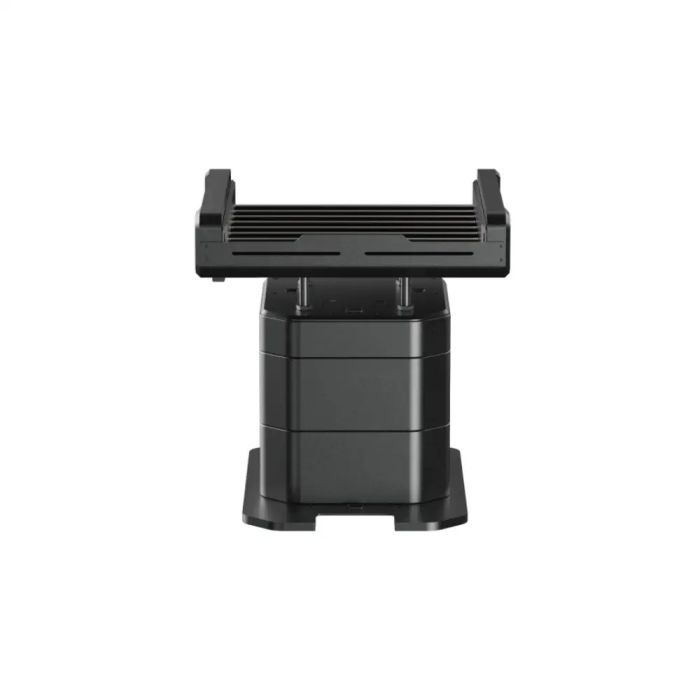
Walk through almost any production hall and you will find a conveyor that appears on no drawing: an operator pushing a trolley of parts from one cell to the next, lifting each carton off at one end and setting it down on a roller bench at the other. That route is flexible, but it is slow, it is tiring and it depends on someone being free at exactly the right moment. The Pudu PUDU T300 Conveyor-D is designed to take over this unrecorded route. It is an autonomous mobile robot whose upper body is itself a powered conveyor, so it can receive a load at one station, travel to another and pass the load across without anyone lifting it.
Robots Middle East sells the PUDU T300 Conveyor-D and supplies it to manufacturers, logistics operators and system integrators across the Middle East. Our team prepares the quotation, coordinates delivery to site and provides after-sales support. We are also glad to advise on which conveyor version suits a particular material flow before any order is placed.
Background
PUDU ROBOTICS and the move into industry
PUDU ROBOTICS built its reputation on service robots for restaurants, hotels and commercial buildings, with delivery and cleaning machines that navigate busy public spaces on their own. The T300 series carries that experience into industrial settings. There, loads are heavier, aisles are shared with forklifts and pedestrians, and a robot must hand material to fixed equipment rather than to a waiting guest. The T300 series meets ISO 3691-4 guidelines for industrial vehicles. This is the international standard that addresses the safety of driverless industrial trucks, and it is the reference point many plant safety officers will ask about first.
A conveyor deck rather than a shelf
Many mobile robots carry loads on a fixed platform and rely on a person, or a separate mechanism, to take them off. The T300 Conveyor family instead carries its own powered conveyor. The conveyor width is adjustable from 4.7–21.3 in (120-540 mm), so the deck can be matched to the totes, cartons or trays a site actually uses. The conveyor depth is 25.6 in (650 mm), and the conveyor sits at a ground clearance of at least 12 in (305mm). That height determines how the robot lines up with roller benches and fixed lines. Docking accuracy of ±0.4 in (±10 mm), ±1° allows the deck to meet a station squarely. Integrated PLC communication lets the robot and the station exchange notifications for automated material pickup and delivery, so a transfer can start without a person pressing a button.
Technical Specifications
| Specification | Value | Applies to |
|---|---|---|
| Product versions | Single Layer Version; Double Layer Version | T300 Conveyor |
| Number of layers | 2 | Double Layer Version |
| Machine weight | 265 lbs (120 kg) | Single Layer Version |
| Machine weight | 397 lbs (180 kg) | Double Layer Version |
| Run-time (no load) | 10 h | Double Layer Version |
| Run-time (full load) | 8 h | Double Layer Version |
| Rated load per layer | 176 lbs/layer, 80 kg/layer | T300 Conveyor |
| Dimensions (front/rear) | 32.9×26.2×53.1 in (835*665*1350 mm) | T300 Conveyor |
| Dimensions (left/right) | 32.9×25.6×53.1 in (835*650*1350 mm) | T300 Conveyor |
| Conveyor depth | 25.6 in (650 mm) | T300 Conveyor |
| Conveyor width | 4.7–21.3 in (120-540 mm) adjustable | T300 Conveyor |
| Conveyor height | Ground clearance ≥ 12 in (305mm) | T300 Conveyor |
| Path clearance | 29.5 in (75 cm) | T300 Conveyor |
| Docking accuracy | ±0.4 in (±10 mm), ±1° | T300 Conveyor |
| Charging time | 2 h(0-90%) | T300 Conveyor |
| Safety standard | Meets ISO 3691-4 guidelines for industrial vehicles | T300 series |
| Connectivity | Integrated PLC communication for automated material pickup/delivery notifications | T300 Conveyor |
Specifications are as published by the manufacturer and are confirmed against the datasheet at quotation.
The manufacturer has not published the battery capacity, the weight of the conveyor module, the IP rating, the operating temperature range, the conveyor belt speed or the contents of the box; all of these are confirmed at quotation.
What does the Double Layer Version change compared with the Single Layer Version?
The T300 Conveyor is offered in two builds, and the choice between them is essentially a choice about how much each journey should carry. The Double Layer Version has two conveyor decks, each rated at 176 lbs/layer, 80 kg/layer. A single trip can therefore serve two transfer heights, or carry two separate consignments, such as outbound parts on one deck and returning empties on the other. In a flow where the robot would otherwise travel back empty, this can noticeably reduce the number of journeys a shift requires.
The second deck comes with consequences that a planner should weigh. The Double Layer Version has a machine weight of 397 lbs (180 kg), against 265 lbs (120 kg) for the Single Layer Version. That matters for mezzanines, lifts and floor loading. Its run-time is 10 h with no load and 8 h at full load. Combined with a charging time of 2 h(0-90%), this gives a clear basis for planning shifts and charging windows. The Single Layer Version suits flows in which every station works at one transfer height and loads travel one at a time; its lower weight makes it the simpler fit where the floor or the route is constrained.
How does the T300 Conveyor-D hand loads over to fixed lines?
A transfer between a mobile robot and a fixed conveyor succeeds or fails on alignment. If the deck arrives a little too far to one side or at an angle, a carton can catch on a roller frame or stop halfway across. The docking accuracy of ±0.4 in (±10 mm), ±1° is the figure that addresses this, and it is the one an integrator will compare with the tolerance of the receiving equipment.
Height and width are the other two dimensions of a good handover. With a ground clearance of at least 12 in (305mm), the conveyor height can be checked against existing benches and lines during the site survey. The adjustable width of 4.7–21.3 in (120-540 mm) allows the deck to be set to the load rather than the load being repacked to suit the robot. Finally, integrated PLC communication tells the station when material is ready for collection and when a delivery has arrived. The handover therefore becomes a coordinated step in the line instead of a moment that needs a person to watch over it.
Who is the PUDU T300 Conveyor-D for?
The most natural buyers are manufacturers whose production cells are linked by repetitive trolley runs: assembly plants moving kits to workstations, electronics and component producers shuttling trays between process steps, and packaging operations collecting finished cartons for palletising. Warehouse and distribution operators are a second group, particularly where totes move between picking, consolidation and dispatch areas that are too far apart, or change too often, for a fixed conveyor to be economical.
System integrators form a third group. For them, the PLC communication and the defined docking accuracy are what allow the robot to be written into a wider automation design. Facilities with narrow routes should note the path clearance of 29.5 in (75 cm) when mapping aisles. Where every station works at one height and loads travel singly, the Single Layer Version is likely the better match. Where two decks per trip would remove return journeys, the Double Layer Version earns its extra weight. Other autonomous machines from the same manufacturer can be found in our Pudu category.
What is the PUDU T300 Conveyor-D used for?
- Line-side replenishment: delivering kitted components from a store to assembly stations and transferring them directly onto the line.
- Work-in-progress transfer: moving trays between process steps whose stations exchange PLC signals with the robot.
- Finished-goods collection: picking up cartons at the end of a packing line and taking them to a palletising or staging area.
- Tote circulation in warehouses: linking picking, consolidation and dispatch zones without a permanent conveyor between them.
- Two-way runs: using the Double Layer Version to carry full loads out and empty containers back on the same journey.
- Bridging conveyor gaps: connecting separate fixed conveyor sections where a permanent link would block an aisle or a walkway.
Pricing and Availability
Robots Middle East supplies the PUDU T300 Conveyor-D on a quotation basis, so that the version, the conveyor width setting and the integration requirements of your site are reflected in the offer. Delivery, customs clearance and after-sales support are arranged together with the quotation. To begin, please share a short description of your stations, loads and routes using the quotation request available on this page.
Frequently Asked Questions
How much can each conveyor layer carry?
The rated load is 176 lbs/layer, 80 kg/layer. The Double Layer Version has two layers.
How long does the Double Layer Version run on a charge?
Its run-time is 10 h with no load and 8 h at full load. Charging takes 2 h(0-90%).
Can the conveyor be adjusted to different load sizes?
Yes. The conveyor width is adjustable from 4.7–21.3 in (120-540 mm), with a conveyor depth of 25.6 in (650 mm).
How accurately does the robot dock at a station?
Docking accuracy is ±0.4 in (±10 mm), ±1°. This is the figure to compare with the tolerance of your fixed conveyor or bench.
Does it work with our existing automation?
The robot has integrated PLC communication for automated material pickup and delivery notifications. The specific interface to your controllers is reviewed during the quotation.
Which safety standard does the T300 series meet?
The T300 series meets ISO 3691-4 guidelines for industrial vehicles. The supporting documentation is confirmed with the quotation.
Where can I buy the PUDU T300 Conveyor-D and what does it cost?
You can buy it from Robots Middle East, which supplies it across the Middle East. The cost depends on the version and the scope of integration, so it is set out in a tailored quotation that you can request on this page.
Summary
Every facility that moves material by trolley already runs a conveyor; it simply runs on people. The PUDU T300 Conveyor-D replaces that invisible line with one that can be planned: a powered deck with adjustable width, docking accuracy measured in millimetres and PLC signals that let stations and robot coordinate each handover. It comes in a Single Layer Version for simpler flows and a Double Layer Version that carries two decks per trip, and both are built on a series that meets ISO 3691-4 guidelines. Robots Middle East quotes, delivers and supports it across the region. For any team ready to take the trolley out of the process, this page is the starting point.