
Pudu PUDU T300 Lifting
In stock
- BRAND:
- PUDU ROBOTICS
- PART #:
- PUDU T300 Lifting
- ORIGIN:
- China
- AVAILABILITY:
- SUBJECT TO AVAILABILITY
- SKU:
- Pudu-PUDU-T300-Lifting
Pudu PUDU T300 Lifting
Between the hand-pushed trolley and the forklift lies a gap that most facilities fill with people: a shelf that is too heavy and travels too often to push by hand, yet is far too ordinary to justify a fork truck and a licensed driver. The Pudu PUDU T300 Lifting is built for that gap. It does not try to be a larger deck on wheels. It drives beneath the shelf you already own, raises it and takes it to where it is needed, then returns for the next one. Its carrying capacity is defined less by the robot itself than by the rack it lifts.
Robots Middle East supplies the PUDU T300 Lifting to warehouses, production sites, hospitals, hotels and other large facilities across the Middle East. Our team prepares each quotation for the specific site, advises on the routes, doors and lifts the robot will need to use, and remains your point of contact for delivery, commissioning and after-sales support.
Background
Pudu Robotics and the T300 platform
Pudu Robotics is known internationally for service robots that work alongside people, from restaurant delivery units to commercial cleaning machines; the wider range is presented in our Pudu category. The T300 carries that experience into heavier internal logistics. The platform comes in two versions: the PUDU T300 Standard (model WTID01) and the PUDU T300 Lifting (model WTIDL1). The lifting function is available only on the WTIDL1. Both share the same underlying platform, built around a high-strength load-bearing chassis with an interactive touchscreen and an open, scalable architecture.
Borrowing the carrying space from the rack
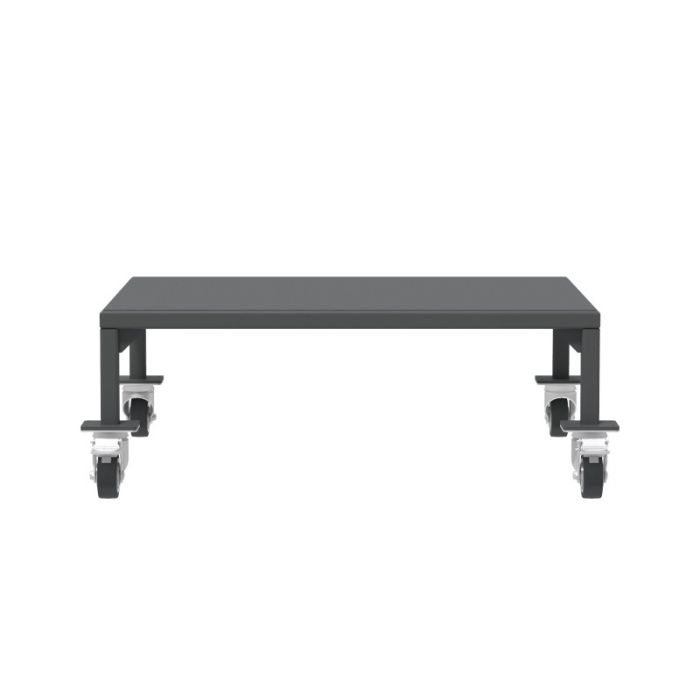
The central idea of the Lifting version is simple. Its chassis is designed to fit under a shelf and lift it up, so that during lifting tasks the robot carries a rack offering a larger carrying space than its own chassis. Instead of loading goods onto the robot, staff load the rack, and the robot handles the movement. This separates two tasks that are usually bundled together, preparing goods and moving them, and allows each to be carried out at its own pace. Navigation relies on VSLAM+ combined with LiDAR, which allows the robot to adapt to changing layouts without a complex set-up process.
Technical Specifications
| Specification | Value |
|---|---|
| Model | WTIDL1 (version with lifting function) |
| Overall weight | 81 kg |
| Battery capacity | 30 Ah |
| Battery life | 8 hours |
| Charging | Fast charging in 2 hours |
| Operating modes | Delivery mode, Cruise mode, Lifting mode |
| Navigation | VSLAM+ and LiDAR |
| Path clearance | 60 cm |
| Thresholds | 20 mm |
| Grooves | 35 mm |
| Interface | Interactive touchscreen |
| IoT integration | Elevator and e-gate control, app-based and pager calling, API interfaces |
| Cross-space functions | Elevator access, gate/turnstile integration, remote call |
| Manual assist | Electric power-assist system for hand-pushing |
| Hardware ports | External power and USB ports |
Specifications as published by the manufacturer; confirmed against the datasheet at quotation.
The manufacturer has not published the dimensions of the Lifting version, its lifting height, lifting payload or lifting speed, its IP rating, its operating temperature range or the contents of the box; Robots Middle East confirms these with you at quotation.
What does the Lifting version add to the PUDU T300?
Both T300 versions share the same platform: the 30 Ah battery, eight hours of operation, two-hour fast charging, VSLAM+ and LiDAR navigation, and the same set of elevator, gate and calling functions. What the WTIDL1 adds is the mechanism that lets the chassis slide beneath a shelf and raise it, together with the Lifting mode that puts this mechanism to work. The difference also shows in the weight: the Lifting version weighs 81 kg, while the Standard WTID01 weighs 65 kg.
In practical terms, the choice comes down to how goods are presented at the start of each journey. If staff place items directly onto the robot and remove them at the destination, the Standard version covers that workflow. If goods already sit on shelves or racks that need to move as a unit, for example kitted parts, linen, supplies or prepared orders, the Lifting version removes the loading step altogether, because the rack itself becomes the load.
How does the PUDU T300 Lifting move through a multi-floor building?
A lifting robot is only useful if it can reach the places where its racks are needed, and those places are rarely on one open floor. The T300 platform supports elevator access and gate or turnstile integration, and its IoT capabilities include elevator and e-gate control. Journeys can therefore cross floors and controlled entrances without someone accompanying the robot. It passes through corridors with a path clearance of 60 cm and crosses 20 mm thresholds and 35 mm grooves, which covers many of the door sills and floor joints found in older buildings.
Tasks can be triggered remotely, through app-based or pager calling, so staff at the destination can summon a rack instead of walking to collect it. API interfaces allow integration with existing systems, and external power and USB ports give integrators hardware connection points. When a person needs to take over, whether for a one-off task or while generating the site map, the electric power-assist system makes hand-pushing the robot easier.
Who is the PUDU T300 Lifting for?
The clearest fit is any operation that already moves goods on shelves or racks and sends staff on repetitive runs with them. Manufacturing sites with line-side supply, distribution and fulfilment centres handling internal transfers, and large back-of-house operations in hotels, hospitals and shopping centres all share this pattern. For facility managers in multi-storey buildings, the elevator and gate integration is often the deciding factor, because it allows a single robot to serve several floors.
Systems integrators and IT teams will value the API interfaces and calling options, which let the robot respond to requests from existing software rather than functioning as an isolated device. Operations where goods are loaded item by item onto the robot, with no shelving involved, may find that the PUDU T300 Standard meets the requirement without the lifting mechanism; Robots Middle East can advise on which version suits your workflow.
What is the PUDU T300 Lifting used for?
- Line-side supply: moving racks of components from storage to production cells on demand.
- Warehouse transfers: shuttling shelves between receiving, storage and dispatch zones.
- Hospital logistics: carrying racks of supplies, linen or consumables between departments and floors.
- Hotel back-of-house: transporting housekeeping and stores shelving through service corridors and lifts.
- Order consolidation: bringing prepared order racks to packing or collection points.
- Scheduled cruising routes: running repeated circuits in Cruise mode to collect or distribute along a fixed path.
Pricing and Availability
Robots Middle East quotes the PUDU T300 Lifting for each project, as the right configuration depends on your racks, routes, lifts and system integration. Delivery, customs clearance and support are arranged with your quotation. To begin, share a brief description of your site and the journeys you want to automate, and our team will respond with a tailored proposal. The quotation request form for the PUDU T300 Lifting is available on this page.
Frequently Asked Questions
What is the difference between the WTIDL1 and the WTID01?
The WTIDL1 is the PUDU T300 Lifting, the only model with the lifting function. The WTID01 is the PUDU T300 Standard, which shares the platform but does not have the lifting mechanism.
How does the robot carry a shelf?
Its chassis is designed to fit under the shelf and lift it up. This allows it to carry a rack that offers a larger carrying space than the chassis itself.
How long does the battery last?
The T300 offers an eight-hour battery life from its 30 Ah battery and supports fast charging in two hours.
Can the robot use lifts and pass through gates?
Yes. The T300 supports elevator access and gate/turnstile integration, along with elevator and e-gate control as part of its IoT capabilities.
Does the robot need a complex set-up when the layout changes?
Its VSLAM+ and LiDAR navigation system is designed to adapt to changing layouts without a complex set-up.
Can the robot be pushed by hand when needed?
Yes. When manual intervention is required for specific tasks or for map generation, an electric power-assist system makes hand-pushing easier.
Where can I buy the PUDU T300 Lifting and what does it cost?
You can buy the PUDU T300 Lifting from Robots Middle East, which supplies and supports it across the Middle East. The cost depends on your configuration and project, so please request a quotation on this page.
Summary
The PUDU T300 Lifting addresses the work that falls between pushing by hand and driving a forklift: the steady, repetitive movement of shelves that occupies staff throughout the day. Rather than offering a larger deck, it lifts the racks you already use and carries them through corridors, gates and lifts, guided by VSLAM+ and LiDAR and powered for an eight-hour shift. Robots Middle East shapes each proposal around your site, your racks and your routes. If moving your shelves is costing your team time, this page is the starting point.