
Pudu PUDU T300 Tray
In stock
- BRAND:
- PUDU ROBOTICS
- PART #:
- PUDU T300 Tray
- ORIGIN:
- China
- AVAILABILITY:
- SUBJECT TO AVAILABILITY
- SKU:
- Pudu-PUDU-T300-Tray
Pudu PUDU T300 Tray
A lift door opens on the third floor and nobody steps out. What appears instead is a stack of loaded shelves, rolling towards the department that requested them, having called the lift, ridden it and left it without anyone pressing a button. That is the working picture behind the Pudu PUDU T300 Tray: an autonomous transport robot that carries its load on adjustable layers rather than on a single flat deck. It is built for buildings where goods must travel between floors, zones and departments many times a day. It does not replace the people who prepare the goods or the people who receive them. It removes the journey in between, and with it the hours that skilled staff lose to carrying.
Robots Middle East sells and supplies the Pudu PUDU T300 Tray to organisations across the Middle East, from manufacturing and logistics sites to hospitals, hotels and large commercial buildings. Each quotation from Robots Middle East is prepared around your site, covering the robot and its configuration, delivery to your premises and the after-sales support that follows. You therefore deal with one partner from the first enquiry to day-to-day operation.
Background
Pudu Robotics and the T300 Series
Pudu Robotics is widely known for service robots that work alongside people in public and commercial spaces, notably delivery robots for restaurants and hotels and autonomous cleaning machines. The T300 Series takes that experience into heavier internal logistics. The series consists of the Standard, Lifting, Conveyor, Tray and Towing versions, a family of transport robots that share a common chassis but differ in how they hold or move their load. A buyer can therefore choose the version that suits the task without changing the underlying platform, its navigation or its fleet software. The wider Pudu range offered by Robots Middle East can be explored in the Pudu category.
The tray version and its modular structure
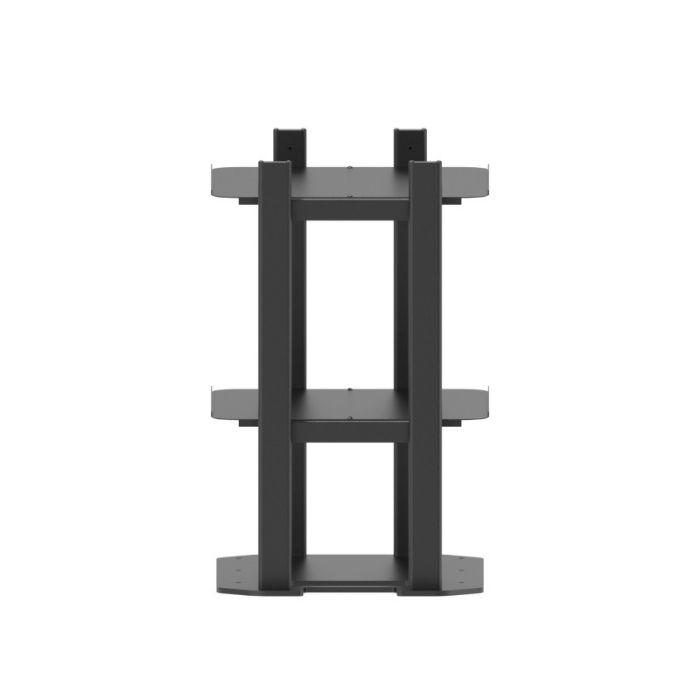
The Tray version is the member of the family designed for goods that are better carried in separate tiers than piled on one surface. Its multi-layer adjustable structure optimises the load capacity of the robot: rather than one deep platform, the load is divided across levels, each with its own permitted weight. The design is modular and allows tool-free installation and disassembly, which meets the need for rapid switching between scenarios. In practice, this means the tray structure can be fitted or removed without workshop equipment when a site's requirements change, so the robot is not tied permanently to a single type of load.
Technical Specifications
| Specification | Value |
|---|---|
| Machine weight | 103kg |
| Loading capacity | 300kg |
| Total maximum load | 300 kg (661 lbs) (including the tray) |
| Maximum load per layer | 100 kg (220 lbs) |
| Load space dimensions | 620 mm × 500 mm (24.4 in × 19.7 in) |
| Layer height (from bottom to top) | 300 mm (11.8 in) / 400 mm (15.7 in) / 400 mm (15.7 in) |
| Maximum speed | 1.2m/s |
| Path clearance | ≥60cm |
| Threshold overcoming height | 20mm |
| Run-time (full load) | 8h |
| Run-time (no load) | 12h |
| Charging time | 2h (0% to 90%) |
| Dimensions (T300 Series table) | 835mm * 500mm * 1350mm |
| Navigation methods | VSLAM & Lidar SLAM |
| Multi-robot scheduling | Dispatch up to 20 robots in one environment |
| IoT and integration | Elevator control, e-gate access, pagers, app-based calling, software API interfaces |
Specifications as published by the manufacturer; confirmed against the datasheet at quotation.
The manufacturer has not published the material grade of the tray body, the operating temperature range of the Tray version, the IP rating, the connectivity standards, the noise level or the contents of the box; Robots Middle East confirms these with you at quotation.
How does the Tray version differ from other T300 versions?
All T300 versions share the same purpose, moving goods autonomously through a building, but the Tray version answers a particular question: how should a mixed or fragile load be arranged while it travels? A single deck invites stacking, and stacking invites crushed cartons, toppled containers and time spent sorting at the destination. The Tray version separates the load into layers, with layer heights of 300 mm (11.8 in) at the bottom and 400 mm (15.7 in) for each of the two levels above. Each layer accepts up to 100 kg (220 lbs), within a total maximum load of 300 kg (661 lbs) including the tray.
That arrangement changes the work at both ends of the journey. At the loading point, staff can assign one layer per destination, per order or per type of item, so the robot leaves already organised. At the receiving point, people take what belongs to them from a known level without searching through a pile. The load space of 620 mm × 500 mm (24.4 in × 19.7 in) on each layer suits standard containers, kits and cartons. The robot weighs 103kg itself, which is part of what gives it a stable base for a full, multi-tier load.
Performance on the move remains that of a T300: a maximum speed of 1.2m/s, a path clearance requirement of ≥60cm, and a threshold overcoming height of 20mm for door sills and floor transitions. Run-time is 8h at full load and 12h with no load, and charging from 0% to 90% takes 2h, which allows planning around shifts rather than around the battery.
Can the PUDU T300 Tray work alongside lifts, doors and other robots?
A transport robot is only as useful as the building lets it be. The T300 navigates using VSLAM and Lidar SLAM, combining visual and laser mapping to locate itself and plan its route through corridors, production halls and storerooms. Beyond navigation, its IoT capabilities support elevator control, e-gate access, pagers, app-based calling and software API interfaces. This is what turns the lift scene in the opening into routine: the robot can request a lift, pass through access-controlled gates and respond when staff call it from a pager or an app.
The software API interfaces matter to organisations that already run warehouse, production or facility management systems, since transport tasks can be linked to those systems rather than handled as a separate island. For larger operations, up to 20 robots can be dispatched in one environment, so a site can begin with a single Tray unit and add further robots, including other T300 versions, as the workload grows. Robots Middle East reviews the lifts, gates and software on your site as part of the quotation, so that the integration scope is clear from the outset.
Who is the Pudu PUDU T300 Tray for?
The Tray version suits operations whose loads are numerous, mixed and destined for different recipients. Manufacturing plants that supply assembly lines with kits of parts are a natural fit: each layer can hold the components for one station or one batch. Warehouses and distribution centres that move picked orders, returns or replenishment between zones benefit from the same separation. Hospitals and laboratories that transport supplies, linen or sample containers between departments value orderly layers and the ability to use lifts without a porter. Hotels, office campuses and large commercial buildings can use it for back-of-house movement of supplies, amenities and post.
Where a task looks different, another member of the series may suit it better. If the work consists of moving existing racks, pulling carts or transferring goods directly onto other equipment, the Lifting, Towing or Conveyor versions of the T300 deserve comparison, while the Standard version offers the base platform. Robots Middle East can advise on which version matches your workflow before you commit.
What is the Pudu PUDU T300 Tray used for?
- Line-side kitting: carrying sorted parts to production stations, one layer per station or batch.
- Order consolidation: moving picked orders from picking zones to packing or dispatch areas without mixing them.
- Hospital logistics: transporting supplies and materials between wards, stores and laboratories, including by lift.
- Back-of-house hospitality: delivering linen, amenities and supplies between storerooms and service floors.
- Inter-floor transport: sending goods between levels of a building using elevator control and e-gate access.
- Tool and material runs: bringing tools, consumables and spares to workshops and maintenance areas on demand.
Pricing and Availability
The investment in a Pudu PUDU T300 Tray depends on the configuration, the number of robots, the integration with lifts, gates and software, and the support your operation requires, so Robots Middle East prepares a quotation for each project rather than publishing a single figure. Delivery, customs clearance and after-sales support are arranged together with your quotation. To begin, share a short description of your site and the transport tasks you wish to automate, using the quotation request available on this page.
Frequently Asked Questions
How much can the Pudu PUDU T300 Tray carry?
The total maximum load is 300 kg (661 lbs), including the tray. Each layer carries up to 100 kg (220 lbs).
Can the tray structure be removed or changed?
Yes. The modular design allows tool-free installation and disassembly, so the robot can be switched between scenarios quickly.
How does the robot find its way around the building?
It uses VSLAM and Lidar SLAM navigation. Robots Middle East helps with the mapping of your site during deployment.
Can it use lifts and pass through access gates?
The T300 supports elevator control and e-gate access, as well as pagers, app-based calling and software API interfaces. The integration with your specific lifts and gates is assessed at quotation.
How long does it run between charges?
Run-time is 8h at full load and 12h with no load. Charging from 0% to 90% takes 2h.
Can several robots work together on one site?
Yes, up to 20 robots can be dispatched in one environment. This allows a fleet to grow step by step as demand increases.
Where can I buy the Pudu PUDU T300 Tray and what does it cost?
You can buy it from Robots Middle East, which supplies the robot across the Middle East. The cost depends on your configuration and integration needs, so please request a tailored quotation on this page.
Summary
The lift that opens on an empty corridor, apart from a set of loaded shelves, captures what the Pudu PUDU T300 Tray offers: goods that arrive organised, layer by layer, without someone walking beside them. Its multi-layer adjustable structure, tool-free modularity, VSLAM and Lidar SLAM navigation and building integration make it a practical choice for sites where mixed loads travel between floors and departments throughout the day. Robots Middle East supplies, delivers and supports it across the region, and for any organisation ready to take the carrying out of its staff's working day, this page is the starting point.