
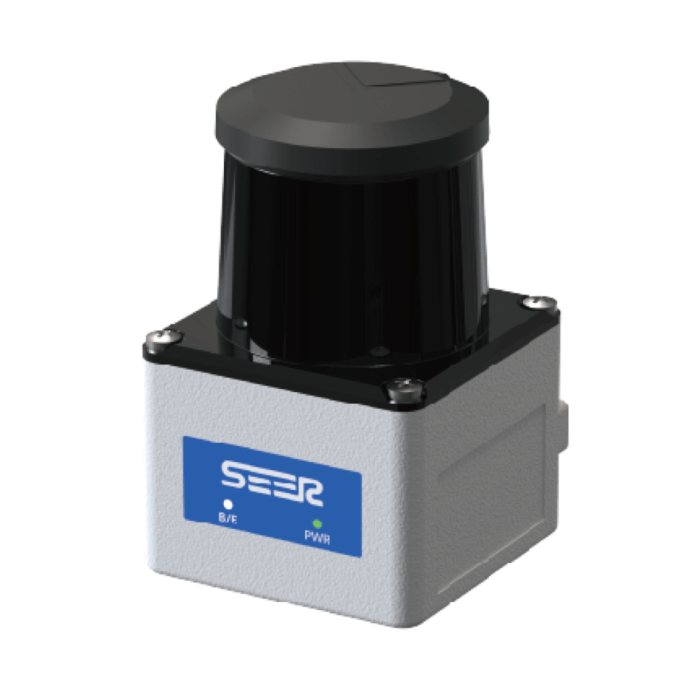
SEER Robotics 2D Obstacle Avoidance Lidar (C214)
In stock
- BRAND:
- SEER ROBOTICS
- MODEL:
- C214
- PART #:
- C214
- ORIGIN:
- China
- Warranty:
- 12 MONTHS
- AVAILABILITY:
- SUBJECT TO AVAILABILITY
- SKU:
- SEER-Robotics-C214
SEER Robotics 2D Obstacle Avoidance Lidar (C214)
At the end of a warehouse aisle, a mobile robot faces two problems at once. It must notice a pallet edge or a pair of safety boots a few centimetres from its bumper, and it must already be aware that a forklift is turning in at the far end of the row. The SEER Robotics 2D Obstacle Avoidance Lidar (C214) is built for that double duty: a single compact scanner measuring from 0.05 m out to 25 m, reporting over Ethernet, with a scanning precision of ±3 cm. It is the kind of component that rarely appears in a brochure photograph, yet it decides how confidently a machine can move among people, racking and goods.
Robots Middle East supplies the C214 to robot builders, system integrators, research teams and operators of automated fleets across the Middle East. Robots Middle East prepares the quotation, arranges delivery to the site or to the integration workshop, and remains the point of contact for technical questions once the sensor is fitted, so that a project team works with one regional partner from specification through to commissioning.
Background
SEER Robotics and the Robot Brain
SEER Robotics (06106.HK) is a platform-based embodied intelligent robotics company built around what it calls the Robot Brain, and it serves more than 2,500 customers worldwide with intelligent robotics solutions. Its portfolio extends from sensors such as the C214 to complete autonomous vehicles, including counterbalance trucks and forklifts for material handling. That breadth is relevant to anyone buying a single lidar: the C214 comes from a manufacturer that designs and deploys whole autonomous machines, and therefore understands the conditions in which an obstacle sensor has to perform day after day.
A sensor dedicated to obstacle avoidance
Two-dimensional lidar sensors sweep a laser across a single plane and measure the distance to whatever the beam meets. On mobile robots they generally serve two purposes: localisation and mapping on the one hand, and detecting obstacles so that the vehicle can slow, stop or steer around them on the other. SEER positions the C214 for the second role, as its name makes clear. The design priorities follow from that brief: a compact housing of 50 x 50 x 77 mm, a weight of about 130 g, power consumption of ≤3 W and an M12 circular connector for seamless interchangeability and enhanced maintainability.
Technical Specifications
| Specification | Value |
|---|---|
| Model | C214 |
| Product type | 2D LiDAR Sensor, measuring range up to 25 m, Ethernet |
| Dimensions (L x W x H) | 50 x 50 x 77 mm |
| Weight | About 130 g |
| Measurement range | 0.05 m to 25 m |
| Scanning precision | ±3 cm |
| Power consumption | ≤3 W |
| Working temperature | -10°C to 50°C |
| Storage temperature | -30°C to 70°C |
| Connector | M12 circular connector |
| Manufacturer | SEER Robotics (06106.HK) |
Specifications are as published by the manufacturer and are confirmed against the datasheet at quotation.
SEER Robotics has not published the supply voltage, the details of the Ethernet interface, the response time, the contents of the box, software compatibility or the length of the connector cable; Robots Middle East confirms each of these at quotation.
What makes the C214 suited to obstacle avoidance on mobile robots?
Obstacle avoidance asks a sensor to be useful at both ends of its range. Close to the vehicle, the robot needs to know that something is there at all, even when it is almost touching the chassis; the C214 begins measuring at 0.05 m, which leaves very little blind space immediately around the mounting point. Further out, the robot needs warning early enough to reduce speed smoothly rather than brake hard, and the C214 continues measuring to 25 m. Between those limits, a scanning precision of ±3 cm gives the controller distances it can act upon with confidence when it calculates safe stopping and slowdown behaviour.
Equally important is what the sensor does not demand. Obstacle sensors are frequently fitted in multiples — at the front, at the rear, or at the corners of a vehicle — and every one of them draws power, adds weight and occupies space. At ≤3 W and about 130 g, the C214 places a light load on the battery and the chassis, which makes it practical to add sensing coverage without redesigning the power budget of the robot. The Ethernet connection brings its data into the same network that many robot controllers already use for other devices.
How does the C214 fit into an existing robot design?
Integration is often where sensor projects lose time, and several characteristics of the C214 address that directly. The 50 x 50 x 77 mm housing can be accommodated in a bumper recess, a corner bracket or a mast without a large cut-out in the bodywork. The M12 circular connector is a familiar, robust standard in industrial automation; SEER chose it for seamless interchangeability and enhanced maintainability, which in practice means that a technician can disconnect one unit and connect a replacement without rewiring the harness.
The environmental figures deserve attention in this region. The C214 has a working temperature range of -10°C to 50°C and a storage range of -30°C to 70°C. Air-conditioned warehouses, factories and laboratories sit comfortably within the working range, while sheltered loading bays and unconditioned facilities during the summer months should be assessed at the design stage, together with the heat generated inside the robot itself. Robots Middle East is glad to discuss the intended installation when preparing the quotation.
Who is the SEER Robotics 2D Obstacle Avoidance Lidar (C214) for?
The first group is manufacturers and builders of autonomous mobile robots and automated guided vehicles who need a dedicated obstacle sensor that is small, light and economical with power. For them, the C214 can sit alongside the primary navigation sensor and take responsibility for what lies in the vehicle's path.
The second group is system integrators who adapt or retrofit vehicles for warehouses and production lines, including projects in logistics robots and factory robots. Here the M12 connector and the compact housing simplify installation on existing platforms, and interchangeability helps when a fleet has to be kept in service with minimal downtime.
The third group is universities, research centres and engineering teams developing their own robots, for whom a clearly stated range and precision make the C214 a straightforward reference sensor for experiments in perception and motion planning. Finally, operators of established fleets may value the C214 as a spare part that can be exchanged quickly by maintenance staff.
Buyers whose principal requirement is localisation and mapping rather than obstacle detection may also wish to consider the separately listed SEER Robotics 2D Navigation Lidar (H1E0-02C); Robots Middle East can advise on which sensor suits each role on the vehicle.
What is the SEER Robotics 2D Obstacle Avoidance Lidar (C214) used for?
- Path monitoring on AMRs — watching the route ahead so that an autonomous mobile robot slows or stops before reaching an obstacle.
- Rear and corner coverage — adding sensing at the back or sides of a vehicle where the main scanner cannot see.
- Automated forklift and pallet handling — detecting people, loads and racking around vehicles that move goods in warehouses.
- Production line transport — protecting tuggers and carts that circulate between workstations on the factory floor.
- Retrofit projects — giving existing guided vehicles an obstacle-detection capability with modest power and space requirements.
- Research and prototyping — serving as a compact, Ethernet-connected range sensor for robotics development and teaching.
Pricing and Availability
The C214 is offered on a quotation basis, so that each project receives terms that reflect its quantities, configuration and destination. Delivery, customs clearance and technical support are arranged by Robots Middle East together with the quotation. To begin, please use the quotation request available on this page.
Frequently Asked Questions
What is the measurement range of the C214?
The C214 measures from 0.05 m to 25 m. This covers both the immediate surroundings of the vehicle and the approach to obstacles further along its path.
How precise is the C214?
The C214 has a scanning precision of ±3 cm. This allows a robot controller to work with dependable distance values when planning slowdowns and stops.
How does the C214 connect to a robot?
The sensor communicates over Ethernet and uses an M12 circular connector. The connector allows a unit to be exchanged without rewiring the harness.
How much power does the C214 consume?
Power consumption is ≤3 W. This places a light load on the robot's battery, even when several sensors are fitted to one vehicle.
Can the C214 operate in hot environments?
The working temperature range is -10°C to 50°C. Installations in unconditioned spaces should be reviewed against that range before deployment, and Robots Middle East can assist with this assessment.
What are the dimensions and weight of the C214?
The C214 measures 50 x 50 x 77 mm and weighs about 130 g. Its compact housing fits into bumpers, corner brackets and masts with little modification.
Where can I buy the SEER Robotics 2D Obstacle Avoidance Lidar (C214) and what does it cost?
The C214 is available from Robots Middle East, which supplies customers across the Middle East. Pricing is provided by quotation according to quantity and project requirements; please submit a request through this page.
Summary
A robot in a busy aisle must judge the boot beside its bumper and the forklift at the far end in the same moment. The SEER Robotics 2D Obstacle Avoidance Lidar (C214) answers that requirement with a measurement range from 0.05 m to 25 m, a scanning precision of ±3 cm and an Ethernet connection, all within a 50 x 50 x 77 mm housing weighing about 130 g and drawing ≤3 W. The M12 connector keeps installation and replacement straightforward, and the manufacturer's experience in complete autonomous vehicles stands behind the design. Robots Middle East quotes, delivers and supports the sensor throughout the region; for any project that needs a dedicated obstacle sensor, this page is the starting point.