
SEER Robotics 2D Navigation Lidar (H1E0-02C)
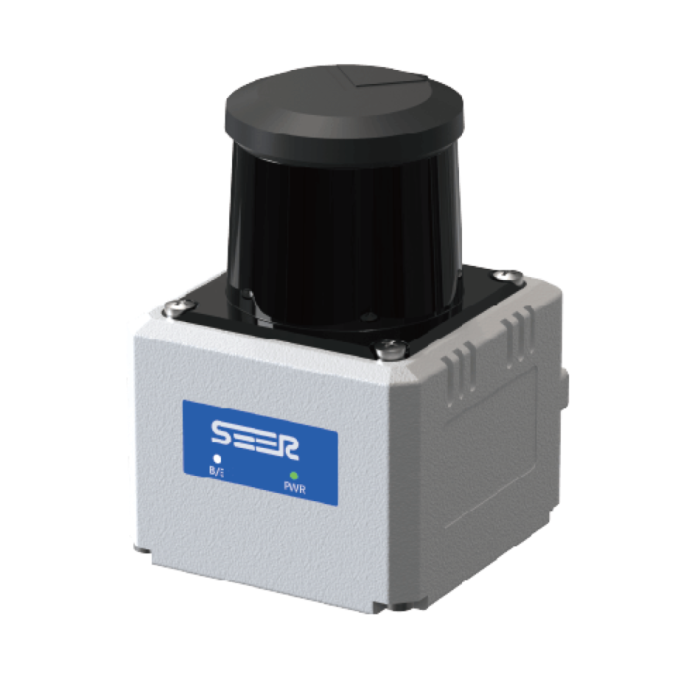
In stock
- BRAND:
- SEER ROBOTICS
- MODEL:
- H1E0-02C
- PART #:
- H1E0-02C
- ORIGIN:
- China
- Warranty:
- 12 MONTHS
- AVAILABILITY:
- SUBJECT TO AVAILABILITY
- SKU:
- SEER-Robotics-H1E0-02C
SEER Robotics 2D Navigation Lidar (H1E0-02C)
Mount a laser scanner on the front corner of a mobile robot and, with the right sensor, the only thing the robot cannot see is itself. That is the quiet logic behind the SEER Robotics 2D Navigation Lidar (H1E0-02C). Its 270° field of view sweeps ahead and to both sides, leaving the remaining wedge to the chassis it is bolted to. It does this from a housing of 60 x 60 x 86 mm and about 280 g, and reports what it sees over Ethernet through an M12 circular connector. It is a component that rarely appears in a brochure photograph, yet it decides whether an autonomous vehicle knows where it is.
Robots Middle East supplies the SEER Robotics 2D Navigation Lidar (H1E0-02C) to integrators, robot builders, research teams and operators of automated fleets across the Middle East. Robots Middle East prepares each quotation, arranges delivery to the customer's site and provides the point of contact for support once the sensor is in service.
Background
SEER Robotics and the Robot Brain
SEER Robotics, listed in Hong Kong under the code 06106.HK, describes itself as a platform-based embodied intelligent robotics company built around what it calls the Robot Brain. The company serves more than 2,500 customers worldwide with intelligent robotics solutions. That orientation matters when assessing a sensor: a firm whose business centres on the control intelligence of robots has a direct interest in the quality of the data that intelligence receives. A navigation lidar from such a company is designed as part of a wider robotics ecosystem rather than as a standalone instrument.
A sensor dedicated to navigation
The H1E0-02C is a 2D LiDAR sensor. It scans a single horizontal plane and measures the distance to whatever that plane meets: walls, racking uprights, columns, machinery and people. For mobile robots, this flat slice of the world is the raw material for building a map and then for working out the robot's position within it. SEER Robotics positions the H1E0-02C specifically as a navigation lidar, and its figures reflect that purpose: a wide scanning angle, a measurement range that reaches across large indoor spaces, a scanning precision of ±3 cm, and an industrial connector chosen for interchangeability and maintainability.
Technical Specifications
| Specification | Value |
|---|---|
| Model | H1E0-02C |
| Product type | 2D LiDAR Sensor |
| Interface | Ethernet |
| Connector | M12 circular connector |
| Dimensions (L x W x H) | 60 x 60 x 86 mm |
| Weight | About 280 g |
| Scanning angle | 270°(-45° to 225°) |
| Measurement range | 0.1 m to 40 m |
| Scanning precision | ±3 cm |
| Light-emitting frequency | 108KHz |
| Working temperature | -10°C to 50°C |
| Storage temperature | -30°C to 70°C |
Specifications are as published by the manufacturer and are confirmed against the datasheet at quotation.
The manufacturer has not published the supply voltage, the Ethernet interface speed, the data output format, the package contents, the compatible controllers, the cable length or the shock and vibration rating; these details are confirmed at quotation.
What does a 270° scanning angle mean for robot navigation?
The H1E0-02C scans across 270°, from -45° to 225°. In practical terms, a sensor positioned at the front of a vehicle sees directly ahead, fully to the left and fully to the right, and some way behind each side. The 90° it does not cover is the sector that, on a typical installation, points back into the robot's own body. A narrower scanner would leave blind areas at the flanks, which is precisely where a vehicle needs to recognise doorway edges, aisle ends and adjacent racking as it turns.
Range completes the picture. The H1E0-02C measures from 0.1 m to 40 m, so it registers features close to the bumper as well as walls and structures across a sizeable hall. For localisation this is valuable, because a robot positions itself by matching what it currently sees against a stored map, and the more distinctive features fall within view, the more information that matching process has to work with. The scanning precision of ±3 cm describes how tightly the sensor reports those distances.
The light-emitting frequency of 108KHz is the figure SEER Robotics links to environmental adaptability. A high emission rate supplies a dense stream of measurements, which helps a navigation system build a clear outline of its surroundings while the vehicle is in motion.
How does the H1E0-02C fit into a mobile robot's design?
Integration is often where a sensor choice succeeds or fails, and three characteristics bear on it. The first is size: at 60 x 60 x 86 mm and about 280 g, the H1E0-02C is compact enough to sit in the corner of a chassis, within a bumper recess or on a small mounting bracket without dominating the vehicle's design. The second is the Ethernet interface, a widely used way of bringing sensor data into an industrial controller or onboard computer. The third is the M12 circular connector, which SEER Robotics associates with seamless interchangeability and enhanced maintainability. In a fleet, this means that a unit can be exchanged at the connector rather than rewired, which shortens the time a vehicle spends out of service.
Environmental limits deserve equal attention, particularly in this region. The working temperature is -10°C to 50°C, and the storage temperature is -30°C to 70°C. Many warehouses and factories in the Gulf are climate-controlled, but mezzanines, loading docks and unconditioned buildings can approach the upper working limit during the summer months. We recommend that buyers compare this working range with the conditions at the intended site and discuss any marginal areas with Robots Middle East during quotation. Electrical and data details, including supply voltage, interface speed and data output format, should be settled before the mechanical and software design is finalised.
Who is the SEER Robotics 2D Navigation Lidar (H1E0-02C) for?
The first group of buyers is system integrators building or upgrading autonomous mobile robots and automated guided vehicles for warehouses and production sites. For them, the combination of a wide field of view, long measurement range and a maintainable connector addresses everyday questions of coverage and serviceability. Projects of this kind are represented in our Logistics Robots and Factory Robots categories.
The second group is fleet operators and maintenance teams who need dependable spare sensors. The M12 connector is intended to make replacement straightforward, and holding a compatible sensor in stock on site can reduce downtime when a unit is damaged.
The third group comprises robot developers, universities and research laboratories working on mapping and localisation. A single-plane navigation lidar with a clearly defined scanning angle, range and precision gives such teams a well-understood sensor around which to build and test their software.
Where the primary requirement is detecting obstacles rather than navigating, buyers may also wish to compare the SEER Robotics 2D Obstacle Avoidance Lidar (C214), which SEER Robotics names for that task; Robots Middle East can advise on which sensor suits a particular vehicle.
What is the SEER Robotics 2D Navigation Lidar (H1E0-02C) used for?
- Warehouse robot localisation: enabling autonomous mobile robots to determine their position between racking and along aisles.
- Autonomous forklift navigation: providing the planar view that automated pallet-handling vehicles use to follow their routes.
- Factory intralogistics: guiding vehicles that carry materials between production cells, stores and assembly lines.
- Map building: scanning a facility so that a navigation system can create the reference map against which robots later localise.
- Research and prototyping: serving as the primary navigation sensor on development platforms in laboratories and engineering teams.
- Fleet maintenance and retrofit: replacing or upgrading scanners on existing vehicles, assisted by the interchangeable M12 connection.
Pricing and Availability
The SEER Robotics 2D Navigation Lidar (H1E0-02C) is supplied on a quotation basis, allowing Robots Middle East to reflect the quantity required, the destination and any project-specific needs. Delivery, customs clearance and support are arranged together with the quotation. At the same stage, our team settles the remaining integration details, so that your plan rests on verified information. To begin, please use the quotation request available on this page.
Frequently Asked Questions
What is the scanning angle of the H1E0-02C?
The sensor scans across 270°, from -45° to 225°. Mounted at the front of a vehicle, it covers the area ahead and both sides.
What measurement range does it offer?
The measurement range is 0.1 m to 40 m. This covers objects close to the vehicle as well as distant walls and structures.
How does the sensor connect to a robot?
The H1E0-02C uses Ethernet and an M12 circular connector. SEER Robotics highlights the connector for its interchangeability and maintainability.
How precise are its measurements?
The scanning precision reaches ±3 cm. This supports the accurate map matching on which robot localisation depends.
Can it operate in hot environments?
The working temperature is -10°C to 50°C. Sites that may exceed this range should be discussed with Robots Middle East before ordering.
Which controllers and supply voltage does it require?
Robots Middle East specifies the compatible controllers, the supply voltage and the data output format for your project in the quotation. Please include details of your vehicle and control system in your request.
Where can I buy the SEER Robotics 2D Navigation Lidar (H1E0-02C) and what does it cost?
You can buy it from Robots Middle East, which supplies customers across the Middle East. The cost is provided in a quotation prepared for your quantity and delivery location; please submit a request through this page.
Summary
A good navigation sensor is measured by what it allows a robot to see, and the H1E0-02C is designed so that very little lies outside its view other than the vehicle carrying it. Its 270° scanning angle, measurement range of 0.1 m to 40 m and precision of ±3 cm provide the information that mapping and localisation depend on. Its compact housing, Ethernet interface and M12 connector make it practical to install and to replace across a fleet. Behind it stands SEER Robotics, a company focused on the intelligence that turns such data into motion. With Robots Middle East handling quotation, delivery and support, whether you are building a new vehicle or maintaining an existing fleet, this page is the starting point.