
SIASUN SA7A-7/0.60 (SA7A-7/0.60)
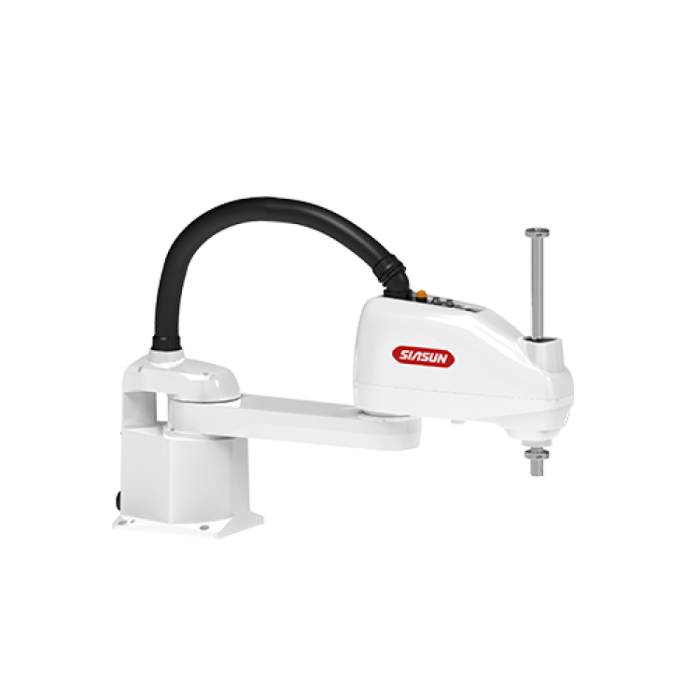
In stock
- BRAND:
- SIASUN
- MODEL:
- SA7A-7/0.60
- PART #:
- SA7A-7/0.60
- ORIGIN:
- China
- Warranty:
- 12 MONTHS
- AVAILABILITY:
- SUBJECT TO AVAILABILITY
- SKU:
- SIASUN-SA7A-7-0-60
SIASUN SA7A-7/0.60 (SA7A-7/0.60)
Most robot purchases are judged on commissioning day, when the cell completes its first cycle and everyone gathers to watch. The more telling verdict comes later: when a product changeover calls for a new gripper, when a cable route must be altered, or when an axis needs attention during a planned stop. The SIASUN SA7A-7/0.60 (SA7A-7/0.60) is designed with that later verdict in mind. It is a SCARA robot built on a modular design that reduces maintenance costs, a dual-support structure for high rigidity and low vibration, and a lighter main body that keeps deployment convenient and simple. With a 7 kg payload and a 600mm reach, it occupies the compact, mid-load part of the SCARA field, where a great deal of assembly and handling work is carried out.
Robots Middle East sells the SIASUN SA7A-7/0.60 and supplies it to manufacturers, system integrators and technical institutions across the Middle East. Our team prepares each quotation around the application in question, arranges delivery to your site and remains your point of contact for support once the robot is in service, so that a single partner accompanies the project from first enquiry through to production.
Background
SIASUN and the new SA7A generation
The SA7A series is a brand-new generation of SIASUN SCARA robots. Rather than a single model, the series is offered in several versions, SA7A-7/0.50, SA7A-7/0.60 and SA7A-7/0.70, which share one design approach and one family identity. The SA7A series sits within a wider SIASUN SCARA portfolio that also includes the SA4A, SA10A and SA20A families, and within the manufacturer's broader range of industrial robots. For a buyer, that breadth matters: a plant that standardises on one manufacturer can keep its programming practices, spare-parts planning and training consistent as it adds cells over the years.
SCARA robots as a class, the name stands for Selective Compliance Assembly Robot Arm, are stiff in the vertical direction and compliant in the horizontal plane. That combination suits them to fast, repetitive tasks in which a part is picked, moved across a working area and placed or inserted from above. They are a familiar sight in electronics assembly, small-component handling and packaging, where their compact footprint allows them to work closely alongside conveyors, feeders and test stations.
Dual support and a modular build
Two design decisions define the SA7A series. The first is the dual-support structure, which delivers a larger load capacity, high rigidity and low vibration. The second is a modular design that caters to more automation scenarios while reducing maintenance costs. Around these sit practical details aimed at the people who install and run the robot: abundant user cables on the main unit, a new generation of S series control cabinet, support for multiple programming and teaching methods, and a lightweight, compact structure with a lighter main body. Together, these features meet more automation scenarios while maintaining the overall machine cost.
Technical Specifications
| Specification | Value |
|---|---|
| Model | SA7A-7/0.60 |
| Robot type | SCARA robot, SA7A series |
| Payload | 7 kg (15.4 lbs) |
| Reach | 600mm |
| Structure | Dual-support structure: larger load capacity, high rigidity, low vibration |
| Design | Modular design |
| Controller | New generation of S series control cabinet |
| Programming | Multiple programming and teaching methods |
| Cabling | Abundant user cables on the main unit |
| Body | Lightweight, compact structure; lighter main body |
Specifications as published by the manufacturer; confirmed against the datasheet at quotation. SIASUN has not published the repeatability, protection rating, degrees of freedom, weight, power supply, axis ranges and speeds, mounting options, package contents or cycle time for this model; these are confirmed at quotation.
What does the dual-support structure change for a SCARA arm?
A SCARA robot spends its working life accelerating, stopping and reversing in the horizontal plane, often many times a minute. Every one of those movements loads the arm and its joints, and any flex or residual vibration has to settle before a part can be placed with confidence. The rigidity of the structure is therefore not an abstract engineering virtue; it governs how cleanly the arm arrives at each position and how consistently it behaves across a long shift.
SIASUN's answer in the SA7A series is a dual-support structure, which delivers a larger load capacity, high rigidity and low vibration. For a production engineer, low vibration at the end of the arm is what allows delicate components to be handled without disturbance, and high rigidity is what keeps a tool steady when it presses, inserts or places. On the SA7A-7/0.60, that structure carries a 7 kg payload across a 600mm reach, giving room for a gripper or end effector of meaningful size rather than only the lightest suction tools.
The modular design complements this. A robot that is rigid but difficult to service can still cost a plant dearly in downtime. Built on modular principles, the SA7A series keeps maintenance costs down and lets the same robot adapt to a wider variety of automation scenarios as production requirements change. Combined with a lighter main body, this keeps the arm practical to install, reposition and maintain over its working life.
How does the SA7A-7/0.60 fit within the SA7A series?
The SA7A series comes in three versions: SA7A-7/0.50, SA7A-7/0.60 and SA7A-7/0.70. They share the series' dual-support structure, modular design, S series control cabinet and user-friendly cabling, which means the choice between them is a question of matching the robot to the geometry of the cell rather than of selecting a different technology. The figures in this article belong to the SA7A-7/0.60 alone: a 7 kg payload and a 600mm reach. Each of the other two versions has its own datasheet, which our team will gladly share so that every version is assessed on its own data.
In practice, the right version follows from the layout. Engineers typically map the positions the robot must serve, such as feeders, fixtures, trays and conveyors, and then choose the arm that covers them comfortably with sensible clearance. Sharing that layout with our team at the enquiry stage is the quickest way to establish whether the SA7A-7/0.60 is the best fit or whether another version of the series suits the cell better.
Who is the SIASUN SA7A-7/0.60 for?
The SA7A-7/0.60 is aimed squarely at the industries the series is built for: 3C (computers, communications and consumer electronics), lithium battery, photovoltaic and automotive electronics, together with related sectors. Manufacturers in these fields frequently run high-volume lines with compact workstations, where a robot must handle components reliably within a limited footprint and be reconfigured when product generations change.
System integrators form a second important group. The abundant user cables on the main unit, the new S series control cabinet and support for multiple programming and teaching methods give integrators flexibility when they build the robot into a complete cell with grippers, vision and peripheral equipment. Plants that place weight on running costs, rather than purchase price alone, will also find the modular design and its reduced maintenance costs relevant to their evaluation.
Buyers whose application lies outside the parameters of this model can compare other SIASUN SCARA families, such as the SIASUN SA4A-4/0.40 (SA4A-4/0.40), the SIASUN SA10A-10/0.60 (SA10A-10/0.60) and the SIASUN SA20A-20/0.80 (SA20A-20/0.80), or browse the complete SCARA range and the wider selection of Industrial Robots. Our team will advise on which model suits the task once the application details are known.
What is the SIASUN SA7A-7/0.60 used for?
- 3C electronics assembly – placing, inserting and transferring components on lines producing consumer and communications devices.
- Lithium battery production – handling cells and battery components between process and inspection stations.
- Photovoltaic manufacturing – moving and positioning parts within solar component production and assembly.
- Automotive electronics – assembling and handling electronic modules destined for vehicle systems.
- Pick-and-place and kitting – transferring parts between feeders, trays and conveyors in compact cells.
- Loading and unloading test stations – presenting parts to test or inspection equipment and sorting them afterwards.
Pricing and Availability
Robots Middle East supplies the SIASUN SA7A-7/0.60 on a quotation basis, because the right configuration depends on the application, the end effector and the cell in which the robot will work. When you send us your requirements, our team prepares an offer suited to your project, together with the full datasheet. Delivery, customs and support are arranged with the quotation. To begin, use the quotation request available on this page.
Frequently Asked Questions
What payload does the SIASUN SA7A-7/0.60 handle?
The SA7A-7/0.60 has a payload of 7 kg (15.4 lbs). This allows it to carry a gripper or tool together with the workpiece within that limit.
What is the reach of the SA7A-7/0.60?
Its reach is 600mm. The SA7A-7/0.50 and SA7A-7/0.70 are the other versions in the same series.
Which industries is this SCARA robot intended for?
Its primary application industries are 3C, lithium battery, photovoltaic and automotive electronics, together with related sectors.
How is the SA7A-7/0.60 controlled and programmed?
It works with a new generation of S series control cabinet and supports multiple programming and teaching methods. The main unit also provides abundant user cables for tools and peripherals.
Is the SA7A-7/0.60 easy to deploy?
Yes. It has a lightweight, compact structure and a lighter main body, which makes deployment convenient and simple.
Why does the modular design matter?
The modular design caters to more automation scenarios while reducing maintenance costs. For a plant, this supports adapting the robot to changing tasks and keeping servicing manageable.
Where can I buy the SIASUN SA7A-7/0.60 and what does it cost?
You can buy the SIASUN SA7A-7/0.60 from Robots Middle East, which supplies it across the Middle East. The cost depends on your configuration and project, so we provide it in a tailored quotation, which you can request on this page.
Summary
The SIASUN SA7A-7/0.60 (SA7A-7/0.60) is a robot to be judged not only on its first day but on its third year. Its dual-support structure provides the rigidity and low vibration that precise handling demands, its 7 kg payload and 600mm reach suit compact mid-load tasks, and its modular design, lighter body, abundant user cabling and S series control cabinet keep the cell adaptable and its maintenance costs under control. For manufacturers in 3C, lithium battery, photovoltaic and automotive electronics, it offers a considered balance between performance on the line and practicality over time. Robots Middle East quotes, delivers and supports it throughout the region, and for anyone planning a SCARA cell around it, this page is the starting point.