
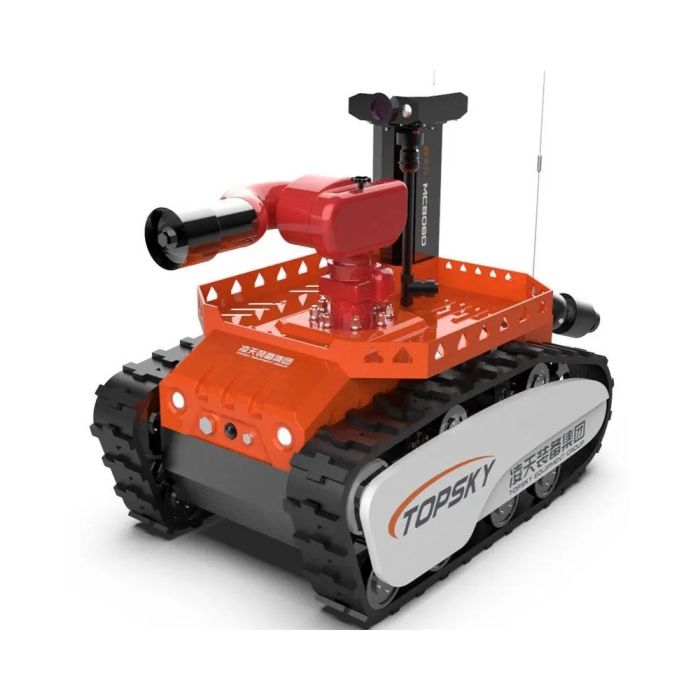
Topsky Dragon Conquest D4 Explosion-Proof Firefighting And Scouting Robot (RXR-MC80BD)
In stock
- BRAND:
- TOPSKY
- PART #:
- Dragon Conquest D4 RXR-MC80BD
- ORIGIN:
- China
- AVAILABILITY:
- SUBJECT TO AVAILABILITY
- SKU:
- Topsky-RXR-MC80BD
Topsky Dragon Conquest D4 Explosion-Proof Firefighting And Scouting Robot (RXR-MC80BD)
Every fire monitor fights its own operator. The jet that reaches the seat of a fire pushes back with equal force, and on a remotely operated vehicle that reaction tries to shove the whole machine backwards just when the aim matters most. The Topsky Dragon Conquest D4 Explosion-Proof Firefighting And Scouting Robot (RXR-MC80BD) answers that problem with its drivetrain. While water is being sprayed, its driving motor changes from driving mode to generating mode and returns charge to the battery, so the force that would unsettle the robot is put to use. Around that idea sits a tracked, explosion-proof certified machine that can fight fire and gather information where a gas cloud, a spark or radiant heat would make human entry a serious risk.
Robots Middle East supplies the RXR-MC80BD to refineries, fuel and gas storage operators, chemical producers and industrial fire services across the Middle East. Each quotation is prepared around the buyer's site and requirements, and Robots Middle East arranges delivery, commissioning and after-sales support within the region.
Background
The manufacturer and the RXR line
The robot is produced under the Topsky brand by Beijing Topsky Intelligent Equipment Group Co., Ltd., which builds the RXR range of firefighting and reconnaissance robots for industrial emergency response. The RXR-MC80BD is the explosion-proof member of that line, and the sources name two versions: the RXR-MC80BD itself and the RXR-MC80BD - M. Robots of this class are typically deployed by site fire brigades and civil defence units as a forward element, sent ahead of crews to apply extinguishing media and report on conditions before people commit to an approach.
Designed and certified for explosive atmospheres
The RXR-MC80BD is designed and certified for fire-extinguishing and reconnaissance in explosive environments such as petrochemical refining, oil and fuel gas storage, and other chemical manufacturing, storage and transportation sites. It is explosion-proof certified and sealed to IP67 and IP68. Its basic functions are fire fighting, audio and video reconnaissance, toxic and hazardous gas reconnaissance, and environmental reconnaissance in disaster areas. An integrated gas detection platform measures gas and environmental parameters, and the robot collects the sound at the scene in real time to support rescue. This combination places it between a pure firefighting vehicle and a scouting platform: it carries the monitor and the hose line, and it also brings back the information the incident commander needs.
Technical Specifications
| Specification | Value |
|---|---|
| Size | 1305*800*1065mm |
| Weight | 529kg |
| Traction | 3800N |
| Speed | 0-1.81m/s |
| Work time | 2-6hrs |
| Obstacle crossing | 220mm |
| Wading depth | 500mm |
| Protection | Explosion-proof certified; IP67 & IP68 |
| Hose towing | Two 100M lengths of DN80 fire hose filled with water |
| Track | Heat tolerant, fire retardant rubber with metal lining |
| Cooling | Automatic water curtain cooling system |
| Monitor | Remote rotation, pitching and multiple spraying modes; switching between water and foam |
| Explosion-proof grade (RXR-MC80BD - M) | Whole machine Exd[ib] II BT4Gb; battery Exd[ib] II CT6Gb |
| Power source (RXR-MC80BD - M) | Electric, ternary lithium battery |
Specifications are as published by the manufacturer and are confirmed against the datasheet at quotation.
The manufacturer has not published the battery capacity, motor power, fire monitor flow rate or range, remote control distance, camera resolution, operating temperature range or the contents of the delivery, so these are confirmed with the quotation.
How does the RXR-MC80BD stay working close to a fire?
A firefighting robot is only useful while it can remain in position, and the RXR-MC80BD addresses that from several directions at once. The first is the regenerative arrangement described above: rather than relying solely on mass and track grip to resist the reaction of the monitor, the drive motor switches to generating mode while water is sprayed and charges the battery. On a long attack, that is energy recovered at the very moment the robot is working hardest.
The second is heat management. An automatic water curtain cooling system shields the machine, and the tracks use heat tolerant, fire retardant rubber with a metal lining, so the running gear is not the first component to fail on hot ground. The third is sealing: IP67 and IP68 protection means water run-off, foam and spray around the robot do not compromise its enclosures, and the 500mm wading depth lets it cross flooded bunds and drainage channels that form during a sustained attack.
The final element is pulling power. With 3800N of traction, the robot drags two 100M lengths of DN80 fire hose filled with water, which is the task that most exhausts crews when a monitor has to be advanced towards a burning tank or loading rack. A speed range of 0-1.81m/s and the ability to cross 220mm obstacles let the operator reposition the line as the fire develops, while the remote monitor control covers rotation, pitching, spraying mode and the switch between water and foam without anyone approaching the jet.
What does the RXR-MC80BD - M version add?
The sources describe a second version, the RXR-MC80BD - M, and publish two points specifically for it. Its whole machine carries the explosion-proof grade Exd[ib] II BT4Gb, with the battery graded Exd[ib] II CT6Gb, and it is powered electrically by a ternary lithium battery. For buyers whose hazardous area classification requires a stated gas group and temperature class on the documentation, those markings are the reason to look at the M version closely.
The figures in the specification table belong to the RXR-MC80BD and should not be read across to the M version, whose dimensions, weight and traction are confirmed separately. Robots Middle East confirms the certification markings, physical figures and configuration of whichever version is specified before a quotation is finalised, so that the robot delivered matches the zone classification of the site.
Who is the RXR-MC80BD for?
The primary buyers are organisations that own or protect explosive atmospheres. Refinery and petrochemical complex fire brigades need a machine that can enter a vapour-laden process area without becoming an ignition source. Operators of oil terminals, tank farms and fuel gas storage sites need a means of putting a monitor close to a tank fire while keeping personnel at a safe standoff. Chemical manufacturers, chemical warehouses and transport hubs handling hazardous goods face the same combination of fire and toxic release, where the gas detection platform is as valuable as the monitor.
Civil defence authorities and municipal fire services covering industrial zones form a further group: for them the robot's reconnaissance functions, with video, audio, sound collection and gas readings, help decide whether and how crews should commit. Integrators and research bodies evaluating tracked platforms can compare it with other models in our UGVs category. Where a site's hazardous area documentation calls for the published Exd[ib] II BT4Gb marking, the RXR-MC80BD - M version is the one to discuss.
What is the RXR-MC80BD used for?
- Tank farm fires — advancing a water or foam monitor towards a burning storage tank while crews remain at a distance.
- Refinery process area incidents — attacking fires in explosive atmospheres where conventional equipment could ignite vapour.
- Gas leak reconnaissance — measuring toxic and hazardous gases and environmental parameters before personnel enter.
- Hose line advancement — dragging charged DN80 lines into position so that crews are spared the heaviest physical task.
- Search and rescue support — collecting live sound and video from the scene to help locate casualties.
- Chemical storage and transport sites — responding to fires and releases at warehouses, loading bays and transfer facilities.
Pricing and Availability
Robots Middle East supplies the RXR-MC80BD on a quotation basis, prepared for the version, configuration and documentation your site requires. Delivery, customs clearance and technical support are arranged together with the quotation. To begin, send us your application and hazardous area details using the quotation request available on this page.
Frequently Asked Questions
Is the RXR-MC80BD explosion-proof certified?
Yes. The robot is explosion-proof certified and sealed to IP67 and IP68. For the RXR-MC80BD - M version, the whole machine is graded Exd[ib] II BT4Gb and the battery Exd[ib] II CT6Gb.
Can the monitor switch between water and foam?
Yes. The monitor is controlled remotely for rotation, pitching and changing between multiple spraying modes, and it switches easily between water and foam.
How long does the robot work on a charge?
The work time is 2-6hrs, depending on the task. While it sprays water, the driving motor switches to generating mode and charges the battery.
How much hose can it pull?
The robot drags two 100M lengths of DN80 fire hose filled with water, with a traction of 3800N.
What can it detect at the scene?
An integrated gas detection platform measures toxic and hazardous gases and environmental parameters. The robot also provides audio and video reconnaissance and collects the sound at the site in real time.
Which version should I choose?
The choice depends on the hazardous area classification and documentation your site requires. Robots Middle East reviews your requirements and confirms the figures and certification of the RXR-MC80BD and the RXR-MC80BD - M before quoting.
Where can I buy the RXR-MC80BD and what does it cost?
Robots Middle East supplies the robot across the Middle East. The cost depends on version, configuration and delivery, so it is set out in a quotation prepared for your project.
Summary
The RXR-MC80BD treats the forces of a fire scene as things to be managed rather than merely endured. The reaction of its own jet becomes charge for the battery, the heat is met by a water curtain and fire retardant tracks, the run-off is shut out by IP67 and IP68 sealing, and the weight of charged hose is taken by its traction rather than by a crew. Around that sits a reconnaissance capability, from gas readings to live sound and video, that tells responders what they face before they move. For refineries, storage terminals and chemical sites across the Middle East that need a robot to go where people should not, this page is the starting point.