
Unitree G1 Edu Pro A U9 Humanoid Robot (G1EDU-U9)
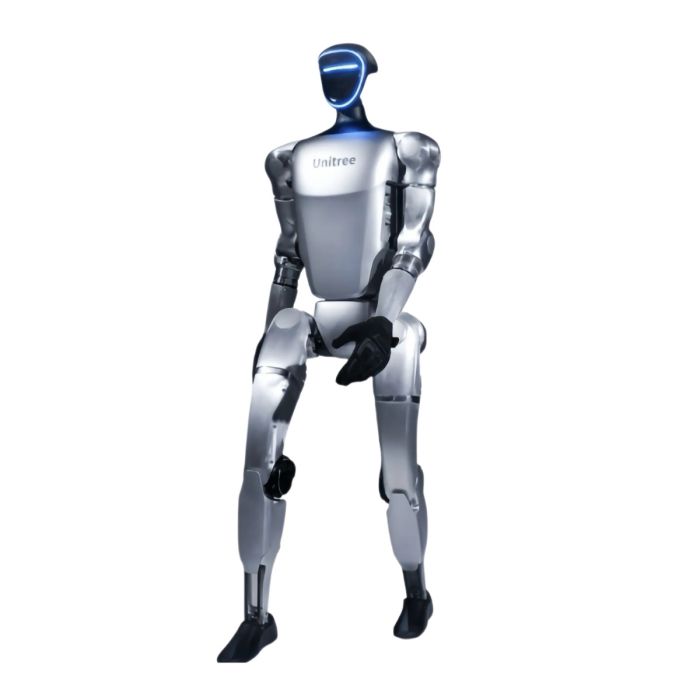
In stock
- BRAND:
- UNITREE ROBOTICS
- MODEL:
- G1 EDU PRO A
- PART #:
- G1EDU-U9
- ORIGIN:
- China
- Warranty:
- 12 MONTHS
- AVAILABILITY:
- SUBJECT TO AVAILABILITY
- SKU:
- Unitree-G1-Edu-U9
Unitree G1 Edu Pro A U9 Humanoid Robot (G1EDU-U9)
Watch a humanoid robot walk across a stage and the eye goes to the silhouette: the arms, the head, the sense of a figure moving with purpose. A research group sees something else. It looks at the joints, because every experiment in balance, manipulation or learned behaviour is decided by what happens inside those small assemblies of motor, encoder and control loop. The Unitree G1 Edu Pro A U9 Humanoid Robot (G1EDU-U9) rewards that second way of looking. Its appeal lies less in the spectacle than in the access it gives: open secondary development, a high computing power module chosen to suit the work, and joints built around low-inertia motors with dual encoders.
Robots Middle East sells the Unitree G1 Edu Pro A U9 Humanoid Robot (G1EDU-U9) and supplies it to universities, research institutes, government innovation programmes and corporate laboratories across the Middle East. Robots Middle East prepares the quotation, arranges delivery and import formalities, and remains the point of contact for support once the robot is in service, so that a project team deals with a single regional partner from the first enquiry onwards.
Background
Unitree Robotics and the G1 family
Unitree Robotics built its reputation on legged robots, first establishing itself with quadrupeds used in research, inspection and education before carrying that experience in actuation and locomotion into humanoid form. The G1 is the company's compact humanoid platform, and the sources describe it in two versions: the G1 and the G1 EDU. The Edu Pro A U9 sits within the EDU branch of the family, which is the branch intended for organisations that want to programme the robot themselves rather than operate it as a finished product. Other configurations in the same family are gathered in the Unitree G1 category.
Positioning: a humanoid for developers
What defines the EDU branch is openness. Secondary development is supported, which means research teams can build their own software on top of the platform, and the robot carries a high computing power module available in several brands and models, Orin among them. Connectivity is provided by WiFi 6 and Bluetooth 5.2, and a manual controller is included in the specification. For manipulation work, the Dex3-1 hand can optionally be installed with tactile sensor arrays, adding a sense of touch to experiments that would otherwise rely on vision and joint feedback alone. Together these features position the robot as a development platform rather than a demonstration piece.
Technical Specifications
| Specification | Value |
|---|---|
| High computing power module | Multiple brands and models available, such as Orin |
| Wireless connectivity | WiFi 6, Bluetooth 5.2 |
| Joint motor | Low inertia high-speed internal rotor PMSM (permanent magnet synchronous motor) |
| Joint encoder | Dual encoder |
| Secondary development | Yes |
| Tactile sensors (Dex3-1) | Dex3-1 can optionally be installed with tactile sensor arrays |
| Manual controller | Yes |
Specifications are as published by the manufacturer for the G1 EDU and are confirmed against the datasheet at quotation.
The manufacturer has not published the IP rating, the walking speed, the onboard storage and RAM or the operating temperature range; Robots Middle East confirms these at quotation.
Why do the joint motors and encoders matter to a research team?
A humanoid is, mechanically, a chain of joints, and the quality of that chain sets the ceiling for everything built on top of it. The G1 EDU uses low inertia, high-speed internal rotor permanent magnet synchronous motors in its joints. Low rotor inertia allows a joint to accelerate and change direction with less resistance from its own moving mass, which matters for balance recovery, compliant contact and the rapid corrections that legged locomotion demands. For a control researcher, a responsive actuator is the difference between an algorithm that behaves in hardware as it did in simulation and one that has to be detuned to cope with sluggish response.
The dual encoder arrangement addresses the other half of the problem: knowing precisely where each joint is. Position feedback is the raw material of every controller, every state estimator and every learned policy. With two encoders per joint, the platform gives developers a richer picture of joint state, which supports more accurate control and more trustworthy data for analysis. When a laboratory publishes results, the credibility of those results rests partly on the quality of the sensing behind them, and the joint design of the G1 EDU is aimed squarely at that concern.
What does the EDU configuration offer for software development?
The central promise of the EDU configuration is that the robot can be rewritten. Secondary development support allows teams to implement their own locomotion controllers, perception pipelines, manipulation strategies and higher-level behaviours, rather than being confined to factory routines. This is what turns a humanoid from an exhibit into an instrument for research and teaching.
The high computing power module reinforces that freedom. Because the module is offered in multiple brands and models, including Orin, a team can discuss with Robots Middle East which option best fits its workload, whether that is onboard inference for vision models, real-time control, or a combination of both. WiFi 6 and Bluetooth 5.2 handle the link between the robot and the wider laboratory, supporting remote monitoring, data logging and the iterative cycle of deploying code, testing and refining. The manual controller gives operators direct command of the robot during setup, testing and supervised trials, which is valuable whenever new software is being exercised for the first time.
For manipulation research, the option of tactile sensor arrays on the Dex3-1 hand opens a further line of enquiry. Grasping delicate or irregular objects, detecting slip and learning from contact are all problems in which touch adds information that cameras cannot supply. Robots Middle East can advise on which hand and sensor options suit a given research programme.
Who is the Unitree G1 Edu Pro A U9 Humanoid Robot (G1EDU-U9) for?
The clearest fit is the university laboratory working on robotics, control engineering or artificial intelligence. Such groups need a platform they can programme at depth, instrument thoroughly and use across several cohorts of students and researchers, and the open development model of the EDU branch is designed for exactly that. Postgraduate research in legged locomotion, whole-body control and embodied AI benefits most directly from the joint design and the onboard compute.
Government-backed innovation centres and national research programmes form a second group. Across the region, investment in artificial intelligence and advanced technology has created demand for platforms that support applied research, skills development and public demonstration. A humanoid that can be programmed locally helps such programmes build home-grown expertise rather than relying solely on imported solutions.
Corporate research and development teams make up the third segment: organisations exploring humanoid robots for future roles in logistics, hospitality, retail or facilities management, and wanting to prototype behaviours before committing to wider deployment. Technical training institutes and schools of engineering are a fourth, using the robot to teach programming, mechatronics and systems integration on real hardware.
Buyers comparing configurations within the family may also wish to review the Unitree G1 Edu Pro B U10 Humanoid Robot (G1EDU-U10) and the Unitree G1 Edu Plus Humanoid Robot with Fake Hands (G1EDU-U2); Robots Middle East can explain how these versions differ. The wider Research Robots category offers further platforms for laboratory use.
What is the Unitree G1 Edu Pro A U9 Humanoid Robot (G1EDU-U9) used for?
- Locomotion research – developing and testing walking, balance and recovery controllers on real hardware.
- Manipulation and grasping – studying dexterous handling, with the option of tactile sensing on the Dex3-1 hand.
- Embodied AI development – training and deploying learned policies that combine perception and movement on the onboard compute.
- University teaching – giving students hands-on experience of control, programming and systems integration.
- Human–robot interaction studies – investigating how people respond to and collaborate with a humanoid form.
- Applied prototyping – trialling humanoid behaviours for future service, logistics or industrial roles before wider investment.
Pricing and Availability
The cost of the Unitree G1 Edu Pro A U9 Humanoid Robot (G1EDU-U9) depends on the configuration chosen, including the computing module and any hand and sensor options, so Robots Middle East provides it by formal quotation. Delivery, customs clearance and after-sales support are arranged together with the quotation. To begin, please share your intended application and preferred configuration through the enquiry options available on this page.
Frequently Asked Questions
Can we develop our own software for this robot?
Yes. Secondary development is supported on the G1 EDU, allowing teams to build their own control, perception and behaviour software.
Which computing module does the robot use?
The G1 EDU carries a high computing power module available in multiple brands and models, such as Orin. Robots Middle East can advise on the option best suited to your workload.
What wireless connectivity does it offer?
The G1 EDU supports WiFi 6 and Bluetooth 5.2 for communication with laboratory systems and operators.
What kind of motors drive the joints?
The joints use low inertia, high-speed internal rotor permanent magnet synchronous motors, paired with dual encoders for joint position feedback.
Can the hands sense touch?
The Dex3-1 hand can optionally be installed with tactile sensor arrays, adding touch feedback to manipulation experiments.
Is a manual controller included?
Yes, a manual controller forms part of the G1 EDU specification, giving operators direct command during setup and testing.
Where can I buy the Unitree G1 Edu Pro A U9 Humanoid Robot (G1EDU-U9) and what does it cost?
You can buy it from Robots Middle East, which supplies it across the Middle East. The cost depends on the configuration, so please request a quotation and Robots Middle East will respond with a tailored offer covering delivery and support.
Summary
The silhouette of a humanoid draws attention, but the value of the Unitree G1 Edu Pro A U9 Humanoid Robot (G1EDU-U9) lies in what sits beneath it. Low-inertia permanent magnet synchronous motors and dual encoders give each joint the responsiveness and feedback that serious control work requires. Secondary development, a selectable high computing power module, WiFi 6 and Bluetooth 5.2 connectivity and a manual controller make the robot a platform to be programmed rather than merely operated, and the tactile option for the Dex3-1 hand extends that openness to the sense of touch. For laboratories, universities and innovation teams in the region that judge a robot by its joints and its access rather than its stage presence, supplied and supported by Robots Middle East, this page is the starting point.
Specifications
General
Physical
Software
Shipping
Feature
| Equipped with all the functions of G1-Edu standard version |
| Upgraded from 1 to 3 degrees of freedom in the waist. |
| Single arm freedom upgraded from 5 to 7, both arms upgraded. |
| Up to 29 DOF for whole robot |