
Unitree G1 Edu Ultimate F U8 Humanoid Robot (G1EDU-U8)
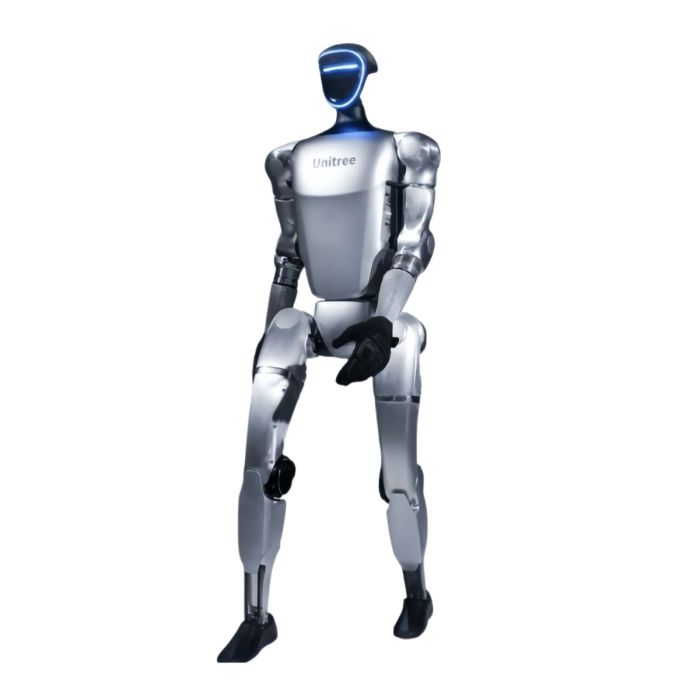
In stock
- BRAND:
- UNITREE ROBOTICS
- MODEL:
- G1 EDU ULTIMATE F
- PART #:
- G1EDU-U8
- ORIGIN:
- China
- Warranty:
- 12 MONTHS
- AVAILABILITY:
- SUBJECT TO AVAILABILITY
- SKU:
- Unitree-G1-Edu-U8
- Buy 2 for AED 247,670.92 each and save 3%
- Buy 5 for AED 242,564.30 each and save 5%
- Buy 10 for AED 229,797.76 each and save 10%
Unitree G1 Edu Ultimate F U8 Humanoid Robot (G1EDU-U8)
Ask someone to find a key at the bottom of a bag without looking, and they will manage it in seconds; their fingertips settle the question long before their eyes could. Robots have mostly worked the other way round, seeing an object clearly and then closing a gripper on it with little sense of what happens at the point of contact. The Unitree G1 Edu Ultimate F U8 Humanoid Robot (G1EDU-U8) belongs to the part of humanoid research that is working to close that gap. It pairs a walking body from the G1 Edu series with two five-finger BrainCo Revo 2 Touch hands that sense pressure, friction, direction and proximity, so that a grasp becomes something the robot can measure as well as perform.
Robots Middle East supplies the Unitree G1 Edu Ultimate F U8 Humanoid Robot (G1EDU-U8) to universities, research institutes, innovation centres and system integrators across the Middle East. Our team prepares each quotation against the configuration you require, arranges delivery and customs clearance to your site, and remains your point of contact for technical support once the robot is in service.
Background
The G1 Edu lineage
Unitree Robotics offers the G1 Edu as a family of versions rather than a single machine. The sources name eight of them: the G1 Edu Standard, the G1 Edu Plus and six Ultimate versions lettered A to F. Every version shares the same foundations, including 100 TOPS of onboard AI computing, six degrees of freedom in each leg and open access for secondary development. Where they differ is in the upper body. The Standard has 23 degrees of freedom in total, five per arm and one at the waist; the Plus has 29, seven per arm and three at the waist. The Ultimate A and B have 43, while the Ultimate C, D, E and F each have 41. The Ultimate F is the version this page describes, and it is defined above all by its hands.
Touch as the defining technology
The BrainCo Revo 2 Touch hands fitted to the Ultimate F are five-fingered and carry tactile sensing across four dimensions: pressure, friction, direction and proximity. In practical terms, this gives a researcher signals for how firmly an object is held, whether it is beginning to slip, which way a contact force is acting and whether a surface is close before it is touched. Combined with the depth camera and 3D LiDAR fitted across the G1 Edu series, the robot can approach an object by sight and then refine its handling by feel. That pairing of perception and touch is what positions the Ultimate F as a platform for manipulation research rather than for locomotion alone.
Technical Specifications
| Specification | Value |
|---|---|
| Dexterous hands | 2× five-finger BrainCo Revo 2 Touch hands with tactile sensing for pressure, friction, direction and proximity |
| Total degrees of freedom | 41 |
| DoF per leg | 6 |
| DoF per arm | 7 |
| DoF of waist | 3 |
| AI computing | 100 TOPS |
| Secondary development | Yes |
| Knee joint torque | 120 N·m |
| Sensors | Depth camera + 3D LiDAR |
| Microphone array | 4 microphones |
| Speaker | 5 W |
| Smart battery | 9000 mAh, quick release |
| Charger | 54 V / 5 A |
| Connectivity | Wi-Fi 6 / Bluetooth 5.2 |
| Joint encoders | Dual encoder |
| Cooling | Local air cooling |
| Travel speed | Up to 2 m/s |
| OTA updates | Yes |
| Manual controller | Yes |
Specifications are as published by the manufacturer and are confirmed against the datasheet at quotation.
The manufacturer has not published the standing dimensions, weight, payload, battery runtime or IP rating of this version, nor the full list of what is in the box; all of these are confirmed with your quotation.
What does the Ultimate F add over the G1 Edu Plus?
In their specifications, the two versions share a great deal. Both have six degrees of freedom per leg, seven per arm and three at the waist, both carry 100 TOPS of computing and both are open to secondary development. The difference appears in the total: the G1 Edu Plus has 29 degrees of freedom, the Ultimate F has 41. Because the legs, arms and waist are counted identically on both, that difference lies outside those joints, at the end of the arm where the Ultimate F carries its BrainCo Revo 2 Touch hands.
For a buyer, this is the essential decision. The Plus suits work in which the arm positions the end effector and the research question concerns balance, gait or whole-body motion. The Ultimate F suits work in which the hand itself is the subject: finger coordination, in-hand manipulation, grasp stability and the use of contact signals in a control loop. Choosing between them is less a question of size or power than of where your experiments place their attention.
How does tactile sensing change what a humanoid can be taught?
Much of robot learning relies on vision: cameras record a demonstration, and a policy learns to reproduce what it saw. Vision struggles, however, at the very moment that matters most in manipulation, when fingers close around an object and hide the contact from view. Tactile signals fill that blind spot. A model that receives pressure and friction data can learn to tighten its grip when an object starts to slide, to ease off on something delicate, and to recognise through touch alone that a grasp has succeeded.
On the Ultimate F, proximity sensing adds a further layer, allowing the hand to register that a surface is near before contact is made. For teams studying imitation learning, reinforcement learning or multimodal perception, this turns the robot into a source of richer training data, and secondary development access means those signals can be brought into your own software rather than remaining locked inside a closed demonstration routine.
Who is the Unitree G1 Edu Ultimate F U8 Humanoid Robot (G1EDU-U8) for?
The clearest fit is a research group working on dexterous manipulation, tactile perception or embodied AI, where the combination of a walking body and sensing hands allows experiments that span locomotion and handling in the same session. University departments of robotics, mechatronics and computer science will find in it a teaching platform that takes students well beyond pre-programmed motion, while postgraduate researchers can build theses around the data it produces.
System integrators and corporate innovation centres form a second group. For them, the Ultimate F offers a way to evaluate how humanoid handling might apply to inspection, light assembly or service tasks before committing to a wider programme. Government-backed technology initiatives and science centres across the region may also value it as a visible, capable demonstrator of applied robotics.
Where a programme concentrates on gait, balance or whole-body control and does not need tactile hands, the Unitree G1 Edu Plus Humanoid Robot with Fake Hands (G1EDU-U2) may be the more suitable choice. Buyers comparing the wider family can review the Unitree G1 category, and those weighing humanoids against other platforms will find alternatives among our Research Robots.
What is the Unitree G1 Edu Ultimate F U8 Humanoid Robot (G1EDU-U8) used for?
- Dexterous manipulation research — studying finger coordination, in-hand reorientation and grasp planning with five-finger hands.
- Tactile learning datasets — recording pressure, friction, direction and proximity signals alongside vision for training manipulation models.
- Embodied AI development — running and testing perception and control models on the robot's onboard computing.
- University teaching — giving students hands-on experience of humanoid control, sensing and secondary development.
- Human-robot interaction studies — using the microphone array and speaker to explore voice-based interaction with a humanoid.
- Applied evaluation — assessing how humanoid handling could support inspection, assembly or service tasks in a controlled setting.
Pricing and Availability
Robots Middle East supplies this robot on quotation, so that the configuration, accessories and support you receive match the work you intend to do. Delivery, customs clearance and technical support are all arranged together with your quotation. Our team is glad to discuss your programme and prepare a formal offer for your organisation. A quotation for the Unitree G1 Edu Ultimate F U8 Humanoid Robot (G1EDU-U8) can be requested directly through the form available on this page.
Frequently Asked Questions
How many degrees of freedom does the Ultimate F have?
The Ultimate F has 41 degrees of freedom in total. These include six in each leg, seven in each arm and three at the waist.
Which hands are fitted to this version?
It carries two five-finger BrainCo Revo 2 Touch hands. Their tactile sensing covers pressure, friction, direction and proximity.
What sensors does the robot use to perceive its surroundings?
The G1 Edu series is fitted with a depth camera and 3D LiDAR. A four-microphone array and a 5 W speaker support audio interaction.
Can we develop our own software for it?
Yes. Secondary development is supported, the robot provides 100 TOPS of onboard AI computing, and over-the-air updates keep the system current.
What battery does it use?
The series uses a 9000 mAh quick-release smart battery. It is charged with a 54 V / 5 A charger.
How does the robot connect to our network and equipment?
The G1 Edu series offers Wi-Fi 6 and Bluetooth 5.2. A manual controller is also provided for direct operation.
Where can I buy the Unitree G1 Edu Ultimate F U8 Humanoid Robot (G1EDU-U8) and what does it cost?
You can buy it from Robots Middle East, which supplies it across the Middle East. The cost depends on the configuration and support you require, and is set out in a formal quotation requested through this page.
Summary
A person who finds a key in the dark is relying on something most robots have lacked: the sense of what their hands are actually doing. The Unitree G1 Edu Ultimate F U8 Humanoid Robot (G1EDU-U8) brings that sense to a humanoid platform, combining 41 degrees of freedom, a depth camera and 3D LiDAR, 100 TOPS of computing and BrainCo Revo 2 Touch hands that register pressure, friction, direction and proximity. It is a robot for teams whose questions begin where vision ends, at the moment of contact. Robots Middle East quotes, delivers and supports it across the region, and for any organisation ready to give its research a sense of touch, this page is the starting point.
Specifications
General
Physical
Software
Shipping
Feature
| Equipped with all the functions of G1-Edu standard version |
| Upgraded from 1 to 3 degrees of freedom in the waist. |
| Single arm freedom upgraded from 5 to 7, both arms upgraded. |
| Up to 29 DOF for whole robot |