
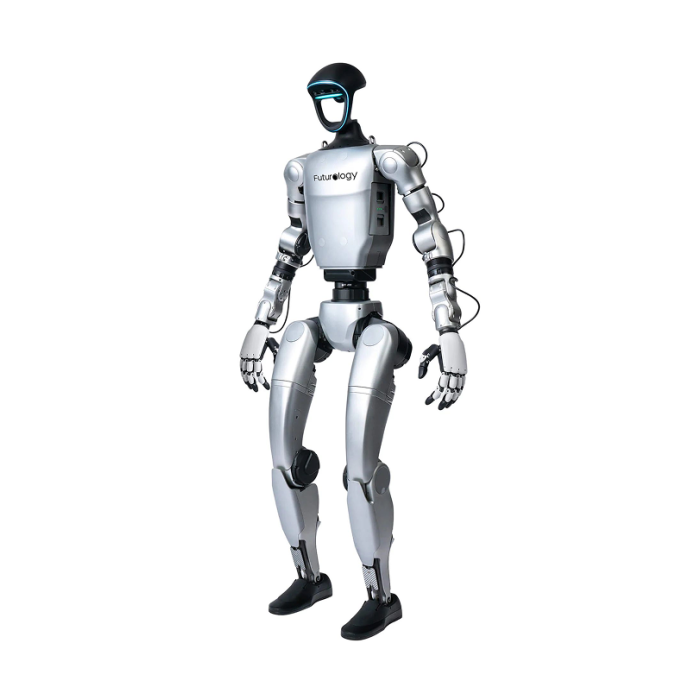
Unitree G1 Edu Pro E (U11) Humanoid Robot
In stock
- BRAND:
- UNITREE ROBOTICS
- MODEL:
- G1edu-U11
- PART #:
- G1edu-U11
- ORIGIN:
- China
- Warranty:
- 12 MONTHS
- AVAILABILITY:
- SUBJECT TO AVAILABILITY
- SKU:
- Unitree-G1edu-U11
Unitree G1 Edu Pro E (U11) Humanoid Robot
In a family with nine named configurations, the letter at the end of a model name carries more weight than any brochure photograph. A buyer choosing the Unitree G1 Edu Pro E (U11) Humanoid Robot is not simply choosing a G1. They are choosing one precise build within the developer branch of the line, with its own joint arrangement, its own feedback hardware and its own place in a research budget. That precision is the real subject of this page: what the E build carries, what it shares with the wider G1 Edu series, and what must still be settled in writing before an order is placed.
Robots Middle East sells the Unitree G1 Edu Pro E (U11) and supplies it to universities, research institutes, government innovation programmes and corporate laboratories across the Middle East. Robots Middle East prepares each quotation against the exact configuration requested, coordinates delivery to the customer's site and remains the point of contact for technical support once the robot is in service.
Background
Unitree Robotics and the G1 family
Unitree Robotics built its reputation on legged machines, first quadrupeds and then humanoids, with a consistent emphasis on making dynamic locomotion available to research and education buyers rather than reserving it for a small circle of national laboratories. The G1 is the company's compact humanoid line, and it is offered as a ladder of versions: G1 Basic, followed by the Edu series of Edu Standard (U1), Edu Plus (U2), Edu Pro A (U9), Edu Pro B (U10), Edu Pro E (U11), Edu Pro F (U12), Edu Pro G and Edu Ultimate. The full range is gathered in the Unitree G1 category. Each rung of that ladder is a distinct product, and a figure attached to one version should never be read across to another.
The Edu Pro E build and its key technology
Within that ladder, the Pro E is a development configuration. It is open to secondary development, so an institution's own software can be built on top of the platform, and it is supplied with a manual controller for direct operation during testing and demonstrations. Its whole-body arrangement offers up to 35 degrees of freedom, which gives researchers a large number of independently controllable joints to work with. The feature that most clearly marks it out on its specification sheet is the joint encoder: the Pro E uses a dual encoder arrangement. Alongside this, it inherits the sensing and communications package of the G1 Edu series, namely a depth camera paired with a 3D LiDAR, and Wi-Fi 6 with Bluetooth 5.2.
Technical Specifications
| Specification | Value |
|---|---|
| Version | G1 Edu Pro E (U11) |
| Degrees of freedom (whole robot) | Up to 35 DOF |
| Joint encoder | Dual encoder |
| Secondary development | YES |
| Manual controller | YES |
| Charger | 54V 5A |
| Sensors (G1 Edu series) | Depth camera + 3D LiDAR |
| Connectivity (G1 Edu series) | Wi-Fi 6 / Bluetooth 5.2 |
| Travel speed (G1 Edu series) | Up to 2 m/s |
Specifications are as published by the manufacturer and are confirmed against the datasheet at quotation.
A dedicated manufacturer specification page for this version, the IP rating, the operating temperature range, the maximum walking speed of the Pro E itself, the weight with hands installed and an exact list of the box contents have not been published; each of these is confirmed at quotation.
Why do dual joint encoders matter on a research humanoid?
An encoder tells the control system where a joint is. On a walking humanoid, that information feeds every balance correction, every step and every arm movement, many times a second. In general terms, a dual encoder arrangement gives the controller more than one source of positional information for a joint, which is valuable to anyone whose work depends on knowing precisely how the robot moved rather than how it was commanded to move.
For a research group, this changes the quality of the data rather than the look of the robot. Locomotion studies, learned control policies trained in simulation and transferred to hardware, and whole-body coordination experiments all rely on accurate joint feedback, both to close the control loop and to log results that can be analysed afterwards. Combined with up to 35 degrees of freedom and open secondary development, the dual encoder design positions the Pro E as a platform for measured, repeatable experimentation, not merely for scripted motion.
How does the Pro E differ from other G1 Edu versions?
The honest answer is that the differences between lettered G1 Edu versions are configuration differences, and they should be compared line by line rather than assumed. The Pro E's own sheet establishes its dual encoder, its secondary development access, its manual controller, its 54V 5A charger and a whole-body arrangement of up to 35 degrees of freedom. The depth camera with 3D LiDAR, the Wi-Fi 6 and Bluetooth 5.2 connectivity and the travel speed of up to 2 m/s are stated for the G1 Edu series as a whole.
Neighbouring versions, such as the Unitree G1 Edu Plus Humanoid Robot with Fake Hands (G1EDU-U2) or the Unitree G1 Edu Pro F (U12) Humanoid Robot, each have their own pages, and Robots Middle East does not rank one version above another here. Where a buyer is weighing two or more versions, a side-by-side comparison of joints, hands, compute and accessories is prepared as part of the quotation.
Who is the Unitree G1 Edu Pro E (U11) for?
The Pro E is aimed at organisations that intend to work inside the robot, not merely operate it. University robotics departments will find in it a platform for graduate research in locomotion, control and embodied artificial intelligence, where open development access and dependable joint feedback matter more than a polished out-of-the-box routine. Teaching laboratories can use it to move students from theory to hardware, with the manual controller providing a straightforward way to run the robot before custom code is deployed.
Corporate research and development teams exploring humanoid applications, from logistics concepts to customer-facing service roles, can use the Pro E to prototype behaviours and assess feasibility in their own facilities. System integrators building demonstrators for clients will value the combination of onboard depth and LiDAR sensing with modern wireless connectivity. Government innovation programmes and science centres in the region, which often need a platform that serves research and public engagement at once, form a further natural audience.
Buyers whose brief centres on a different specialism should review the alternatives, including the Unitree G1 EDU Pro G (U14) Humanoid Robot, and the wider Research Robots category, before settling on a configuration. Robots Middle East will advise on which version best matches the stated requirements.
What is the Unitree G1 Edu Pro E (U11) used for?
- Locomotion research: developing and testing walking, balance and recovery controllers on a full-size bipedal platform.
- Learned control: transferring policies trained in simulation to real hardware, with joint feedback to measure the gap between the two.
- Perception and mapping: building spatial awareness and navigation on the depth camera and 3D LiDAR of the G1 Edu series.
- Human–robot interaction: studying how people respond to a humanoid and designing safe, intuitive behaviours around them.
- University teaching: giving students hands-on experience with a real humanoid in robotics, mechatronics and AI courses.
- Applied pilots: prototyping service, inspection or demonstration roles before an organisation commits to a wider programme.
Pricing and Availability
The Unitree G1 Edu Pro E (U11) is supplied on quotation, because the final configuration, accessories and support package are agreed with each customer rather than fixed in advance. Robots Middle East prepares a written quotation that sets out the exact version and the items included. Delivery, customs clearance and after-sales support are arranged with the quotation, so the customer receives one coordinated offer. A request for a quotation for the Unitree G1 Edu Pro E (U11) Humanoid Robot is available on this page.
Frequently Asked Questions
Can we develop our own software for the G1 Edu Pro E?
Yes. The Pro E is open to secondary development, so your team can build its own control, perception and application software on the platform.
What sensors does the G1 Edu Pro E use?
The G1 Edu series carries a depth camera together with a 3D LiDAR, giving the robot both close-range depth perception and three-dimensional scanning of its surroundings.
How fast can the robot travel?
The G1 Edu series is listed with a travel speed of up to 2 m/s.
What kind of joint feedback does it have?
The Pro E uses a dual encoder arrangement at its joints, across a whole-body layout of up to 35 degrees of freedom.
Is a controller supplied with the robot?
Yes, the Pro E comes with a manual controller, and its charger is rated at 54V 5A.
What wireless connectivity does the G1 Edu Pro E offer?
The G1 Edu series supports Wi-Fi 6 and Bluetooth 5.2, which allows the robot to be linked to laboratory networks and development workstations.
Where can I buy the Unitree G1 Edu Pro E (U11) Humanoid Robot and what does it cost?
You can buy it from Robots Middle East, which supplies it across the Middle East. The cost depends on the agreed configuration and support package and is set out in a written quotation that you can request on this page.
Summary
The letter E is where this product's story begins and ends. It identifies a specific G1 Edu build with dual joint encoders, up to 35 degrees of freedom, open secondary development and a manual controller, sharing the depth camera, 3D LiDAR and Wi-Fi 6 with Bluetooth 5.2 of the Edu series. It also marks the point at which careful buyers stop reading across from sibling versions. Robots Middle East supplies the Pro E with that discipline: a quotation that sets out the exact configuration, with delivery and support arranged in one offer. For any team ready to choose its G1 by letter rather than by photograph, this page is the starting point.