
Unitree G1 EDU Pro G (U14) Humanoid Robot
In stock
- BRAND:
- UNITREE ROBOTICS
- MODEL:
- G1edu-U14
- PART #:
- G1edu-U14
- ORIGIN:
- China
- Warranty:
- 12 MONTHS
- AVAILABILITY:
- SUBJECT TO AVAILABILITY
- SKU:
- Unitree-G1edu-U14
Unitree G1 EDU Pro G (U14) Humanoid Robot
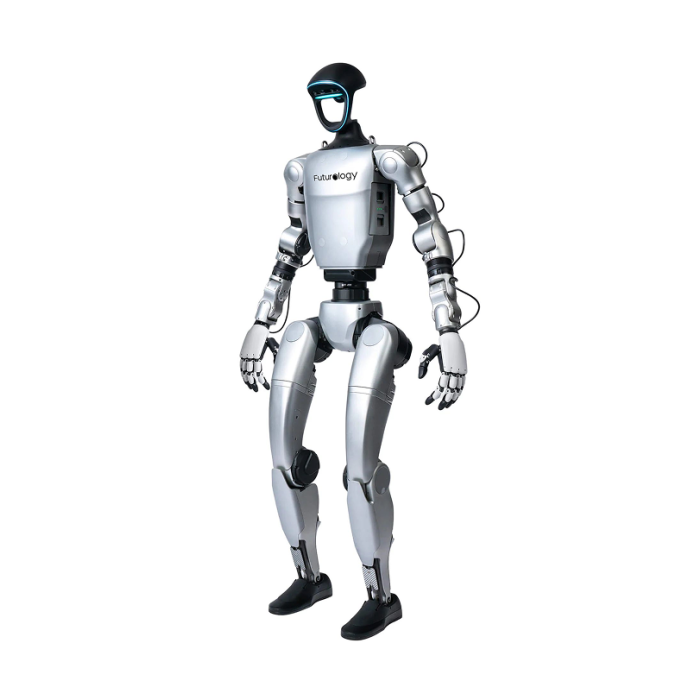
The legs of a humanoid robot attract the cameras, but the hands are where the experiments happen. In any manipulation laboratory, the questions are about grip, release, approach and recovery when an object slips, not about how gracefully the machine crossed the room. The Unitree G1 EDU Pro G (U14) Humanoid Robot is a G1 configured for exactly that kind of work. It carries two Dex2/5 hands on a body with 27 degrees of freedom, and it does so without tactile sensors. What the robot understands about an object therefore comes from the perception and control your team builds around it, not from touch sensing in the fingertips. For a group that wants to study vision-led grasping on a full humanoid body, that is a clear and candid place to begin.
Robots Middle East sells the Unitree G1 EDU Pro G (U14) Humanoid Robot to universities, research institutes, innovation centres and technology companies across the Middle East. Our team prepares the quotation for this exact configuration, arranges delivery into your country and remains your point of contact for technical support once the robot is in service.
Background
Unitree Robotics and the step from four legs to two
Unitree Robotics made its name with quadruped robots, which became familiar sights in university laboratories, industrial inspection trials and online demonstrations. Building on that experience with legged locomotion, the company moved into humanoids, and the G1 is its compact bipedal platform. Unitree positions the G1 for research, education and content work: a machine small enough to share a teaching laboratory or a studio, yet complete enough to serve as a real development platform rather than a display piece.
One platform, many configurations
Every G1 in the range is the same core platform. Unitree offers that platform as a family of named versions, from the G1 Basic and G1 PRO through the G1 Edu Standard, a series of lettered Edu Professional configurations, the G1 Edu Ultimate G, the G1 Edu Boxing and the G1-Comp. The EDU versions add a Jetson Orin NX 16GB module rated at 100 TOPS alongside the high-performance 8-core CPU, which is what turns the robot into a platform for on-board AI development. Within that family, the Professional G is defined by what it brings to the hands: two Dex2/5 hands, a total of 27 degrees of freedom, and no tactile sensor. You can see the whole family in our Unitree G1 category.
Technical Specifications
| Specification | Value |
|---|---|
| Hands fitted | 2 Dex2/5 hands |
| Degrees of freedom (total) | 27 |
| Degrees of freedom per leg | 6 |
| Tactile sensing | Tactile sensor not included |
| CPU | High-performance 8-core CPU |
| AI computing (EDU) | Jetson Orin NX 16GB, 100 TOPS |
| Connectivity | Wi-Fi 6 / Bluetooth 5.2 |
| Smart battery | 9000 mAh, quick release |
| Microphone array | 4 microphones |
| Height, width and thickness (folded) | 690x450x300mm |
Specifications are as published by the manufacturer and are confirmed against the datasheet at quotation.
Unitree has not published the weight, standing dimensions, knee torque, arm payload or battery runtime of this version, nor its IP rating or the contents of the box; we confirm each of these with you at quotation.
What does the Professional G configuration bring to the G1 platform?
The answer lies above the waist. The legs follow the series design, with 6 degrees of freedom per leg, so locomotion research carries over directly from any other G1. What sets this version apart is that it arrives with two Dex2/5 hands fitted, giving it a total of 27 degrees of freedom. Those additional joints are where grasping, handling and gesture experiments take place, and they are why a team would choose this configuration over a G1 intended mainly for walking and balance studies.
The hands are only half of the story. As an EDU version, the robot carries a Jetson Orin NX 16GB module rated at 100 TOPS alongside its 8-core CPU. That on-board computing allows perception models, grasp planners and control policies to run on the robot itself rather than on a tethered workstation, which matters when the aim is to observe a humanoid acting on its own. Wi-Fi 6 and Bluetooth 5.2 handle communication with the laboratory network and peripherals, a four-microphone array provides the audio input for voice and interaction work, and the quick-release 9000 mAh smart battery means a session can continue with a fresh pack rather than a pause for charging.
How much does the absence of tactile sensing matter?
It depends on the question your laboratory is trying to answer. Tactile sensing gives a hand direct information about contact: where an object touches the fingers and how firmly it is held. Without it, a robot has to infer contact from other signals and from the outcome of its own actions. For some research programmes, that is a limitation; for others, it is precisely the point.
A great deal of current work in embodied AI concerns manipulation guided by vision and learned models, where the challenge is to grasp reliably without rich touch feedback. A platform that leaves tactile sensing out keeps the experiment focused on that challenge and avoids paying for sensors the project will not use. Teams whose work centres on contact-rich handling, slip detection or force-sensitive tasks should raise this at the outset, and we will compare the Professional G with the other G1 configurations before you commit.
Who is the Unitree G1 EDU Pro G (U14) Humanoid Robot for?
The clearest fit is a research group working on dexterous manipulation that wants a complete humanoid body rather than a standalone arm. With hands fitted and AI computing on board, the robot lets such a group study grasping in the context of a walking, balancing machine, which is where many of the most interesting problems appear.
University departments form the second audience. A teaching laboratory can use one platform to cover legged locomotion, hand control, speech interaction and on-board AI deployment, giving students exposure to the whole stack of a modern humanoid. For institutions building a broader programme, our Research Robots range shows how the G1 sits alongside other research platforms.
Developers of embodied AI and content producers make up the third group. The robot's compact build, folding for transport, suits studios, exhibitions and demonstration centres that need a humanoid able to travel between venues.
Buyers still weighing hand options can compare this version with the Unitree G1 Edu Pro A U9 Humanoid Robot (G1EDU-U9) or the Unitree G1 Edu Pro F (U12) Humanoid Robot, and teams whose interest is combat-style demonstration will find a dedicated configuration in the Unitree G1 EDU Combat Boxing Humanoid Robot. We are glad to set out the differences in writing with your quotation.
What is the Unitree G1 EDU Pro G (U14) Humanoid Robot used for?
- Vision-led grasping research: studying how a humanoid picks up and places objects without relying on touch sensing.
- Embodied AI deployment: running perception and control models on the on-board Jetson Orin NX rather than on an external computer.
- University teaching: giving students hands-on experience of locomotion, manipulation and interaction on a single platform.
- Voice and interaction studies: using the four-microphone array for speech commands and human–robot dialogue experiments.
- Locomotion and balance work: exploring walking and whole-body control with the series-standard leg design.
- Content and demonstration: filming, exhibitions and public engagement, with a compact robot that folds for transport.
Pricing and Availability
Robots Middle East supplies this robot on quotation, so that the offer reflects the exact configuration, any accessories and the destination you require. Delivery, customs clearance and after-sales support are arranged together with the quotation. Tell us about your project, your institution and the country of delivery, and we will prepare an offer tailored to your configuration. The quotation request for the Unitree G1 EDU Pro G (U14) Humanoid Robot is available on this page.
Frequently Asked Questions
How many degrees of freedom does the Unitree G1 EDU Pro G (U14) Humanoid Robot have?
This version has 27 degrees of freedom in total, with 6 degrees of freedom in each leg.
Which hands are fitted to this version?
It is equipped with two Dex2/5 hands. Tactile sensors are not included with this configuration.
What on-board computing does the robot carry?
It combines a high-performance 8-core CPU with a Jetson Orin NX 16GB module rated at 100 TOPS, which is the computing specification of the G1 EDU versions.
How does the robot connect to other systems?
The EDU series provides Wi-Fi 6 and Bluetooth 5.2 for wireless communication.
What battery does it use?
It uses a 9000 mAh smart battery with quick release, so a depleted pack can be exchanged for a fresh one between sessions.
How large is the robot when folded?
Folded, it measures 690x450x300mm in height, width and thickness, which makes it practical to transport between laboratories and venues.
Where can I buy the Unitree G1 EDU Pro G (U14) Humanoid Robot and what does it cost?
You can buy it from Robots Middle East, which supplies it across the Middle East. The cost depends on configuration, accessories and destination, so we provide it in a written quotation that you can request on this page.
Summary
Plenty of humanoids are judged by how they walk; this one is best judged by what it does with its hands. The Unitree G1 EDU Pro G (U14) Humanoid Robot pairs two Dex2/5 hands and 27 degrees of freedom with EDU-grade on-board computing, a four-microphone array and a quick-release battery, all on the shared G1 platform. Its lack of tactile sensing makes it a focused tool for vision-led manipulation and embodied AI rather than for contact-rich force work, and knowing that from the outset is what makes it a sound choice. Robots Middle East will help you settle the remaining details and supply the robot to your institution; for any team ready to put a humanoid's hands to work, this page is the starting point.