
Unitree H2-D Standard A Humanoid Robot
In stock
- BRAND:
- UNITREE ROBOTICS
- MODEL:
- H2-D-Standard-A
- PART #:
- H2-D-Standard-A
- ORIGIN:
- China
- Warranty:
- 12 MONTHS
- AVAILABILITY:
- SUBJECT TO AVAILABILITY
- SKU:
- Unitree-H2-D-Standard-A
Unitree H2-D Standard A Humanoid Robot
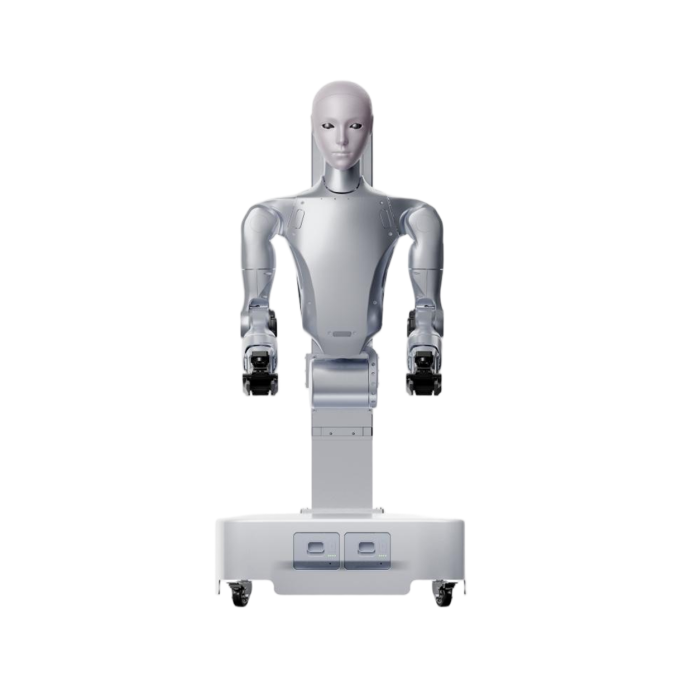
Robots in industry tend to be either talkers or doers. Service robots greet visitors, answer questions and point the way, but they rarely lift anything heavier than a tablet. Industrial arms move heavy parts with great precision, but they stay silent and fenced off from the people around them. The Unitree H2-D Standard A Humanoid Robot refuses that division. It pairs a humanoid upper body that carries a meaningful load in each hand with a microphone array and a high-power speaker, so the same machine that handles components can also hold a conversation with the person who asked for them. It does this from a lifting column mounted on a manual-move chassis rather than on a pair of legs, which changes what a buyer should expect from it and where it belongs.
Robots Middle East sells the Unitree H2-D Standard A Humanoid Robot and supplies it to industrial sites, commercial operators, universities and research laboratories across the Middle East. Our team prepares each quotation for the configuration you require, arranges delivery to your site and provides support once the robot is in service, so that one point of contact covers the whole path from first enquiry to everyday operation.
Background
Unitree Robotics and the H2 Series
Unitree Robotics built its reputation on legged robots and has since extended its range into humanoid platforms for research and applied work. The H2 Series is its dual-arm humanoid family, and it is organised into two product lines, H2-D and H2-A. Together they are designed to support different deployment configurations for industrial operations, commercial services, research and development, and embodied intelligence training. The sources name three versions: the H2-A Standard with a fixed base, the H2-D Standard with a manual-move chassis, and the H2-D Flagship with a mobile chassis. The H2-D Standard A belongs to the middle of these, the version that can be repositioned by hand between tasks without being permanently anchored and without a self-driving base.
A column in place of legs
The defining choice in the H2-D Standard is the way it reaches its work. Instead of balancing on two legs, the upper body rides on a vertical lifting column, can pitch forward at the waist and can rotate in place about its vertical axis. Unitree combines waist pitch adjustment, the vertical travel of the column and whole-body coordination algorithms to extend the operational workspace, so that the arms can manipulate objects anywhere from ground level up to 2 meters. Freed from the work of staying upright, the machine can devote its structure and its power budget to the task in front of it. The frame is built from aerospace-grade aluminium, titanium alloy and high-strength engineering plastics, and the robot can run from a quick-release base battery or from a direct power supply for continuous operation.
Technical Specifications
| Specification | Value |
|---|---|
| Product line | H2 Series, H2-D line |
| Version | H2-D Standard (Manual-Move Chassis) |
| Total weight (with battery) | Approx. 148Kg |
| Overall dimensions, minimum column height | 1200x560x605mm |
| Overall dimensions, maximum column height | 1700x560x605mm |
| Rated payload | Up to 7 kg per arm |
| Lift speed | Up to 200 mm/s |
| Waist joint range of motion | Pitch: 0°-115° |
| Turning | ±90° in-place Z-axis rotation |
| Workspace height | From ground level up to 2 meters |
| Materials | Aerospace-Grade Aluminum, Titanium Alloy, and High-Strength Engineering Plastics |
| Battery | Quick-Release Base Battery: 48V/18Ah (864Wh) |
| Direct power supply | 7*24H |
| Voice interaction | Microphone Array & High-Power Speaker |
| Wireless connectivity | WiFi 6 & Bluetooth 5.2 |
| End effectors | Optional 2-Finger Gripper / 3-Finger Dexterous Hand / 5-Finger Dexterous Hand |
| High-performance computing module | Multiple brands and models available, such as Thor |
| Secondary development | Supports secondary development and system customisation |
Specifications are as published by the manufacturer and are confirmed against the datasheet at quotation.
The manufacturer has not published a separate height figure, the joint motor peak speed, the battery life on battery power, the battery charge time, the IP rating, the noise level, the operating temperature range, the included accessories or the names of the software and SDK, so we confirm each of these with you at quotation.
What makes the H2-D Standard different from the H2-A and the H2-D Flagship?
The three versions in the H2 Series share the idea of a dual-arm humanoid upper body, but they differ in how that body relates to the floor. The H2-A Standard sits on a fixed base, which suits a workstation that will not move. The H2-D Flagship stands on a mobile chassis, intended for deployments where the robot itself travels between locations. The H2-D Standard takes the middle ground with a manual-move chassis: it can be wheeled by staff from one cell, counter or laboratory bench to another, then set to work at its new position.
For many buyers that middle ground is the practical one. A production engineer may want to trial the robot at several stations before committing to a permanent layout. A research group may share one platform between projects in different rooms. A commercial operator may move it between a reception area and a back-of-house space depending on the day. In each case the ability to relocate the robot by hand matters more than autonomous driving, and a fixed base would be too restrictive. At the new location the column, waist and in-place rotation take over, giving the arms their working envelope without further movement of the chassis.
How far can the Unitree H2-D Standard A reach, and what can it carry?
Reach in this design comes from several joints working together rather than from long arms alone. The lifting column moves at up to 200 mm/s and changes the overall height of the machine between its two published configurations, 1200x560x605mm at minimum column height and 1700x560x605mm at maximum. The waist pitches through 0°-115°, which lets the upper body lean down towards the floor or over a bench, and the robot turns ±90° in place about its Z-axis to face a neighbouring surface without moving the chassis. Coordinated by Unitree's whole-body algorithms, these motions give a manipulation range from ground level up to 2 meters.
Each arm is rated for a payload of up to 7 kg, which Unitree presents as suitable for handling and assembling heavy industrial components. What the hands do with that load depends on the end effector chosen: a 2-finger gripper for straightforward pick-and-place, or a 3-finger or 5-finger dexterous hand where grasping varied or delicate objects is the aim. The computing module is equally configurable, with several brands and models offered, so the choice of hand and compute should be settled together when the configuration is specified.
Who is the Unitree H2-D Standard A Humanoid Robot for?
Manufacturers exploring humanoid automation are an obvious audience. The combination of payload per arm, a workspace that runs from the floor to head height and a chassis that can be moved between cells allows pilot projects in assembly, kitting and material handling without rebuilding the line around the robot. Continuous operation on direct power suits stations that run across several shifts.
Commercial service operators form a second group. The microphone array and high-power speaker support natural voice interaction, so the robot can address visitors or customers while it hands over items, demonstrates products or carries out simple tasks behind a counter.
Universities, research institutes and corporate laboratories working on embodied intelligence make up a third. Support for secondary development and system customisation, a choice of computing modules and a choice of hands make the platform a base for experiments in manipulation, perception and human-robot interaction, and for collecting training data.
Where a station will never move, the fixed-base H2-A Standard may be the better fit; where the robot must travel under its own power, the H2-D Flagship with its mobile chassis is the version to discuss with us. Within the manual-move line, the full range of lettered configurations is collected under H2-D Standard, including the Unitree H2-D Standard B Humanoid Robot and the Unitree H2-D Standard C Humanoid Robot, and the wider family is shown under Unitree H2-D. Our team will explain how each configuration differs when preparing your quotation.
What is the Unitree H2-D Standard A Humanoid Robot used for?
- Component handling and assembly — moving and fitting industrial parts within the rated payload of each arm.
- Floor-to-shelf picking — reaching items from ground level up to shelf height by combining column lift and waist pitch.
- Multi-station pilot projects — being wheeled between workcells to test humanoid automation before a layout is fixed.
- Customer-facing service — greeting, informing and handing over items through natural voice interaction.
- Embodied intelligence research — serving as a customisable platform for manipulation, perception and learning experiments.
- Training data collection — recording demonstrations of dual-arm tasks with interchangeable grippers and dexterous hands.
Pricing and Availability
The cost of the Unitree H2-D Standard A depends on the configuration you specify, above all the end effector and the computing module, together with any customisation your project requires. Robots Middle East therefore prices each order by quotation, so that the figure you receive reflects the exact build you intend to deploy. Delivery, customs clearance and after-sales support are arranged together with your quotation. To begin, tell us about your application and the configuration you have in mind using the quotation request available on this page.
Frequently Asked Questions
Does the Unitree H2-D Standard A walk?
No. It uses a lifting column on a manual-move chassis instead of legs, and it is repositioned by hand between work locations.
How much can each arm carry?
The rated payload is up to 7 kg per arm, which Unitree describes as suitable for handling and assembling heavy industrial components.
What height range can it work across?
Through waist pitch, column lift and whole-body coordination, it manipulates objects from ground level up to 2 meters.
How is the robot powered?
It carries a quick-release base battery rated at 48V/18Ah (864Wh) and can also run from a direct power supply for 7*24H operation.
Which hands can be fitted?
The options are a 2-Finger Gripper, a 3-Finger Dexterous Hand or a 5-Finger Dexterous Hand, chosen to suit the objects your application handles.
Can we develop our own software for it?
Yes. The H2-D Standard supports secondary development and system customisation, and a choice of high-performance computing modules is available.
Where can I buy the Unitree H2-D Standard A Humanoid Robot and what does it cost?
You can buy it from Robots Middle East, which supplies it across the Middle East. The cost depends on the configuration, so we provide it in a tailored quotation that also covers delivery and support.
Summary
The Unitree H2-D Standard A Humanoid Robot answers a simple question: why should a robot that works with its hands not also speak with the people it serves? By swapping legs for a lifting column, a pitching waist and in-place rotation on a manual-move chassis, Unitree has put its effort into reach, payload and endurance, then added voice interaction, wireless connectivity and a choice of hands and computing modules on top. The result is a machine that can handle components in a workcell in the morning and explain its task to a visitor in the afternoon, and that can be wheeled to wherever it is needed next. For manufacturers, service operators and research teams in the region who want both capabilities in one platform, Robots Middle East quotes, delivers and supports the robot, and this page is the starting point.