
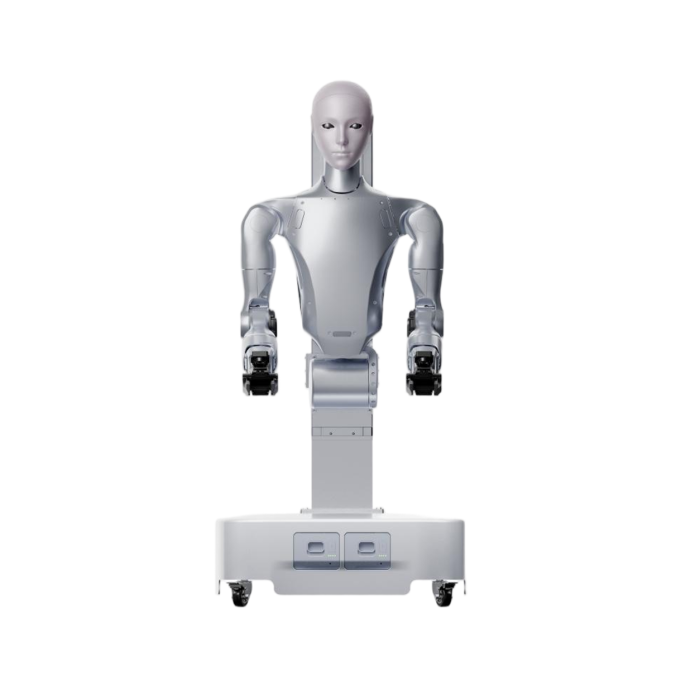
Unitree H2-D Standard B Humanoid Robot
In stock
- BRAND:
- UNITREE ROBOTICS
- MODEL:
- H2-D-Standard-B
- PART #:
- H2-D-Standard-B
- ORIGIN:
- China
- Warranty:
- 12 MONTHS
- AVAILABILITY:
- SUBJECT TO AVAILABILITY
- SKU:
- Unitree-H2-D-Standard-B
Unitree H2-D Standard B Humanoid Robot
Most robot arms are installed at one height, and the work is brought to them. People do the opposite: they bend at the waist, rise towards a high shelf and turn their head to check what their hands are doing. The Unitree H2-D Standard B Humanoid Robot borrows that habit. Its two arms, pitching waist and two-axis head sit on a lift column that raises, lowers and turns the whole upper body. A single platform can therefore address a bench, a trolley and a shelf without being re-mounted. For laboratories and integrators who want human-scale manipulation rather than another fixed cell, that adjustability is the point.
Robots Middle East supplies the Unitree H2-D Standard B Humanoid Robot to universities, research centres and companies across the Middle East. Robots Middle East prepares the quotation for the chosen configuration, arranges delivery to the customer's site and supports the platform after installation. One point of contact handles the robot from the first enquiry through to commissioning and beyond.
Background
Unitree Robotics and its humanoid range
Unitree Robotics built its reputation on legged robots, bringing quadrupeds out of research laboratories and into commercial use, and then extended that engineering to full humanoids. The H2 family continues this line and includes several versions: the H2-D Standard, the H2-D Flagship and the H2-A Standard. The store lists the H2-D Standard in a number of lettered configurations, and this page covers the B. The wider family can be browsed in the Unitree H2-D category, and the lettered configurations of this version are grouped under H2-D Standard.
An upper body that changes height
The H2-D Standard has 19 degrees of freedom, distributed as dual arms of seven each, one in the waist, two in the head and two in the lift column. The waist moves in pitch, so the torso can lean towards a work surface. The column provides vertical lift and yaw, so the entire upper body can rise, descend and rotate to face a new station. The robot draws its energy from a direct power supply rated for 7*24H operation. Two onboard computers divide the workload: PC1, an Intel Core i5, runs the platform capabilities, while PC2, an Intel Core i7, is reserved for custom development. A high-performance computing module can be added, with multiple brands and models available, such as Thor.
Technical Specifications
| Specification | Value |
|---|---|
| Total degrees of freedom | 19 |
| DOF breakdown | Dual arms 7*2 + Waist 1 + Head 2 + Lift Column 2 |
| Waist DOF | Pitch |
| Lift column DOF | Vertical Lift, Yaw |
| Maximum arm payload | Peak: ~15 kg; Rated: ~7 kg |
| Maximum arm joint torque | 120N.M |
| End-effector options | Optional 2-Finger Gripper / 3-Finger Dexterous Hand / 5-Finger Dexterous Hand |
| Base computing | PC1: Intel Core i5 (Platform Capabilities); PC2: Intel Core i7 (Custom Development) |
| High-performance computing module | Multiple brands and models available, such as Thor |
| Perception sensors | Humanoid Binocular Camera with Wide Field of View ×1; Wrist HD Camera ×2 |
| Wireless connectivity | WiFi 6 & Bluetooth 5.2 |
| Power | Direct Power Supply: 7*24H |
| Handheld controller | Yes |
| Visualisation PC | Yes |
| Intelligent OTA updates | Yes |
| Secondary development | Yes |
Specifications are as published by the manufacturer and are confirmed against the datasheet at quotation.
The manufacturer has not published the IP rating, the charging time, the operating temperature range, the camera resolution, the operating system, the noise level or a full list of package contents; Robots Middle East confirms these at quotation.
How does the H2-D Standard B differ from a fixed collaborative arm?
A collaborative arm on a pedestal offers one kinematic chain and one working envelope. The H2-D Standard B offers two arms of seven degrees of freedom each, and seven joints give each arm a redundant axis. The elbow can therefore be repositioned while the hand holds its pose, which matters when reaching around fixtures or past the other arm. Above the arms, the two-axis head carries the wide-field binocular camera, so the robot can direct its gaze at the task in the way a person would. A further HD camera on each wrist watches the grasp at close range.
The decisive difference is the lower body. Instead of fixing the shoulders at one height, the lift column moves the whole upper body vertically and rotates it in yaw, while the waist pitches the torso forward. The same robot can work at a low bench, then rise and turn towards a higher shelf. A fixed arm would need either a larger reach or a second installation to do the same.
Load planning follows the two payload figures. The rated arm payload of ~7 kg is the sensible basis for repeated work, while the peak figure of ~15 kg describes the upper limit. The maximum arm joint torque is 120N.M. Because the robot runs from a direct power supply rated for 7*24H, sessions are limited by the experiment rather than by a battery. The trade-off is that the platform is designed for a defined workspace: its motion comes from the arms, waist, head and lift column, whereas the H2-D Flagship offers a maximum mobility speed of up to 1.5 m/s.
Which hand and computing set-up should you specify?
The end effector is a choice rather than a fixed feature. The optional 2-Finger Gripper suits pick-and-place work, where a reliable parallel grasp is worth more than dexterity. The 3-Finger Dexterous Hand adds the ability to wrap around irregular shapes. The 5-Finger Dexterous Hand is the natural choice for research into human-like manipulation and for teams that collect demonstration data intended to transfer between human and robot hands.
Computing follows a similar logic. With PC1 dedicated to platform capabilities and PC2 to custom development, a team can run its own code without competing for resources with the robot's base functions. Where a project involves heavier on-device inference, the optional high-performance computing module, available in models such as Thor, adds capacity. Secondary development is supported, intelligent OTA updates keep the base software current, and WiFi 6 and Bluetooth 5.2 connect the robot to the surrounding network. A handheld controller and a visualisation PC are listed for the platform. Robots Middle East sets out the exact hand, module and accessory combination in writing before the order is placed.
Who is the Unitree H2-D Standard B Humanoid Robot for?
The first audience is research groups working on bimanual manipulation and embodied intelligence, for whom two redundant arms, head-mounted stereo vision and wrist cameras form a coherent sensing and acting system. The second is university departments that teach robotics and need a platform that students can program through secondary development rather than merely operate. The third is system integrators and industrial innovation teams who wish to evaluate humanoid manipulation at real working heights before committing to a deployment, and who value continuous operation from mains power during long trials.
Buyers whose application depends on the robot moving between rooms should look at the H2-D Flagship, which offers a maximum mobility speed of up to 1.5 m/s. Buyers comparing lettered configurations of the H2-D Standard, such as the Unitree H2-D Standard A Humanoid Robot or the Unitree H2-D Standard M Humanoid Robot, are advised to ask Robots Middle East for a side-by-side comparison of what each configuration includes.
What is the Unitree H2-D Standard B Humanoid Robot used for?
- Bimanual manipulation research: studying coordinated two-arm grasping, handover and assembly with redundant arms.
- Embodied AI data collection: recording demonstrations through the binocular head camera and the wrist HD cameras for policy learning.
- Dexterous hand studies: comparing gripper, three-finger and five-finger end effectors on the same platform.
- Workstation automation trials: testing tasks across benches and shelves at different heights using the lift column.
- Robotics teaching: giving students a humanoid upper body with a dedicated development computer for their own code.
- Long-duration experiments: running extended test cycles from the direct power supply without battery interruptions.
Pricing and Availability
Robots Middle East prices the Unitree H2-D Standard B Humanoid Robot by quotation, because the final configuration depends on the end effector, the optional computing module and the accessories chosen. Delivery, customs clearance and after-sales support are arranged together with the quotation. To begin, please share your intended application and preferred hand option, and request a quotation for the Unitree H2-D Standard B Humanoid Robot using the enquiry options available on this page.
Frequently Asked Questions
How many degrees of freedom does the H2-D Standard B have?
The H2-D Standard has 19 degrees of freedom: seven in each arm, one in the waist, two in the head and two in the lift column. The waist moves in pitch, and the column provides vertical lift and yaw.
How is the robot powered?
It runs from a direct power supply rated for 7*24H operation. This allows long sessions without stopping to recharge.
Which hands can be fitted?
The optional end effectors are a 2-Finger Gripper, a 3-Finger Dexterous Hand and a 5-Finger Dexterous Hand. The selected option is specified in the quotation from Robots Middle East.
Can we develop our own software for it?
Yes. Secondary development is supported, PC2 with an Intel Core i7 is dedicated to custom development, and intelligent OTA updates keep the base software current.
What cameras does the robot carry?
It carries one humanoid binocular camera with a wide field of view on its head and two wrist HD cameras that observe the grasp at close range.
Can the H2-D Standard B move around a facility?
Its motion comes from the arms, waist, head and lift column. The H2-D Flagship offers a maximum mobility speed of up to 1.5 m/s, so buyers who need travel between locations should discuss that version with Robots Middle East.
Where can I buy the Unitree H2-D Standard B Humanoid Robot and what does it cost?
You can buy it from Robots Middle East, which supplies it across the Middle East. The cost depends on the configuration you choose and is set out in a written quotation, which you can request from this page.
Summary
The Unitree H2-D Standard B Humanoid Robot answers a simple question that fixed arms leave open: what if the robot could adjust itself to the work, rather than the other way round? Its lift column, pitching waist and moving head carry two seven-axis arms to wherever the task sits, while stereo and wrist cameras, two dedicated computers and an optional high-performance module give researchers and integrators the tools to make use of that reach. A direct power supply keeps it working for as long as the project requires. Robots Middle East quotes, delivers and supports the platform across the region, and for anyone planning human-scale manipulation at real working heights, this page is the starting point.