
Unitree R1-A5-D Smart G Humanoid Robot
In stock
- BRAND:
- UNITREE ROBOTICS
- MODEL:
- R1-A5-D-Smart-G
- PART #:
- R1-A5-D-Smart-G
- ORIGIN:
- China
- Warranty:
- 12 MONTHS
- AVAILABILITY:
- SUBJECT TO AVAILABILITY
- SKU:
- Unitree-R1-A5-D-Smart-G
Unitree R1-A5-D Smart G Humanoid Robot
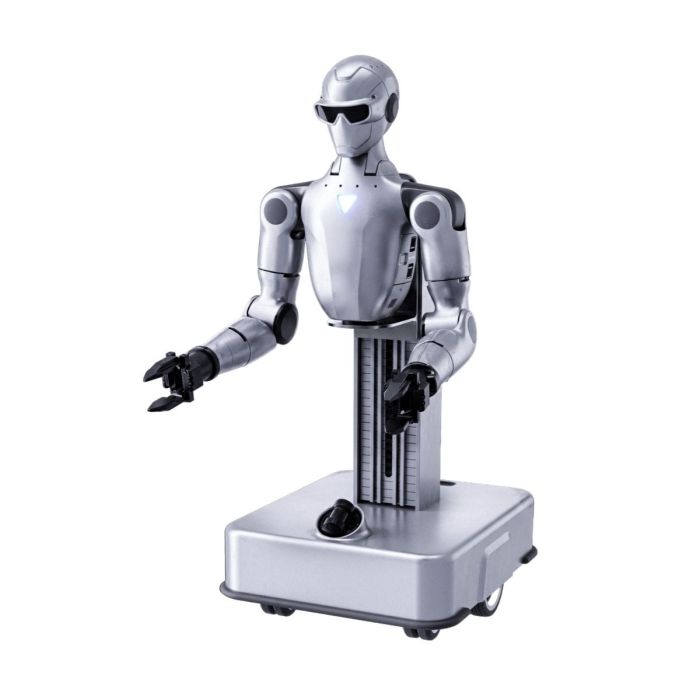
Every mobile robot lives with a trade-off between the freedom of a battery and the endurance of a cable. A platform that can only run untethered is limited by its charge; one that must stay plugged in never leaves the bench. The Unitree R1-A5-D Smart G Humanoid Robot avoids that choice: it runs either from external power or from its Li-ion battery, so the same robot can spend a long development session connected at the workstation and then move off on its chassis for a demonstration or a field trial. Combined with a body that folds down for transport and rises to working height, a binocular head with its own computing module and a choice of end effectors, it is a platform designed to follow a project from the laboratory to the place where the work happens.
Robots Middle East sells and supplies the Unitree R1-A5-D Smart G Humanoid Robot across the Middle East, working with universities, research institutes, integrators and corporate innovation teams throughout the region. Robots Middle East prepares each quotation for the exact configuration requested, arranges delivery and customs clearance, and provides support after the robot has been installed.
Background
Unitree Robotics and the R1 family
Unitree Robotics built its reputation on agile legged robots before extending its range to humanoid platforms intended for research, education and applied development. The R1 family continues that direction with a range of versions: R1-A5, R1-A7, R1-A5-D, R1-A7-D, R1-A5-D Smart G and R1-A5-D Ultimate. The Smart G is a configuration of the R1-A5-D, and the figures on this page are those of the R1-A5-D platform. The package contents of the Smart G are agreed when the configuration is chosen, so that buyers compare like with like when considering other listings in the Unitree R1-A5-D range.
Joint technology and perception
At the heart of the platform's movement is Unitree's joint design. Each joint uses a low-inertia, high-speed inner rotor PMSM, a motor type chosen for superior responsiveness and heat dissipation, and the joint output is carried by a crossed roller bearing combined with a deep groove ball bearing. For a robot that reaches, turns and holds positions repeatedly during development work, responsive drives and robust bearings matter as much as any headline figure. Perception is handled by a chassis LiDAR and a binocular camera in the head, with an optional wrist camera, while a head module providing 10 TOPS of computing power runs on-board processing. Wireless connectivity through WiFi 6 and Bluetooth 5.2 links the robot to development machines and networks, and secondary development is supported.
Technical Specifications
| Specification | Value |
|---|---|
| Weight (R1-A5-D) | Approx. 30kg |
| Shrunk size (R1-A5-D) | 683x520x440mm |
| Raised size (R1-A5-D) | 1600x520x440mm |
| Waist joint motion range (R1-A5-D) | Yaw±35° |
| Head joint motion range (R1-A5-D) | Yaw±115° Pitch±36° |
| Joint motor | Low-Inertia High-Speed Inner Rotor PMSM (Superior Responsiveness & Heat Dissipation) |
| Joint output bearing | Crossed Roller + Deep Groove Ball |
| Camera module (R1-A5-D) | Chassis LiDAR + Binocular Camera + Optional Wrist Camera |
| Binocular field of view | Horizontal 146°, Vertical 124° |
| Binocular eye spacing | 60mm |
| Head module computing power | 10 TOPS |
| Speakers | Dual Speakers (3W×2) |
| Wireless | WiFi 6 & Bluetooth 5.2 |
| Power supply | External Power or Li-ion Battery |
| Battery life (battery-powered) | Approx. 1.5h |
| End effector options | Optional two-finger gripper / three-finger dexterous hand / five-finger dexterous hand |
| Secondary development | Supported |
Specifications as published by the manufacturer; confirmed against the datasheet at quotation.
Unitree has not published the box contents, the IP rating, the chassis drive speed, the lifting column payload, the operating temperature or the chassis battery capacity; Robots Middle East confirms these at quotation.
Battery or external power: which suits your application?
The dual power arrangement shapes how the robot is best used. On battery, the platform runs for approximately 1.5 hours, which suits demonstrations, visitor sessions, short data-collection runs and trials in spaces where trailing a cable would be impractical or unsafe. For longer sessions, such as training manipulation policies, tuning control software or running repeated grasping experiments at a fixed station, external power removes the time limit and lets the team work without interruption.
In practice, many teams will use both: development and testing take place on external power at the bench, and the battery comes into play when the robot needs to move to another room, a showroom floor or a client site. Because the chassis carries its own LiDAR, the robot can be brought into new spaces and perceive them without additional fixed infrastructure. Planning around the battery life from the outset helps a project schedule its untethered work realistically.
What does the head module bring to the R1-A5-D Smart G?
The head is more than a camera mount. Its binocular camera, with eyes spaced 60mm apart, covers a horizontal field of view of 146° and a vertical field of view of 124°, giving the robot a broad view of the workspace in front of it. Stereo cameras of this kind provide depth cues that are valuable for locating objects before reaching for them. The head itself turns through Yaw±115° and Pitch±36°, so the robot can look across a work surface, down at a shelf or towards a person without moving its base, while the waist adds Yaw±35° of rotation.
Processing sits close to the sensors: the head module delivers 10 TOPS of computing power for on-board perception tasks, and dual 3W speakers allow the robot to speak to the people around it. For developers, this means vision, audio output and local computation are integrated into one assembly, reducing the amount of external hardware needed to build an interactive or perception-led application. Secondary development support allows teams to bring their own software to that hardware.
Who is the Unitree R1-A5-D Smart G Humanoid Robot for?
University laboratories working on embodied AI, mobile manipulation and human-robot interaction are a natural fit. The combination of a mobile chassis, a height-changing body and interchangeable end effectors allows a single platform to support several research lines, and secondary development means students and researchers can work directly with its capabilities.
Systems integrators and corporate innovation teams across the Middle East will find it useful for proof-of-concept work in logistics, retail and service settings, where a robot must move to a location, observe it and handle objects at different heights. Technical colleges and training centres can use it to teach perception, motion and robot programming on a platform that reflects current humanoid design.
Buyers who wish to compare configurations should review the Unitree R1-A5-D Mobile Base Dual-Arm Humanoid Robot and the other packages in the Unitree R1-A5-D category; Robots Middle East can explain the differences in package contents for each option.
What is the Unitree R1-A5-D Smart G Humanoid Robot used for?
- Mobile manipulation research – developing and testing algorithms that combine navigation, perception and grasping on one platform.
- Embodied AI data collection – gathering vision and motion data for training learning-based control policies.
- Dexterous handling studies – comparing grippers and dexterous hands on the same body for different grasping tasks.
- Human-robot interaction – exploring how a speaking, looking humanoid engages visitors, customers or staff.
- Robotics education – giving students hands-on experience with perception, joint control and software development.
- Service and retail pilots – evaluating how a mobile humanoid performs reaching and presenting tasks in real environments.
Pricing and Availability
Robots Middle East supplies the Unitree R1-A5-D Smart G Humanoid Robot by quotation, prepared for the configuration and end effector your project requires. Delivery, customs clearance and after-sales support are arranged together with the quotation. To begin, tell us about your application and preferred options, and a tailored quotation is available on this page.
Frequently Asked Questions
How does the size of the robot change?
The R1-A5-D has a shrunk size of 683x520x440mm and a raised size of 1600x520x440mm. The footprint stays the same in both positions, which helps with transport and storage.
Can the robot run on battery?
Yes. It runs from external power or from a Li-ion battery, with a battery life of approximately 1.5 hours.
Which end effectors can be fitted?
The options are a two-finger gripper, a three-finger dexterous hand and a five-finger dexterous hand. The end effector supplied with your order is agreed when you configure it.
What sensors does the robot use?
The R1-A5-D carries a chassis LiDAR and a binocular camera, with an optional wrist camera. The binocular camera covers 146° horizontally and 124° vertically.
Can we develop our own software for it?
Secondary development is supported, and the robot connects through WiFi 6 and Bluetooth 5.2. Robots Middle East can advise on the development resources included with your configuration.
Can the robot speak to people?
Yes. Dual speakers (3W×2) give the robot a voice, and its head turns through Yaw±115° to face the person it is addressing.
Where can I buy the Unitree R1-A5-D Smart G Humanoid Robot and what does it cost?
You can buy it from Robots Middle East, which supplies it across the Middle East. The cost depends on the configuration and options chosen, and is provided in a quotation requested through this page.
Summary
The Unitree R1-A5-D Smart G Humanoid Robot resolves the familiar tension between tethered endurance and untethered freedom by offering both: external power for long development sessions and a Li-ion battery for work away from the bench. Around that flexibility sit a body that shrinks for transport and rises to working height, a binocular head with 10 TOPS of on-board computing, responsive inner rotor joint motors and a choice of grippers and dexterous hands. For research groups, integrators and educators in the region who want one platform to carry a project from experiment to demonstration, with Robots Middle East handling supply and support, this page is the starting point.