
Unitree R1-A5-D Mobile Base Dual-Arm Humanoid Robot
In stock
- BRAND:
- UNITREE ROBOTICS
- MODEL:
- R1-A5-D
- ORIGIN:
- China
- Warranty:
- 12 MONTHS
- AVAILABILITY:
- SUBJECT TO AVAILABILITY
- SKU:
- Unitree-R1-A5-D
Unitree R1-A5-D Mobile Base Dual-Arm Humanoid Robot
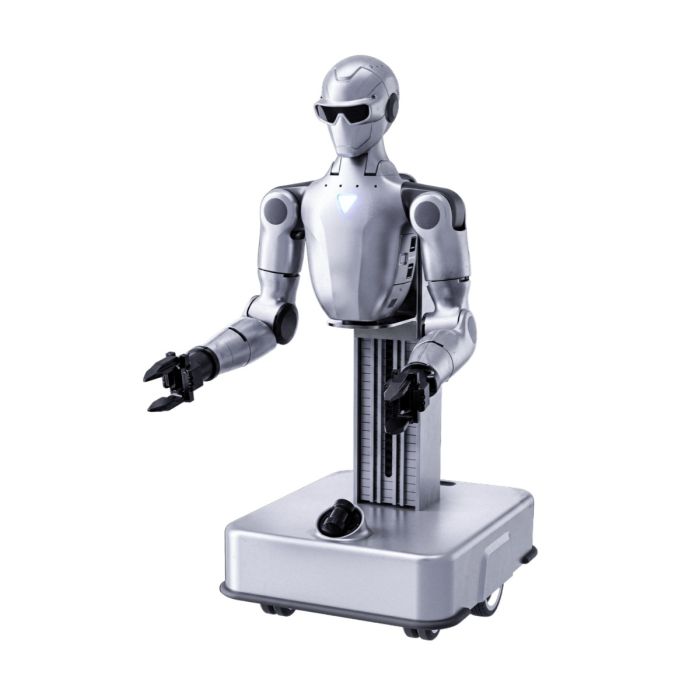
Ask a robot to fetch a sample from a bench on the far side of a laboratory and three separate problems appear at once: getting there, seeing the object clearly, and closing a hand around it. Most platforms solve one of these well and borrow the rest. The Unitree R1-A5-D Mobile Base Dual-Arm Humanoid Robot answers all three in a single machine. A chassis carrying LiDAR covers the floor, a binocular head with a wide field of view reads the scene, and two arms accept grippers or dexterous hands for the final stage of the task. Its lifting body adds a fourth answer, to a question many buyers only ask later: where does all this equipment go when the work is done?
Robots Middle East supplies the R1-A5-D to universities, research centres, system integrators and corporate innovation teams across the Middle East. Our team prepares the quotation for the configuration you require, arranges delivery to your site and remains your point of contact for technical support once the robot is in service.
Background
Unitree Robotics and the R1 family
Unitree Robotics is a Chinese manufacturer that built its reputation on agile legged robots before extending its range into humanoids. The R1 family is one of its humanoid lines, and the sources name four versions within the branch discussed here: R1-A5, R1-A7, R1-A5-D and R1-A7-D. Each version keeps its own specification, so the figures on this page belong to the R1-A5-D unless a line is stated for the family as a whole. The wider range is presented on the Unitree R1 category page.
A body that changes height
The defining feature of the R1-A5-D is a body that rises and lowers. In its shrunk state the robot measures 683x520x440mm; raised, it reaches 1600x520x440mm, while the other two dimensions stay the same. The same machine can therefore be stored or moved in a compact form and then brought up to a working height at which its arms and binocular head operate at a scale suited to benches, counters and people. The -D designation brings a lumbar joint with a movement range of ±35°, giving the torso its own freedom of movement relative to the base, and the head moves through ±115° of yaw and ±36° of pitch. At approximately 30kg, the robot remains a manageable unit for a laboratory or demonstration space.
Technical Specifications
| Specification | Value |
|---|---|
| Shrunk size | 683x520x440mm |
| Raised size | 1600x520x440mm |
| Weight | Approx. 30kg |
| Body processor | 8-core high-performance CPU |
| Binocular field of view | Horizontal 146°, Vertical 124° |
| Binocular eye spacing | 60mm |
| Lumbar joint movement (Model -D) | ±35° |
| Cervical joint range | Yaw ±115°, Pitch ±36° |
| Sensors | Chassis LiDAR + Binocular Camera + Optional Wrist Camera |
| Voice | 4-array microphone + dual speakers |
| Speakers | Dual Speakers (3W×2) |
| Battery life (battery-powered) | Approx. 1.5h |
| Wireless | WiFi 6 & Bluetooth 5.2 |
| End effectors | Optional two-finger gripper / three-finger dexterous hand / five-finger dexterous hand |
| Add-on compute module | Multiple brands and models available, such as Orin (40-100TOPS) |
| Secondary development | Open interfaces for the underlying system, robotic arm, audio, lighting, visual control, etc. |
| Smart OTA update | Yes |
Specifications are as published by the manufacturer and are confirmed against the datasheet at quotation.
The manufacturer has not published the battery capacity, the chassis maximum speed, the IP rating, the LiDAR model or the operating temperature; we confirm these with you at quotation.
What does the -D designation bring to the R1-A5?
The suffix matters because the waist is where reach is won or lost. Unitree's -D models have a lumbar movement range of ±35°, which means the R1-A5-D can move its upper body relative to the chassis rather than relying on the base alone to reposition the arms. In practice, a robot that can turn or lean at the waist can address a second work surface, follow a visitor who has stepped to one side, or bring an object into view of its cameras without a full manoeuvre of the base.
That waist works together with the rest of the perception chain. The sensor set listed for the R1-A5-D combines chassis LiDAR, the binocular camera in the head and an optional wrist camera. LiDAR gives the base its sense of the room; the binocular head, with a horizontal field of view of 146° and a vertical one of 124°, takes in a broad scene; and a wrist camera, where fitted, gives the arm a close view at the moment of grasping. The ±115° yaw and ±36° pitch of the neck widen what the head can survey before the body moves at all.
The sources also name the R1-A7 and R1-A7-D. We do not transfer figures from one version to another, so if you are weighing the R1-A5-D against those versions, our team will set out the differences in writing alongside your offer.
How far can the R1-A5-D be developed beyond its factory set-up?
For many buyers, the robot is the beginning of a project rather than the end of one. Unitree provides open interfaces for the underlying system, the robotic arm, audio, lighting and visual control, so teams can write their own behaviours instead of working only with pre-built routines. This is the difference between demonstrating a robot and building something with it.
Computing headroom is addressed through add-on compute modules, with multiple brands and models available, such as Orin modules rated at 40-100TOPS. That gives research groups room to run heavier perception or learning workloads on the robot itself, alongside the 8-core high-performance CPU that runs the body. WiFi 6 and Bluetooth 5.2 handle connectivity to development machines and peripherals, and smart OTA updates keep the system software current without returning the unit.
The hands are equally open to choice. An optional two-finger gripper suits straightforward pick-and-place tasks, while the optional three-finger and five-finger dexterous hands open the way to manipulation research that requires a more human-like grasp. Choosing the end effector early shapes the whole project, and it is one of the first points we discuss with buyers.
Who is the Unitree R1-A5-D Mobile Base Dual-Arm Humanoid Robot for?
University departments in robotics, computer science and mechatronics will find a platform that brings mobile navigation, binocular vision, voice interaction and dual-arm manipulation together, so that students can work across the full chain from perception to action. Research laboratories studying mobile manipulation or embodied intelligence gain open interfaces and the option of additional on-board compute for their own models.
System integrators and innovation teams building pilots for reception, retail, hospitality or exhibition settings can make use of the robot's voice hardware and its ability to lower for transport between sites. Human-robot interaction researchers will value the combination of a 4-array microphone, dual speakers and an expressive, wide-ranging head.
Robots Middle East also lists packaged configurations of this robot, from the Unitree R1-A5-D Smart A Humanoid Robot through to the Unitree R1-A5-D Smart Ultimate D Humanoid Robot. All of them are gathered in the Unitree R1-A5-D category, and we detail the contents of each package in your offer so that you can match the bundle to your segment.
What is the Unitree R1-A5-D Mobile Base Dual-Arm Humanoid Robot used for?
- Mobile manipulation research: combining base navigation, waist movement and two arms to study fetch-and-place tasks across a room.
- Dexterous grasping studies: fitting a three-finger or five-finger hand to explore human-like manipulation.
- Robotics teaching: giving students one platform on which to programme perception, motion and interaction.
- Embodied AI development: running models on an add-on compute module directly on the robot.
- Visitor engagement: greeting and answering guests at receptions, exhibitions and showrooms through its voice hardware.
- Proof-of-concept pilots: allowing integrators to test service scenarios before committing to a wider deployment.
Pricing and Availability
Robots Middle East supplies the R1-A5-D by quotation, because the configuration you choose, including the end effector, the optional wrist camera and any add-on compute module, determines what is delivered. Tell us about your application and we will recommend a set-up and prepare a written offer.
Delivery, customs clearance and technical support are arranged together with your quotation. To begin, send us your requirements through the quotation request available on this page.
Frequently Asked Questions
How large is the R1-A5-D when raised and when lowered?
Raised, the robot measures 1600x520x440mm; in its shrunk state it measures 683x520x440mm. It weighs approximately 30kg.
How long does the R1-A5-D run on battery power?
Battery life is approximately 1.5h when the robot is battery-powered. Teams can plan their test and demonstration sessions around that figure.
Which hands can be fitted to the arms?
You may choose an optional two-finger gripper, a three-finger dexterous hand or a five-finger dexterous hand. We advise on the choice according to the tasks you have in mind.
Can additional computing power be added?
Yes. Add-on compute modules are available from multiple brands and in several models, such as Orin modules rated at 40-100TOPS.
Can the robot listen and speak?
It carries a 4-array microphone and dual speakers rated at 3W×2. Through the open audio interfaces, developers can build their own voice interactions.
Which sensors does the R1-A5-D use?
The robot combines chassis LiDAR with a binocular camera in the head, and an optional wrist camera can be added for close-range work at the hand. The binocular field of view is 146° horizontally and 124° vertically.
Where can I buy the Unitree R1-A5-D Mobile Base Dual-Arm Humanoid Robot and what does it cost?
You can buy it from Robots Middle East, which supplies and supports it across the Middle East. The cost depends on the configuration you select, so we provide it in a written quotation prepared for your project.
Summary
Reaching an object, seeing it and grasping it are usually three problems handled by three compromises. The R1-A5-D brings them into one platform: LiDAR on the chassis to get there, a binocular head with a broad field of view to see, a waist with ±35° of movement and two arms with a choice of hands to grasp, and a body that lowers to 683x520x440mm when the work is finished. Open interfaces, optional add-on compute and OTA updates make it a robot to build on rather than merely to show. For universities, laboratories and integrators across the Middle East who want to solve all three problems at once, this page is the starting point.