
Unitree R1-A5-D Smart Ultimate B Humanoid Robot
In stock
- BRAND:
- UNITREE ROBOTICS
- MODEL:
- R1-A5-D-Smart-Ultimate-B
- PART #:
- R1-A5-D-Smart-Ultimate-B
- ORIGIN:
- China
- Warranty:
- 12 MONTHS
- AVAILABILITY:
- SUBJECT TO AVAILABILITY
- SKU:
- Unitree-R1-A5-D-Smart-Ultimate-B
Unitree R1-A5-D Smart Ultimate B Humanoid Robot
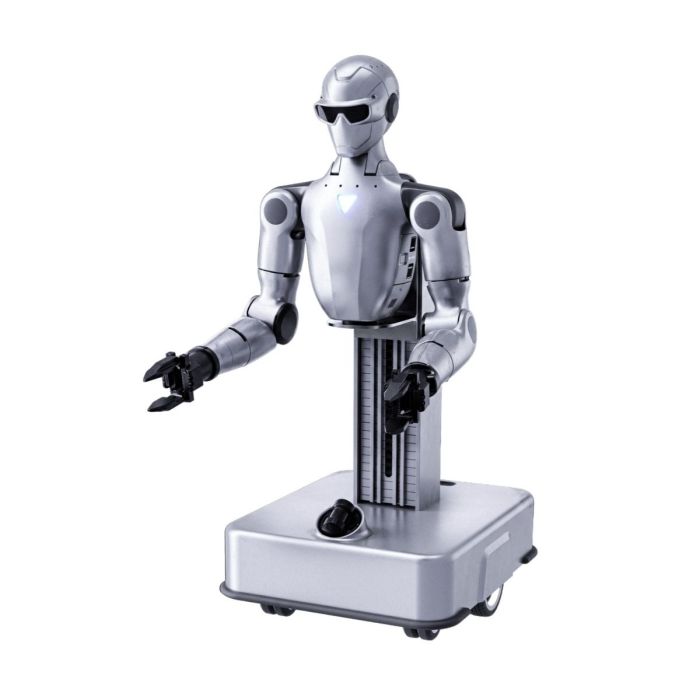
A model name with seven segments reads less like a label and more like an order form that has already been half completed. Each part narrows the choice: the R1 family, the A5 and D designations, and then the Smart and Ultimate B package terms that set this listing apart from its neighbours. The Unitree R1-A5-D Smart Ultimate B Humanoid Robot is a dual-arm humanoid on a base, with a moving head that carries its own processor and a binocular camera, and a body that runs a second processor of its own. The question worth asking is not what a humanoid robot is in general. It is what this precise combination brings to a laboratory, a lecture hall or an integration project, and what must be fixed in writing before an order is placed.
Robots Middle East supplies this humanoid to universities, research centres, system integrators and corporate innovation teams across the Middle East. Robots Middle East prepares each quotation for the requested configuration and arranges delivery, commissioning guidance and after-sales support for customers in the region.
Background
Unitree Robotics and the R1 family
Unitree Robotics, based in Hangzhou, China, first became widely known for its legged quadruped robots. It later extended its range into humanoid platforms intended for research, education and applied development. The R1 family belongs to that later phase. Rather than a single fixed machine, it is offered as a series of related versions that the sources name individually: the R1-A5 and R1-A7, the R1-A5-D and R1-A7-D, and package variants of the R1-A5-D such as Smart B, Ultimate B and Ultimate C. For a buyer, this structure has a practical consequence. Two listings that look alike on the surface may differ in arm configuration, base or bundled package, so every figure has to be read alongside the exact version it belongs to.
Split computing and binocular perception
Two design choices define the character of this platform. The first is that computing is divided between the head and the body, each of which has its own 8-core high-performance CPU, with a head module rated at 10 TOPS of computing power. The second is a binocular camera in the head, giving the robot stereo vision across a wide field of view. Taken together, these choices place perception close to the sensors that produce the data, while the body keeps a separate processor of its own. That arrangement suits work in which a robot must look, interpret and move within the same task.
Technical Specifications
| Specification | Value |
|---|---|
| Total degrees of freedom (R1-A5-D) | 16 (5 single arms × 2 + 1 waist + 2 heads + 1 pillar + 2 bases = 16) |
| Forearm + upper arm length (R1-A5-D) | 420 mm |
| Head module computing power | 10 TOPS |
| Head processor | 8-core high-performance CPU |
| Body processor | 8-core high-performance CPU |
| Binocular camera field of view | Horizontal 146°, Vertical 124° |
| Binocular eye spacing | 60mm |
Specifications are as published by the manufacturer and are confirmed against the datasheet at quotation.
The manufacturer has not published the part number, the IP rating, the box contents, the operating temperature or the maximum chassis speed; Robots Middle East confirms these details with the quotation.
How does the R1-A5-D divide its computing between head and body?
Many compact robots route every camera frame and every motor command through one central computer. The R1-A5-D takes a different approach. The head has an 8-core high-performance CPU and a computing module rated at 10 TOPS, and the body has an 8-core high-performance CPU of its own. In practice, this gives a development team two clear places to put software. Vision and interaction workloads can sit in the head, beside the binocular camera that feeds them. Body-side tasks, such as coordinating the arms, waist, pillar and base, can run on the second processor.
This separation matters most to teams who intend to write their own code. It allows perception experiments and motion experiments to be developed, tested and replaced with less interference between them, and it gives an engineering course a natural way to divide a robot between student groups. Teams with a specific software environment in mind are welcome to name it in their quotation request.
What does the binocular head bring to the R1-A5-D Smart Ultimate B?
The head carries a binocular camera with a field of view of 146° horizontally and 124° vertically, and an eye spacing of 60mm. A wide field of view lets the robot keep a large part of its surroundings in frame without constantly turning, which helps when it must follow a person or monitor a work surface. Two cameras set a fixed distance apart are the basis of stereo depth perception, the technique robots commonly use to judge how far away an object is before reaching for it.
The head is also articulated: of the 16 degrees of freedom on the R1-A5-D, two belong to the head. Combined with the waist, the pillar and two arms of five degrees of freedom each, with a forearm and upper arm length of 420 mm, the robot can direct its gaze and its hands towards the same point. That coordination between seeing and reaching is what makes the platform relevant to manipulation research and to interaction studies alike.
Who is the Unitree R1-A5-D Smart Ultimate B Humanoid Robot for?
The first group is university and institute researchers working on manipulation, perception or human–robot interaction, who need a physical platform with arms, an articulated head and stereo vision rather than a simulation alone. The second is educators running robotics, mechatronics or artificial intelligence programmes, for whom a humanoid with clearly separated head and body computing provides a concrete teaching subject. The third is system integrators and corporate innovation teams who want to prototype service or demonstration tasks before committing to a larger deployment.
Buyers who have not yet settled on a package can compare this listing with the Unitree R1-A5-D Mobile Base Dual-Arm Humanoid Robot and the Unitree R1-A5-D Smart B Humanoid Robot. They can also browse the full Unitree R1-A5-D range or the wider Unitree R1 family. Robots Middle East can set out the differences between packages in writing, so that the version ordered matches the brief.
What is the Unitree R1-A5-D Smart Ultimate B Humanoid Robot used for?
- Manipulation research: developing and testing grasping and reaching strategies with two articulated arms.
- Stereo vision studies: working with binocular camera data for depth estimation and object localisation.
- Human–robot interaction: studying how people respond to a robot that turns its head and gestures towards them.
- Robotics teaching: giving students a real platform on which perception and motion software can be built in separate modules.
- Integration prototyping: trialling service and assistance scenarios before a larger deployment is planned.
- Exhibitions and visitor centres: presenting embodied artificial intelligence to the public in a form that people can watch and engage with.
Pricing and Availability
Robots Middle East supplies this robot by quotation, prepared for the exact configuration and package requested. Each quotation states the version and the scope of supply in writing. Delivery, customs and support are arranged together with the quotation, so that the full scope of supply is agreed before an order is confirmed. To begin, use the quotation request available on this page.
Frequently Asked Questions
How many degrees of freedom does the R1-A5-D have?
The R1-A5-D has 16 degrees of freedom in total: five for each arm, one for the waist, two for the head, one for the pillar and two for the base.
What processors does the robot use?
The head and the body each have an 8-core high-performance CPU, and the head module provides 10 TOPS of computing power.
What can the head camera see?
The binocular camera covers a field of view of 146° horizontally and 124° vertically, with an eye spacing of 60mm between the two cameras.
How long are the arms?
On the R1-A5-D, the combined forearm and upper arm length is 420 mm.
Can the robot turn its head towards a person or object?
Yes. Two of the 16 degrees of freedom on the R1-A5-D belong to the head, so the robot can direct its binocular camera towards whoever or whatever it is working with.
Which other R1 versions can I compare it with?
The sources name the R1-A5, R1-A7, R1-A5-D and R1-A7-D, as well as R1-A5-D packages such as Smart B, Ultimate B and Ultimate C. Robots Middle East can compare any of these with this package for you.
Where can I buy the Unitree R1-A5-D Smart Ultimate B Humanoid Robot and what does it cost?
Robots Middle East supplies the robot across the Middle East and prices it by quotation for the exact configuration you request. Please submit a quotation request through this page.
Summary
A long model name only becomes useful once each part of it is matched to something tangible. For this humanoid, the published facts give that name its substance: 16 degrees of freedom on the R1-A5-D, two arms with a forearm and upper arm length of 420 mm, separate 8-core processors in the head and body, a 10 TOPS head module and a wide-angle binocular camera. Everything else that a buyer needs to know about the package is agreed in writing with Robots Middle East before any commitment is made. For any team that wants this exact configuration confirmed down to the last suffix, this page is the starting point.