
Unitree R1-A5-D Smart Ultimate D Humanoid Robot
In stock
- BRAND:
- UNITREE ROBOTICS
- MODEL:
- R1-A5-D-Smart-Ultimate-D
- PART #:
- R1-A5-D-Smart-Ultimate-D
- ORIGIN:
- China
- Warranty:
- 12 MONTHS
- AVAILABILITY:
- SUBJECT TO AVAILABILITY
- SKU:
- Unitree-R1-A5-D-Smart-Ultimate-D
Unitree R1-A5-D Smart Ultimate D Humanoid Robot
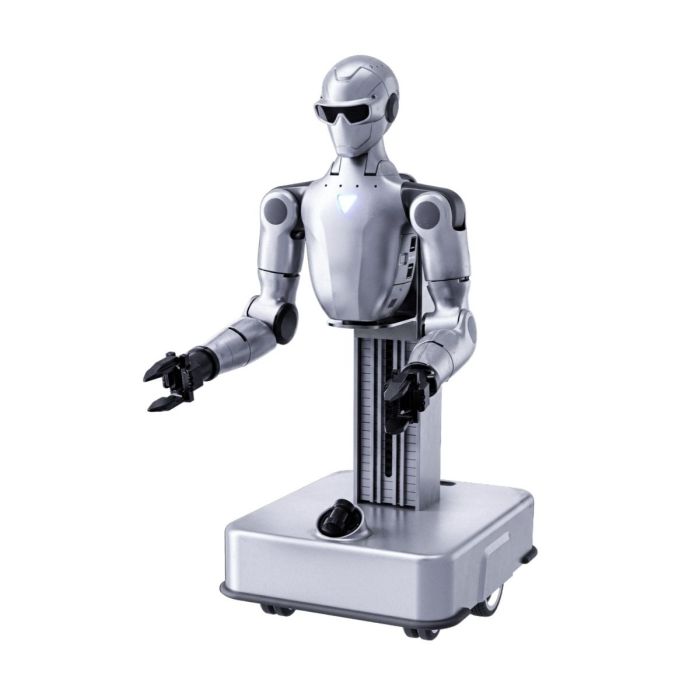
Ask what a humanoid robot can actually do, and the honest answer usually lies at the end of its arms. A platform may see well and calculate quickly, but the value of its work is decided where the hand meets the object. The Unitree R1-A5-D Smart Ultimate D Humanoid Robot is built around that point of contact. It pairs a dual-arm upper body with a choice of two-finger gripper, three-finger dexterous hand or five-finger dexterous hand. Its head carries its own computing power and binocular vision, and its chassis scans the surroundings with LiDAR. It is a robot to be judged by what it can pick up, place and handle, rather than by how it looks standing still.
Robots Middle East sells the Unitree R1-A5-D Smart Ultimate D Humanoid Robot and supplies it to universities, research institutes, system integrators and corporate innovation teams across the Middle East. Our team prepares each quotation against the configuration you require, arranges delivery to your premises and provides support once the robot is in service. The aim is a platform that arrives ready for the programme it was purchased for, not one that has to be reconfigured on arrival.
Background
Unitree Robotics and its route to humanoids
Unitree Robotics first became widely known for agile legged robots, and it has since extended that engineering into humanoid platforms for research, education and applied development. The company's work centres on the elements that decide how a robot behaves in practice: joint actuation, motion control and the integration of sensors with onboard computing. The R1 family reflects that emphasis. Its joints use low-inertia, high-speed inner rotor permanent magnet synchronous motors, a design chosen for responsiveness and heat dissipation. Both qualities matter when a robot must repeat precise movements over a working session.
The R1-A5-D within the R1 family
The sources name several members of the family: the R1-A5, R1-A7, R1-A5-D and R1-A7-D, together with configuration packages labelled Smart D and Ultimate D. The R1-A5-D arranges its 16 degrees of freedom as five in each arm, one in the waist, two in the head, one in the pillar and two in the base. In practice, this means the robot can turn its torso, adjust its height through the pillar, direct its gaze and reposition through its base while the arms work. The package letters denote bundled options rather than a different mechanical platform. For that reason, the exact contents of this configuration are set out line by line in the quotation.
Technical Specifications
| Specification | Value |
|---|---|
| Weight (R1-A5-D) | Approx. 30kg |
| Total degrees of freedom (R1-A5-D) | 16 (5 single arms × 2 + 1 waist + 2 heads + 1 pillar + 2 bases = 16) |
| Head module computing power | 10 TOPS |
| Head processor | 8-core high-performance CPU |
| Binocular FOV | Horizontal 146°, Vertical 124° |
| Camera module (R1-A5-D) | Chassis LiDAR + Binocular Camera + Optional Wrist Camera |
| Battery life (battery-powered) | Approx. 1.5h |
| Joint motor | Low-Inertia High-Speed Inner Rotor PMSM (Superior Responsiveness & Heat Dissipation) |
| Wireless | WiFi 6 & Bluetooth 5.2 |
| Secondary development | Yes |
| Smart OTA update | Yes |
| End effector options | Optional two-finger gripper / three-finger dexterous hand / five-finger dexterous hand |
Specifications are as published by the manufacturer and are confirmed against the datasheet at quotation.
The manufacturer has not published the battery capacity, the payload at full extension, the IP rating, the maximum travel speed of the chassis, the model of the chassis LiDAR, the operating temperature or the power consumption; these are confirmed at quotation.
What does the 10 TOPS head module bring to the R1-A5-D?
A manipulation robot is only as capable as its understanding of what lies in front of it. The R1-A5-D places that understanding in its head. There, an 8-core high-performance CPU works alongside a module rated at 10 TOPS of computing power, so perception tasks can run on the robot itself rather than depend entirely on an external workstation. For research teams, onboard processing simplifies experiments in which the robot must react to what it sees without the latency of a round trip over the network.
The binocular camera covers a field of view of 146° horizontally and 124° vertically. That is a wide window for a robot whose arms work across the space in front of its torso. With two degrees of freedom in the head, the robot can also redirect that view towards the task. The chassis LiDAR gives the base its own awareness of the surroundings, and an optional wrist camera adds a close-range viewpoint at the point of grasp. Taken together, the robot observes its environment from three distinct positions: the base, the head and, where fitted, the wrist.
Connectivity completes the picture. WiFi 6 and Bluetooth 5.2 link the robot to development machines and peripherals. Smart OTA updates keep the system software current, and support for secondary development means research groups and integrators can build their own applications on the platform.
Which end effector should I choose for the R1-A5-D?
The choice of end effector shapes the kind of work the robot can take on, and the R1-A5-D offers three. A two-finger gripper suits tasks built around reliable grasping of regular objects, where simplicity and repeatability matter more than dexterity. A three-finger dexterous hand allows more varied grasps and suits studies of how a robot adapts its hold to objects of different shapes. A five-finger dexterous hand comes closest to the human hand. It is the natural choice for research into dexterous manipulation, imitation of human demonstrations and tasks designed around human tools.
Because each arm has five degrees of freedom and the robot can also move its waist, pillar and base, the end effector does not have to do all of the positioning work alone. The body brings the hand to the task, and the hand completes it. Robots Middle East discusses the intended application with each buyer before quotation, so that the end effector specified matches the experiments or workflows planned.
Who is the Unitree R1-A5-D Smart Ultimate D Humanoid Robot for?
University laboratories working on embodied artificial intelligence form the first group. They need a platform that combines vision, onboard computing and dual-arm manipulation in one body and that opens itself to secondary development. Robotics and engineering faculties form a second group. For them, the R1-A5-D offers students a complete system on which to study perception, motion planning and control without first building the hardware.
System integrators and corporate innovation teams make up a third group. They use the robot to prototype service and handling tasks and to test whether a humanoid form suits a given workflow before committing to wider deployment. Technology showcases and visitor centres form a fourth, where a robot that interacts visibly with objects communicates more than a static display.
Buyers still weighing the alternatives may compare this configuration with the Unitree R1-A5-D Mobile Base Dual-Arm Humanoid Robot and the Unitree R1-A5-D Smart D Humanoid Robot, or browse the full Unitree R1-A5-D range and the wider Unitree R1 family. Our team can set out the differences in package contents when preparing the quotation.
What is the Unitree R1-A5-D Smart Ultimate D Humanoid Robot used for?
- Embodied AI research — training and testing models that connect what the robot sees with what its arms do.
- Dexterous manipulation studies — comparing grasp strategies across the gripper and the dexterous hand options.
- Robotics education — giving students a complete platform for perception, planning and control coursework.
- Human-robot interaction — studying how people respond to a humanoid that turns its head and reaches towards shared objects.
- Service task prototyping — trialling fetch, sort and hand-over tasks before wider deployment.
- Perception and navigation development — combining chassis LiDAR and binocular vision in mapping and scene understanding work.
Pricing and Availability
The Unitree R1-A5-D Smart Ultimate D Humanoid Robot is supplied on quotation, because the final configuration depends on the end effector, the optional wrist camera and the package contents you require. Robots Middle East agrees the exact specification with you before issuing the quotation, so that the document reflects the robot you will receive. Delivery, customs clearance and after-sales support are arranged together with the quotation. To begin, please share your intended application and preferred configuration; the quotation request form is available on this page.
Frequently Asked Questions
How many degrees of freedom does the R1-A5-D have?
The R1-A5-D has 16 degrees of freedom: five in each arm, one in the waist, two in the head, one in the pillar and two in the base.
What computing power does the head module provide?
The head module provides 10 TOPS of computing power, supported by an 8-core high-performance CPU.
How long does the robot operate on battery power?
When battery-powered, the robot runs for approximately 1.5 hours.
Which sensors are fitted?
The R1-A5-D carries a chassis LiDAR and a binocular camera with a field of view of 146° horizontally and 124° vertically. A wrist camera is available as an option.
Can I develop my own software for the robot?
Yes. The platform supports secondary development and receives Smart OTA updates, and it connects over WiFi 6 and Bluetooth 5.2.
Which hands can be fitted?
You may choose a two-finger gripper, a three-finger dexterous hand or a five-finger dexterous hand. Robots Middle East will advise on the option best suited to your work when preparing your quotation.
Where can I buy the Unitree R1-A5-D Smart Ultimate D Humanoid Robot and what does it cost?
You can buy it from Robots Middle East, which supplies it across the Middle East. The cost depends on the configuration selected and is set out in a quotation prepared for your requirements.
Summary
The Unitree R1-A5-D Smart Ultimate D Humanoid Robot returns attention to where robotic work is actually decided: the point at which a hand closes on an object. Everything else in its design serves that moment. The 10 TOPS head module and wide binocular view tell the arms what is there, and the chassis LiDAR keeps the base aware of its surroundings. Sixteen degrees of freedom bring the end effector into position, and a choice of gripper or dexterous hand determines how it grasps. For laboratories, faculties and integrators who need a manipulation platform open to their own development, Robots Middle East offers the configuration, delivery and support in one quotation, and this page is the starting point.