
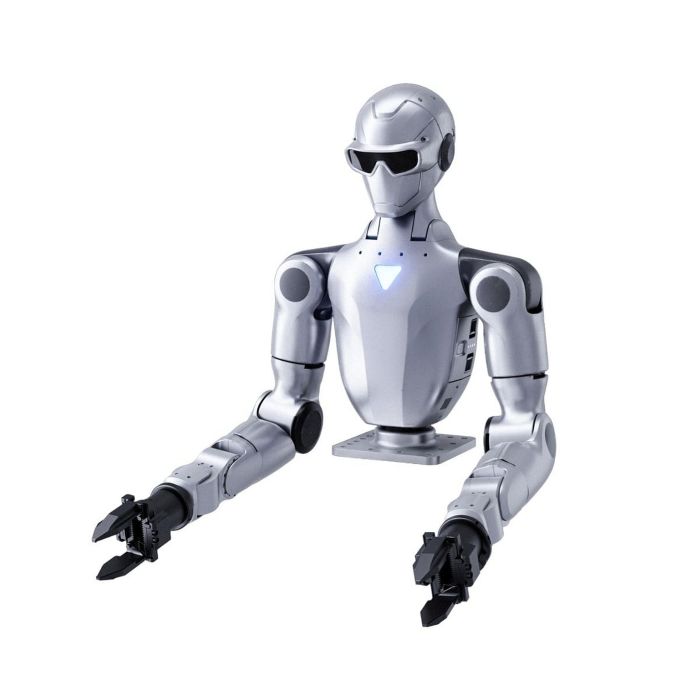
Unitree R1-A7 Smart D Humanoid Robot
In stock
- BRAND:
- UNITREE ROBOTICS
- MODEL:
- R1-A7-Smart-D
- PART #:
- R1-A7-Smart-D
- ORIGIN:
- China
- Warranty:
- 12 MONTHS
- AVAILABILITY:
- SUBJECT TO AVAILABILITY
- SKU:
- Unitree-R1-A7-Smart-D
Unitree R1-A7 Smart D Humanoid Robot
In a laboratory, the instruments that earn their keep are often the ones that never move: the microscope, the fume cupboard, the bench oscilloscope. They stay where the work is, and the work is brought to them. The Unitree R1-A7 Smart D Humanoid Robot belongs to that tradition rather than to the world of walking machines. Unitree describes the R1-A7 plainly as a torso, not a humanoid, and states that it does not walk. What it offers instead is a fixed and repeatable upper body: two arms, a turning waist and a head with binocular vision, finished in this configuration with BrainCo Revo 2 Basic Hands. For teams whose questions concern grasping, handling and coordinated two-arm work, staying in one place is not a limitation but the very thing that makes the results comparable from one day to the next.
Robots Middle East sells the R1-A7 Smart D and supplies it to universities, research centres, system integrators and corporate innovation teams across the Middle East. Our team prepares each quotation against the exact configuration you request, arranges delivery to your site and supports the robot once it is installed, so that it arrives as a working instrument rather than a crate of open questions.
Background
Unitree Robotics and the R1 line
Unitree Robotics made its name with agile legged robots, first quadrupeds and later full-size humanoids, and has since built a broad portfolio for research, education and commercial development. The Unitree R1 family brings that engineering to a more compact form. Within it, the Unitree R1-A7 range is offered in several builds: the desk-mount R1-A7, the R1-A7-D on a mobile base, Smart configurations lettered A to H on each of those, Ultimate configurations A to H on the mobile base, and the related R1-A5. The Smart D examined here is the desk-mount R1-A7 in its Smart configuration with BrainCo Revo 2 Basic Hands. Reading the letter correctly matters, because it identifies the end effector fitted to the robot.
Joints designed for repeatable work
The strength of a fixed torso lies in its joints, and Unitree has given them careful attention. Each arm carries seven degrees of freedom on low-inertia inner-rotor joint motors. The joints run on crossed-roller and deep-groove ball bearings, the wiring is routed through hollow internal channels, the arm joints use dual encoders, and local air cooling manages heat. The software side is equally open: Unitree provides interfaces to the underlying system, the arms, audio, lighting and vision, with full support for secondary development. For a research group, that combination means a mechanically consistent platform whose behaviour can be programmed, logged and reproduced.
Technical Specifications
| Specification | Value |
|---|---|
| Configuration | R1-A7 Smart D – BrainCo Revo 2 Basic Hands |
| Product type | Torso (does not walk), desk-mount |
| Dimensions | 835 x 357 x 190 mm (32.9 x 14.1 x 7.5 in) |
| Weight | About 13 kg (29 lb) |
| Total degrees of freedom | 19 |
| Arms | Two arms, 7 degrees of freedom per arm, low-inertia inner-rotor joint motors |
| Arm reach | Forearm plus upper arm 555 mm (21.9 in) |
| Arm payload | 2 to 4 kg (4.4 to 8.8 lb) per arm, varying with arm extension |
| Maximum shoulder torque | 60 Nm (44 lb-ft) |
| End-clamp repeatability | ±0.1 mm (±0.004 in) |
| Waist yaw | ±150° |
| Head range | Yaw ±115°, pitch ±36° |
| Joint design | Crossed-roller and deep-groove ball bearings, hollow internal wiring, dual encoders on the arm joints, local air cooling |
| Head camera | Binocular; RGB 1280 x 720 at 30 Hz, depth 544 x 448 at 10 Hz |
| Binocular field of view | 146° horizontal by 124° vertical; eye spacing 60 mm (2.4 in) |
| Standard compute | 8-core CPU in the body; 8-core CPU with 10 TOPS in the head |
| NVIDIA Orin module | Optional, 40 to 100 TOPS; 40 TOPS Orin Nano in Smart configurations |
| Audio | 4-array microphone, dual 3 W speakers |
| Wireless | Wi-Fi 6, Bluetooth 5.2 |
| Power | External supply standard; optional upper-body battery giving about 1.5 h |
| Development | Open interfaces for the underlying system, arms, audio, lighting and vision; full secondary development support |
Specifications are as published by the manufacturer and are confirmed against the datasheet at quotation.
Unitree has not published the IP rating, the operating temperature range, the top speed or the contents of the box; these are confirmed at quotation.
What do the BrainCo Revo 2 Basic Hands bring to the R1-A7?
The letter in a Smart configuration tells you which hand the robot carries, and the choice shapes the research it suits. Unitree groups the options clearly: BrainCo Revo 2 hands on the D and E configurations and LinkerBot O6 hands on F and G provide bionic, humanlike form factors, while the tendon-driven hands on H are chosen to maximise dexterity. The Smart D therefore sits among the humanlike options, fitted with the Basic version of the Revo 2.
A humanlike hand matters most where people teach the robot. In teleoperation and learning from demonstration, a hand that resembles the operator's own allows grasps to be transferred more naturally, and objects designed for human hands, such as cups, tools and handles, can be approached in a familiar way. Paired with arms that repeat to ±0.1 mm at the end clamp and a binocular camera with a wide field of view, the hands give a coherent setup for collecting manipulation data at the bench. The on-board compute supports the same workflow: an 8-core CPU in the body, an 8-core CPU with 10 TOPS in the head, and, in the Smart configurations, the 40 TOPS Orin Nano for running your own perception and policy models directly on the robot.
Why choose a desk-mount torso instead of a walking humanoid?
A walking humanoid spends a great deal of its engineering, and its operators' attention, on balance. A desk-mount torso removes that question entirely. The R1-A7 Smart D runs from an external supply as standard, so long sessions of data collection or teaching are not divided into battery cycles; where a cable is inconvenient, the optional upper-body battery gives about 1.5 h. The waist turns through ±150°, letting the arms address a wide arc of the bench without the base moving, and the head pans through ±115° to follow the work.
There is also a practical argument. At 835 x 357 x 190 mm and about 13 kg, the robot fits on a laboratory bench or a demonstration table, and its fixed position keeps camera calibration and workspace geometry stable between experiments. Teams that do need the robot to travel between workstations should consider the R1-A7-D, which mounts the same upper body on a mobile base.
Who is the Unitree R1-A7 Smart D Humanoid Robot for?
The clearest fit is the research group working on dexterous manipulation, embodied AI or imitation learning, where humanlike hands and a stable, repeatable platform shorten the path from demonstration to trained policy. University departments teaching robotics benefit from the open interfaces, which allow students to work on arms, vision and audio within one system. System integrators and corporate innovation teams can use the robot to prototype handling tasks or to present interactive demonstrations, drawing on the microphone array and speakers for voice interaction.
Some buyers will be better served by a neighbouring version. If you require mobility, the R1-A7-D on its wheeled base is the more suitable choice. If your project calls for a different end effector, the other Smart configurations are worth comparing: the Unitree R1-A7 Smart E Humanoid Robot is the other configuration built around BrainCo Revo 2 hands, and the Unitree R1-A7 Fixed Base Dual-Arm Humanoid Robot is the starting point for those who wish to specify the platform themselves. Robots Middle East can advise on the differences before you commit.
What is the Unitree R1-A7 Smart D Humanoid Robot used for?
- Manipulation research: studying grasping and object handling with humanlike hands on a repeatable platform.
- Learning from demonstration: recording teleoperated tasks to train perception and policy models.
- On-board AI development: running custom models on the robot's own compute and Orin Nano module.
- Robotics teaching: giving students access to arms, vision, audio and lighting through open interfaces.
- Task prototyping: testing bench-level handling and assembly steps before wider automation.
- Interactive demonstrations: presenting voice-driven, two-arm interaction at exhibitions and innovation centres.
Pricing and Availability
Robots Middle East supplies the R1-A7 Smart D by quotation, prepared for the exact configuration and options your project requires, including the optional upper-body battery where needed. Delivery, customs clearance and after-sales support are arranged together with your quotation. Tell us about your application and site, and we will confirm the specification with you in writing. A quotation request for the Unitree R1-A7 Smart D Humanoid Robot is available on this page.
Frequently Asked Questions
Can the Unitree R1-A7 Smart D Humanoid Robot walk?
No. Unitree states that the R1-A7 is a torso, not a humanoid, and that it does not walk. The Smart D is the desk-mount build.
Which hands does the Smart D configuration use?
The Smart D is fitted with BrainCo Revo 2 Basic Hands, a bionic, humanlike form factor.
How much can each arm carry?
Each arm carries 2 to 4 kg (4.4 to 8.8 lb), and the figure varies considerably with how far the arm is extended.
Can I run my own AI models on the robot?
Yes. The robot has an 8-core CPU in the body and an 8-core CPU with 10 TOPS in the head, and the Smart configurations use the 40 TOPS Orin Nano for on-board perception and policy models.
Does it need a battery?
The desk-mount R1-A7 runs from an external supply as standard. An optional upper-body battery gives about 1.5 h of operation.
Is the software open for development?
Unitree provides open interfaces for the underlying system, the arms, audio, lighting and vision, with full secondary development support.
Where can I buy the Unitree R1-A7 Smart D Humanoid Robot and what does it cost?
You can buy it from Robots Middle East, which supplies it across the Middle East. The cost depends on the configuration and options you choose, so we provide it in a tailored quotation requested through this page.
Summary
Like the bench instruments that anchor any good laboratory, the Unitree R1-A7 Smart D Humanoid Robot earns its value by staying where the work is. It sets aside walking in favour of a stable upper body with two seven-joint arms, ±0.1 mm end-clamp repeatability, a wide-angle binocular head and BrainCo Revo 2 Basic Hands, supported by on-board compute and open development interfaces. For research groups, educators and integrators focused on what hands can do at a table, it is a precise and reproducible tool, supplied and supported by Robots Middle East. To discuss your configuration and receive a quotation, this page is the starting point.