
Unitree R1-A7 Fixed Base Dual-Arm Humanoid Robot
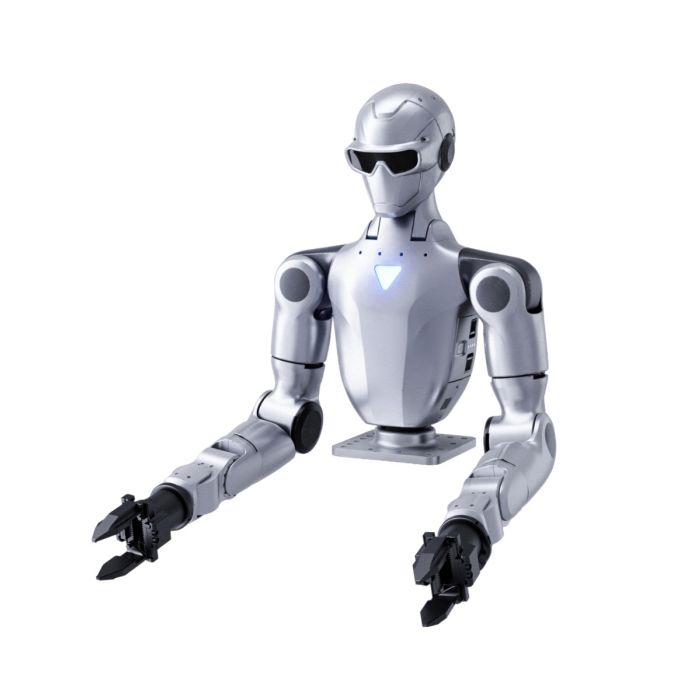
In stock
- BRAND:
- UNITREE ROBOTICS
- MODEL:
- R1-A7
- ORIGIN:
- China
- Warranty:
- 12 MONTHS
- AVAILABILITY:
- SUBJECT TO AVAILABILITY
- SKU:
- Unitree-R1-A7
Unitree R1-A7 Fixed Base Dual-Arm Humanoid Robot
Most humanoid robots are introduced by what their legs can do. The Unitree R1-A7 Fixed Base Dual-Arm Humanoid Robot is better understood through three decisions its owner makes before it ever moves: which hands to fit at the ends of its arms, which computer to place behind them, and which task to set in front of them. Unitree sums up the line as "ultra-fast deployment, multi-scenario application", and the fixed-base format is what gives that phrase its weight. The robot is mounted where the work happens, and every hour of effort goes into manipulation, perception and software rather than balance and walking.
Robots Middle East sells the Unitree R1-A7 Fixed Base Dual-Arm Humanoid Robot and supplies it to universities, research centres, system integrators and businesses throughout the Middle East. Our team prepares each quotation around the end effector and computing module you select, and Robots Middle East remains your point of contact for delivery, technical questions and after-sales support once the robot is in your hands.
Background
Unitree Robotics and the R1 family
Unitree Robotics built its reputation on agile legged robots before extending its range into humanoid platforms for research, education and applied development. The R1 line is the company's dual-arm humanoid family, and the sources name four versions within it: R1-A5, R1-A7, R1-A5-D and R1-A7-D. The figures on this page belong to the R1-A7 alone, and our team is glad to explain where this model sits within the family when you get in touch.
Joints designed for responsiveness
At the heart of each joint is a low-inertia, high-speed inner rotor permanent magnet synchronous motor (PMSM), a design Unitree selected for superior responsiveness and heat dissipation. Low rotor inertia matters in a manipulator because it allows the arm to accelerate, stop and change direction with less lag, which is precisely what fine handling and coordinated two-handed work demand. The joint output runs on a combination of crossed roller and deep groove ball bearings. In general engineering practice, crossed roller bearings carry radial, axial and tilting loads within a compact envelope, which is why they are favoured in robot joints where stiffness and space are both at a premium.
Technical Specifications
| Specification | Value |
|---|---|
| Product line | Unitree Dual-Arm Humanoid Robot — ultra-fast deployment, multi-scenario application |
| Dimensions (R1-A7) | 835x357x190mm |
| Weight (R1-A7) | Approx. 13kg (with external power supply) |
| Joint motor | Low-Inertia High-Speed Inner Rotor PMSM (Superior Responsiveness & Heat Dissipation) |
| Joint output bearing | Crossed Roller + Deep Groove Ball |
| Wireless | WiFi 6 & Bluetooth 5.2 |
| End effectors | Optional two-finger gripper / three-finger dexterous hand / five-finger dexterous hand |
| High-computing module | Multiple brands and models available, such as Orin (40-100TOPS) |
| Charger | Included |
| Software and development | Smart OTA update; secondary development supported; open interfaces for the underlying system, robotic arm, audio, lighting and visual control |
Specifications are as published by the manufacturer and are confirmed against the datasheet at quotation.
Unitree has not published the ingress protection rating, the operating temperature range, the battery capacity, the charging time, the operating system, the full list of included accessories or the repeatability of the arm; each of these is confirmed with you at quotation.
What does a fixed base change for a dual-arm humanoid?
A walking humanoid spends a considerable share of its engineering budget simply staying upright. Balance control, foot placement and fall recovery all compete for computing power, development time and battery. By removing locomotion altogether, the R1-A7 lets a team concentrate on the part of humanoid robotics that most practical tasks actually depend on: two arms working together, hands that grasp, and cameras that guide them.
The physical footprint reflects that focus. The R1-A7 measures 835x357x190mm and weighs approximately 13kg with its external power supply, so it is planned for a bench, a workstation or a demonstration stand rather than an open floor. For a laboratory, that means the robot can sit beside the instruments, fixtures and objects it is meant to handle, and an experiment can be repeated in the same position day after day. For a classroom, it means students meet a humanoid upper body at working height, where they can observe how joint commands translate into movement.
A fixed base does not remove the need for care. Unitree states that users must maintain a sufficient safety distance between humans and the robot, and any installation plan should define a clear working zone around the arms before the first program is run.
How far can the Unitree R1-A7 be configured?
Configuration is where the R1-A7 becomes a specific tool rather than a generic platform. Three end effectors are offered: a two-finger gripper, a three-finger dexterous hand and a five-finger dexterous hand. The two-finger gripper suits pick-and-place routines and tasks where a simple, predictable grasp is preferable, while the dexterous hands open the door to research on in-hand manipulation, tool use and human-like grasping. The choice shapes the kind of work the robot will do, so it is worth settling early.
The second decision is computing. Unitree offers a high-computing module from multiple brands and models, with Orin options in the 40-100TOPS range among them. Heavier perception and learning models generally call for the upper end of that range, whereas teaching and scripted demonstrations may need less. Our team can discuss which module fits your intended workload when preparing the quotation.
Software completes the picture. The R1-A7 supports smart OTA updates and secondary development, with open interfaces for the underlying system, the robotic arm, audio, lighting and visual control. WiFi 6 and Bluetooth 5.2 provide the wireless links for development and operation. Together, these allow a research group or integrator to build its own applications on top of the platform instead of working within a closed set of behaviours.
Who is the Unitree R1-A7 for?
University departments in robotics, mechatronics and computer science will find the R1-A7 a tangible way to teach manipulation, kinematics and perception on a humanoid form without the overhead of a walking machine. Research laboratories working on embodied AI, grasp planning or two-handed coordination gain a stationary platform whose open interfaces allow their own algorithms to run on the arms, cameras and peripherals.
System integrators and engineering firms can use the robot to prototype service and handling concepts for clients, testing different end effectors before committing to a design. Innovation centres, museums and corporate showrooms may value its humanoid presence for demonstrations, provided the safety distance Unitree specifies is observed around visitors.
If you are weighing up the R1-A7 against other configurations, the Unitree R1-A7 category brings together the configured packages of this model, and the wider Unitree R1 range presents the rest of the family. Our team will set out the differences between any packages you shortlist when we prepare your quotation.
What is the Unitree R1-A7 used for?
- Manipulation research: studying grasping, placing and two-handed coordination on a stable, repeatable platform.
- Robotics education: giving students hands-on experience with humanoid arms, joint control and programming.
- Embodied AI development: running perception and learning models on the onboard high-computing module.
- End effector evaluation: comparing grippers and dexterous hands for a given handling task.
- Application prototyping: building custom software through the open interfaces before a wider deployment.
- Demonstrations and exhibitions: presenting humanoid technology to visitors in a controlled, stationary setting.
Pricing and Availability
The Unitree R1-A7 is offered on a quotation basis, because the final configuration depends on the end effector, the high-computing module and any development requirements you specify. Robots Middle East prepares each quotation to match that configuration. Delivery, customs clearance and technical support are all arranged together with your quotation. To begin, simply send us your intended application and preferred configuration using the quotation request available on this page.
Frequently Asked Questions
Does the Unitree R1-A7 walk?
No. The R1-A7 is a fixed-base humanoid, designed to be installed at a workstation or bench, where its two arms carry out manipulation tasks.
Which hands can be fitted to the R1-A7?
Unitree offers an optional two-finger gripper, a three-finger dexterous hand and a five-finger dexterous hand. The choice is made at configuration and is reflected in your quotation.
What computing power is available?
The high-computing module is available in multiple brands and models, with Orin options in the 40-100TOPS range among them. We can help you match the module to your workload.
Can I develop my own software for the robot?
Yes. The R1-A7 supports secondary development, with open interfaces for the underlying system, the robotic arm, audio, lighting and visual control, and it receives smart OTA updates.
How large and heavy is the R1-A7?
The R1-A7 measures 835x357x190mm and weighs approximately 13kg with its external power supply.
Is a charger supplied, and what safety precautions apply?
Yes, a charger is included with the robot. Unitree states that users must maintain a sufficient safety distance between humans and the robot, so a clear working zone around the arms should be planned before operation.
Where can I buy the Unitree R1-A7 Fixed Base Dual-Arm Humanoid Robot and what does it cost?
You can buy it from Robots Middle East, which supplies it across the Middle East. The cost depends on the configuration you choose, so we provide it in a tailored quotation that also covers delivery, customs and support.
Summary
The Unitree R1-A7 earns its place not through a single headline figure but through the decisions it leaves to its owner. Fit a two-finger gripper for dependable handling, or a three- or five-finger dexterous hand for research into human-like grasping; pair it with a high-computing module sized to your models; and build on open interfaces that reach from the arm to audio, lighting and vision. Low-inertia PMSM joints, crossed roller and deep groove ball bearings, and WiFi 6 with Bluetooth 5.2 form the foundation, while the fixed base keeps the effort on manipulation rather than locomotion. Robots Middle East will help you make those three decisions well, and for a configuration matched to your work, this page is the starting point.