
Unitree R1-A7 Smart G Humanoid Robot
In stock
- BRAND:
- UNITREE ROBOTICS
- MODEL:
- R1-A7-Smart-G
- PART #:
- R1-A7-Smart-G
- ORIGIN:
- China
- Warranty:
- 12 MONTHS
- AVAILABILITY:
- SUBJECT TO AVAILABILITY
- SKU:
- Unitree-R1-A7-Smart-G
Unitree R1-A7 Smart G Humanoid Robot
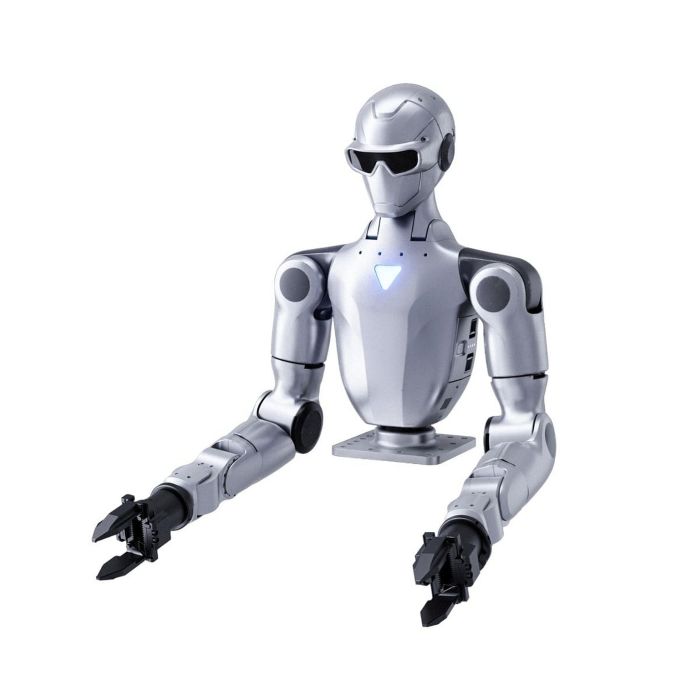
Every grasp a robot performs produces data, yet most platforms record only the half that cameras can see. The Unitree R1-A7 Smart G Humanoid Robot records the other half. It is a stationary dual-arm torso whose two seven-jointed arms end in LinkerBot O6 hands with tactile fingertip sensing. Pressure, slip and contact become signals that software can log, learn from and act upon. For any laboratory building manipulation datasets or testing grasp policies, that missing half is often the part that matters most.
Robots Middle East supplies the R1-A7 Smart G to universities, research centres, system integrators and corporate innovation teams across the Middle East. Robots Middle East prepares each quotation for the exact configuration requested, arranges delivery to your site and provides support after installation. Our English-speaking and Arabic-speaking teams can advise on choosing between the R1-A7 variants before you commit.
Background
Unitree Robotics and the R1 family
Unitree Robotics built its reputation on agile legged machines, first quadrupeds and then full humanoids. These platforms brought capable robot hardware within reach of research groups that had previously relied on far costlier systems. The R1 family takes a different path. Unitree describes the R1-A7 as the 7-DoF-per-arm version of its dual-arm manipulation platform: two arms, a rotating waist and a 2-DoF sensor head, built for work at a bench rather than across a floor. The family includes the desk-mount R1-A7, the R1-A7-D on a mobile base, and a range of Smart and Ultimate configurations identified by a letter. Each letter denotes a particular choice of hands.
Where the Smart G sits
The Smart configurations add built-in NVIDIA Orin Nano compute rated at 40 TOPS to the standard processing in the body and head, and they pair it with the buyer's choice of hands. In the Smart G, that choice is the LinkerBot O6 six-DoF hand in its tactile version, which adds sensing at the fingertips. The result is a configuration aimed squarely at contact-rich manipulation. The compute to run perception and learning models sits on board, and the hands report what they touch as well as where they move.
Technical Specifications
| Specification | Value |
|---|---|
| Configuration | R1-A7 Smart G – LinkerBot O6 Tactile Hands |
| Arms | Two 7-DoF arms |
| Arm reach (forearm plus upper arm) | 555 mm |
| Total degrees of freedom (desk-mount) | 19 |
| Arm payload | 2 to 4 kg per arm, varying with arm extension |
| Maximum shoulder torque | 60 Nm |
| End-clamp repeatability | ±0.1 mm |
| Waist yaw (desk-mount) | ±150° |
| Head range | Yaw ±115°, pitch ±36° |
| Dimensions (desk-mount) | 835 x 357 x 190 mm |
| Weight (desk-mount) | About 13 kg |
| Joint motor | Low-Inertia High-Speed Inner Rotor PMSM |
| Joint design | Crossed-roller and deep-groove ball bearings, hollow internal wiring, dual encoders on the arm joints, local air cooling |
| Head camera | Binocular; RGB at 1280 x 720 at 30 Hz, depth at 544 x 448 at 10 Hz |
| Binocular field of view | 146° horizontal by 124° vertical; eye spacing 60 mm |
| Standard compute | 8-core CPU in the body; 8-core CPU with 10 TOPS in the head |
| Smart compute | Built-in Orin Nano, 40 TOPS |
| Hands | LinkerBot O6 six-DoF hands with tactile fingertip sensing |
| Audio | 4-array microphone, dual 3 W speakers |
| Wireless | Wi-Fi 6, Bluetooth 5.2 |
| Power supply | External power or Li-ion battery |
| Battery life (battery-powered) | Approx. 1.5 h |
| Development | Open interfaces for the underlying system, arms, audio, lighting and vision; full secondary development support |
| Locomotion | None; a torso that does not walk |
Specifications are as published by the manufacturer and are confirmed against the datasheet at quotation.
The manufacturer has not published the IP rating, the operating temperature range, the motion range of the individual arm joints, the power consumption, the battery capacity or the list of included accessories; Robots Middle East confirms these at quotation.
What does the Smart G add to the R1-A7?
Every R1-A7 shares the same mechanical foundation: two 7-DoF arms with 555 mm of reach, 60 Nm of maximum shoulder torque and end-clamp repeatability of ±0.1 mm. Each arm joint carries dual encoders, and the joints are driven by low-inertia inner-rotor motors with local air cooling. The Smart G changes two things. Firstly, it adds Orin Nano compute rated at 40 TOPS alongside the standard 8-core body processor and the 10 TOPS head processor. Vision models, grasp planners and learned policies can therefore run on the robot itself rather than on a tethered workstation.
Secondly, and more distinctively, it fits LinkerBot O6 six-DoF hands in their tactile version. A dexterous hand without touch must infer contact from motor current or vision, and both become unreliable when the fingers hide the object from the cameras. Fingertip sensing gives the controller direct evidence of contact. That evidence is precisely what research into in-hand manipulation, slip detection and force-aware grasping depends on. Because Unitree provides open interfaces to the arms, vision and underlying system, the tactile stream can be combined with joint and camera data in the buyer's own software.
Why choose a torso instead of a walking humanoid?
Unitree states plainly that the R1-A7 is a torso and does not walk. For manipulation work, that is an advantage rather than a limitation. A stationary base removes balance control from the problem, so every experiment isolates the behaviour of the arms and hands. The desk-mount unit weighs about 13 kg and measures 835 x 357 x 190 mm, which means it can be bolted to a bench, moved between laboratories and reset quickly between trials. The waist yaws through ±150° on the desk-mount, so both arms can reach a wide working arc without the robot changing position.
Teams that do need mobility can consider the R1-A7-D, which places the torso on a wheeled chassis with a LiDAR. Its figures differ from the desk-mount figures shown here, and Robots Middle East can quote it separately.
Who is the Unitree R1-A7 Smart G Humanoid Robot for?
The Smart G is best suited to university laboratories and research institutes that study dexterous manipulation and need tactile data as part of their experiments. Robot-learning groups collecting demonstration datasets will value the combination of binocular RGB and depth vision, a wide field of view and fingertip sensing on a single platform. System integrators prototyping assembly, handling or inspection cells for clients across the Gulf and the wider region can use the R1-A7 Smart G to test grasping strategies before committing to dedicated industrial hardware. Corporate innovation centres and technology showcases benefit from its voice interaction hardware and expressive sensor head.
Not every buyer needs touch. Where on-board compute matters but tactile sensing does not, other Smart configurations, such as the Unitree R1-A7 Smart A Humanoid Robot or the Unitree R1-A7 Smart B Humanoid Robot, pair the same compute with a different choice of hands. Buyers who intend to fit their own end effectors may prefer the Unitree R1-A7 Fixed Base Dual-Arm Humanoid Robot. The complete range is gathered in the Unitree R1-A7 category.
What is the Unitree R1-A7 Smart G Humanoid Robot used for?
- Tactile manipulation research: studying grip force, slip and contact events with sensing at the fingertips.
- Robot-learning data collection: recording synchronised vision, joint and touch data for training manipulation policies.
- Bimanual task development: programming coordinated two-handed actions such as handovers, folding and assembly.
- Industrial cell prototyping: evaluating grasping and handling strategies before specifying production equipment.
- Teaching and coursework: giving engineering students a real dual-arm platform with open development interfaces.
- Human–robot interaction studies: exploring voice-driven tasks through the microphone array, speakers and sensor head.
Pricing and Availability
Robots Middle East supplies the R1-A7 Smart G by quotation, prepared for the exact configuration and options you require, including optional wrist cameras where requested. Delivery, customs clearance and after-sales support are arranged as part of the quotation. To begin, send us your intended application and site details, and our team will respond with a formal proposal; the request form is available on this page.
Frequently Asked Questions
Does the R1-A7 Smart G walk?
No. It is a torso designed for stationary manipulation, and it does not walk. A wheeled variant, the R1-A7-D, exists for buyers who need mobility.
What makes the Smart G different from other Smart configurations?
All Smart configurations add built-in Orin Nano compute rated at 40 TOPS. The Smart G is the configuration fitted with LinkerBot O6 six-DoF hands with tactile fingertip sensing.
How much can each arm carry?
The payload is 2 to 4 kg per arm, and Unitree is explicit that the figure varies considerably with arm extension. Robots Middle East confirms the figure for your intended task at quotation.
Can it run on battery power?
Yes. It operates from an external power supply or a Li-ion battery, with a battery life of approx. 1.5 h when battery-powered.
Can we develop our own software for it?
Yes. Unitree provides open interfaces for the underlying system, the arms, audio, lighting and vision, with full secondary development support.
What sensors does the head carry?
The head carries a binocular camera providing RGB at 1280 x 720 at 30 Hz and depth at 544 x 448 at 10 Hz, with a 146° by 124° field of view. It also houses a 10 TOPS processor.
Where can I buy the Unitree R1-A7 Smart G Humanoid Robot and what does it cost?
You can buy it from Robots Middle East, which supplies it across the Middle East by quotation. The cost depends on the configuration and options selected, so please request a quotation through this page.
Summary
The R1-A7 Smart G is a manipulation platform that captures the whole of a grasp: what its binocular head sees, what its seven-jointed arms do and what its tactile LinkerBot O6 fingertips feel. A stationary torso keeps experiments clean, on-board Orin Nano compute keeps processing local, and open interfaces keep the data in the buyer's hands. For laboratories and integrators in the region that want to work with touch as well as sight, Robots Middle East can quote, deliver and support the system, and this page is the starting point.