
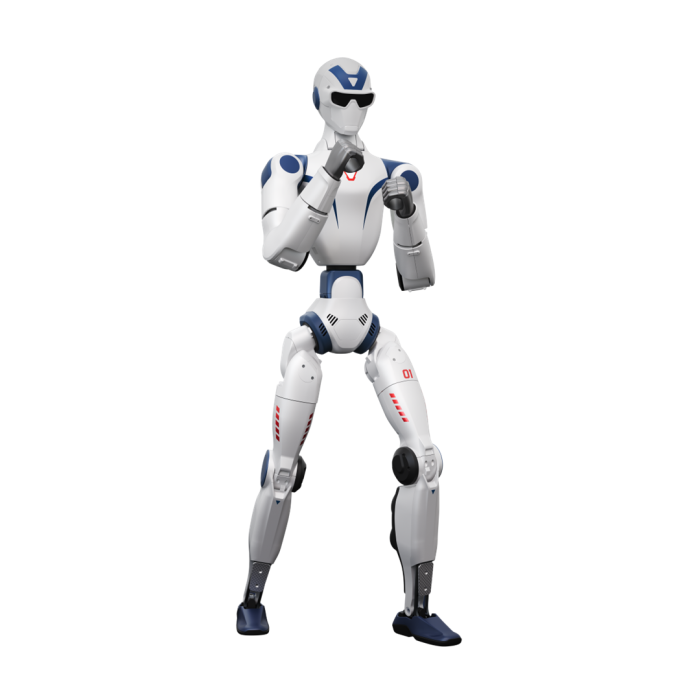
Unitree R1 Edu Pro H AI Humanoid Robot for Advanced Robotics Research
In stock
- BRAND:
- UNITREE ROBOTICS
- MODEL:
- R1 EDU-U10
- PART #:
- R1 EDU-U10
- ORIGIN:
- China
- Warranty:
- 12 MONTHS
- AVAILABILITY:
- SUBJECT TO AVAILABILITY
- SKU:
- Unitree-R1-EDU-U10
Unitree R1 Edu Pro H AI Humanoid Robot for Advanced Robotics Research
Unitree's R1 line runs to eleven named versions, from the R1 Basic through the R1 EDU Standard and Smart to a lettered sequence of EDU Pro configurations that ends at H. That final letter belongs to the Unitree R1 Edu Pro H AI Humanoid Robot for Advanced Robotics Research, the configuration that pairs the full-body R1 humanoid with two Unitree tendon-driven five-finger dexterous hands. For a laboratory facing so many variants, the real question is not whether to buy a humanoid but which combination of body, hands and software belongs on its bench. This page sets out what is published for the Pro H so that the decision can rest on facts rather than on a catalogue letter.
Robots Middle East supplies the Unitree R1 Edu Pro H to universities, research institutes, technology integrators and corporate innovation teams throughout the Middle East. Robots Middle East prepares the quotation for the exact configuration requested and coordinates delivery, commissioning guidance and after-sales support for customers across the region.
Background
Unitree Robotics and its humanoid lineage
Unitree Robotics is a Chinese robotics company that built its reputation on legged machines and has since extended that work into humanoids. Its development ecosystem shows how closely the families are related: the unitree_sdk2 package is used to develop the Go2, B2, H1, G1, H2, R1 and A2 robots in real environments. For a research group, that shared software foundation matters as much as any single robot, because code, tooling and experience gained on one Unitree platform can inform work on another. The R1 sits within this lineage as a compact full-body humanoid intended for development, teaching and applied research rather than as a finished consumer product.
Tendon-driven hands on a compact research body
Dexterous hands are what turn a humanoid from a locomotion study into a manipulation platform. Tendon-driven designs route actuation through cables in the manner of human tendons, which allows the fingers to remain slim while the drive elements sit elsewhere in the hand. Unitree's own Dex2/5 hand illustrates the company's approach: hidden internal wiring, an RS485 communication interface, and compatibility with both G1 and R1 models. On the Pro H, Unitree's tendon-driven five-finger hands complete a 30-DOF full-body humanoid, giving researchers a single platform on which perception, whole-body motion and grasping can be studied together.
Technical Specifications
| Specification | Value |
|---|---|
| Configuration (R1 EDU Pro H, U10) | 30-DOF full-body humanoid with two Unitree tendon-driven five-finger dexterous hands |
| Hand articulation (R1 EDU Pro H, U10) | 2 DOF per hand (10 joints) |
| Dimensions (R1 series) | 1230 x 357 x 190 mm |
| Weight (R1 series) | 29 kg |
| Arm payload (R1 series) | 2 kg |
| Head DOF (R1 series) | 2 |
| Camera (R1 series) | Humanoid binocular camera |
| Microphones (R1 series) | 4-mic array |
| Connectivity (R1 series) | WiFi 6, Bluetooth 5.2 |
| Battery (R1 series) | Smart, quick release |
| Cooling (R1 series) | Local air cooling |
| Transport (R1 series) | Hard case |
| Software development kit | unitree_sdk2 (used to develop Go2, B2, H1, G1, H2, R1, A2 robots) |
| Unitree Dex2/5 hand weight | 365g |
| Unitree Dex2/5 hand size | 151mm x 70mm x 63mm |
| Unitree Dex2/5 hand interface | RS485 |
| Unitree Dex2/5 hand compatibility | G1/R1 models |
Specifications as published by the manufacturer; every figure is confirmed against the datasheet at quotation.
Unitree has not published the weight or dimensions of the Pro H with its hands fitted, the battery capacity, the charging time, the walking speed, the IP rating, the operating temperature range, the camera resolution or the full contents of the box; Robots Middle East confirms each of these at quotation.
What does the Pro H configuration add to the R1 body?
The R1 series figures describe a humanoid of 1230 x 357 x 190 mm and 29 kg, with a 2 kg arm payload, a head with 2 DOF, a humanoid binocular camera and a 4-mic array. Those elements give the robot the means to see, hear and reach. What the Pro H adds is the ability to close a hand around what it reaches: two Unitree tendon-driven five-finger dexterous hands, with 2 DOF per hand (10 joints), on a 30-DOF full-body humanoid.
That distinction shapes the research a team can undertake. A humanoid without hands can study balance, gait, gesture and spoken interaction; one with five-finger hands opens up grasp planning, object handover, tool use and imitation learning from human demonstration. Because the hands belong to the same manufacturer as the body, the integration questions that arise when mixing suppliers are reduced, and the software path remains within the unitree_sdk2 ecosystem.
Unitree also publishes separate figures for its Dex2/5 hand, which it lists as compatible with G1/R1 models: 365g, 151mm x 70mm x 63mm and an RS485 interface. These figures describe the Dex2/5 hand as a component in its own right and appear in the table under its name.
How does the Unitree R1 Edu Pro H compare with the other R1 EDU Pro versions?
The R1 EDU Pro family runs from A to H, and the letters distinguish packages rather than separate robots: the body described by the R1 series figures is common ground, while hands, compute and development options vary. Some neighbouring versions are identified by third-party hands, such as the Unitree R1 Edu Pro C Humanoid Robot with BrainCo Revo 2 Basic Dexterous Hands (R1 EDU U5) and the Unitree R1 Edu Pro D Humanoid Robot with BrainCo Revo 2 Touch Dexterous Hands (R1 EDU U6). The Pro H, by contrast, carries Unitree's own tendon-driven hands.
Each lettered version is described on its own page, and the figures shown here belong to the Pro H and the R1 series alone. Buyers weighing several configurations can ask Robots Middle East for a written comparison of the exact packages under consideration, and can browse the full Unitree R1 EDU range in the meantime.
Who is the Unitree R1 Edu Pro H for?
The Pro H is aimed first at university laboratories and research institutes whose work centres on manipulation: grasping, dexterous control and the coordination of hands with whole-body posture. Groups working on embodied artificial intelligence will find a platform on which vision, audio and hand action can be recorded and learned together, with development handled through unitree_sdk2.
Teaching programmes in robotics, mechatronics and computer science form a second audience. A full-body humanoid with working hands gives students a tangible subject for kinematics, control theory and software engineering, and the hard transport case and quick-release battery suit a platform that moves between teaching rooms and demonstration spaces.
Systems integrators and corporate innovation teams form a third group, using the robot to prototype service, retail or light assembly concepts before committing to larger deployments. Where a project's emphasis is tactile feedback in the fingertips, the Pro D named above may merit comparison; where a team wishes to begin with a different package, the Unitree R1 Edu Pro A Humanoid Robot (R1 EDU U3) is a further point of reference. Robots Middle East can advise on which configuration matches the research plan.
What is the Unitree R1 Edu Pro H used for?
- Dexterous manipulation research: studying grasp strategies and finger coordination with tendon-driven five-finger hands.
- Embodied AI and imitation learning: collecting perception and action data to train policies that link sight, sound and movement.
- Human–robot interaction: exploring handover, gesture and spoken dialogue using the binocular camera and microphone array.
- Robotics education: giving students a full-body humanoid for laboratory work in control, kinematics and software development.
- Application prototyping: testing service and light-handling concepts before wider deployment by integrators and innovation teams.
- Demonstration and outreach: presenting humanoid robotics at exhibitions, open days and corporate showcases, transported in its hard case.
Pricing and Availability
Robots Middle East supplies the Unitree R1 Edu Pro H by quotation, so that the configuration, the hands and any accompanying development support are specified precisely before an order is placed. Delivery, customs clearance and after-sales support are arranged together with the quotation. The form to request a quotation for the Unitree R1 Edu Pro H is available on this page.
Frequently Asked Questions
How many degrees of freedom does the Unitree R1 Edu Pro H have?
The Pro H is a 30-DOF full-body humanoid. Its two Unitree tendon-driven five-finger dexterous hands are listed at 2 DOF per hand (10 joints).
Which software is used to develop on the R1?
Development uses unitree_sdk2, the SDK package Unitree provides for developing the Go2, B2, H1, G1, H2, R1 and A2 robots in real environments.
What sensors does the R1 series carry?
The R1 series is equipped with a humanoid binocular camera and a 4-mic array, with a head offering 2 DOF for directing them.
How does the robot connect to a network?
The R1 series supports WiFi 6 and Bluetooth 5.2.
What kind of battery does the R1 series use?
The R1 series uses a smart, quick-release battery, and the robot is cooled by local air cooling.
How is the robot transported?
The R1 series is transported in a hard case, which suits laboratories that move the robot between rooms, campuses or events.
Where can I buy the Unitree R1 Edu Pro H and what does it cost?
The Unitree R1 Edu Pro H is available from Robots Middle East, which supplies customers across the Middle East. The cost depends on the chosen configuration and is set out in a formal quotation, which you can request on this page.
Summary
In a lineup of eleven versions, the letter H stands for a specific answer: the R1 humanoid body, with its binocular camera, microphone array and quick-release battery, joined to two Unitree tendon-driven five-finger dexterous hands on a 30-DOF platform developed through unitree_sdk2. That combination suits laboratories, teaching programmes and integrators whose work depends on what a humanoid can do with its hands as well as its body. Robots Middle East quotes the exact configuration and supports the robot across the region; for any team deciding which R1 belongs on its bench, this page is the starting point.