
Unitree R1 Edu Pro D Humanoid Robot With BrainCo Revo 2 Touch Dexterous Hands (R1 EDU U6)
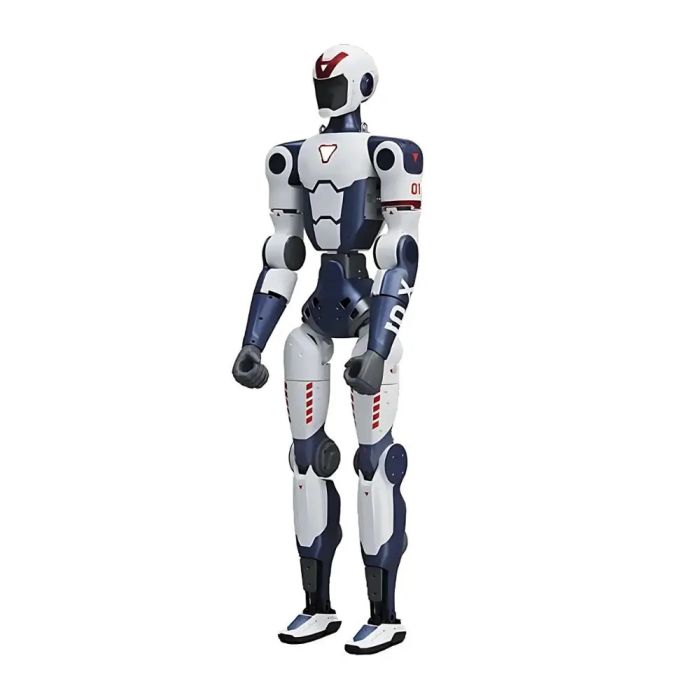
In stock
- BRAND:
- UNITREE ROBOTICS
- MODEL:
- R1 EDU PRO D
- PART #:
- R1 EDU U6
- ORIGIN:
- China
- Warranty:
- 12 MONTHS
- AVAILABILITY:
- ALLOW 2-4 WEEKS FOR DELIVERY
- SKU:
- Unitree Robotics-R1-EDU-U6
Unitree R1 Edu Pro D Humanoid Robot With BrainCo Revo 2 Touch Dexterous Hands (R1 EDU U6)
A grasp policy that looks flawless in simulation usually meets its first real test in the last few millimetres before contact, where friction, compliance and timing stop being parameters and become physics. Closing that gap between simulated and physical manipulation is one of the most persistent problems in embodied AI. It is only properly addressed on hardware that can register what it touches. The Unitree R1 Edu Pro D Humanoid Robot with BrainCo Revo 2 Touch Dexterous Hands (R1 EDU U6) places that capability on a complete humanoid body: 38 actuated degrees of freedom across the legs, arms, waist and head, finished with five-finger hands that each carry 6 degrees of freedom and 4-channel tactile sensing. It is intended for research groups that want their manipulation experiments to return contact information as well as joint angles.
Robots Middle East supplies the R1 EDU U6 to universities, research institutes, innovation centres and corporate laboratories across the Middle East. Our team prepares each quotation for the exact configuration requested, arranges delivery and customs clearance to the destination country, and remains your point of contact for technical support once the robot is in service.
Background
Unitree Robotics and the R1 family
Unitree Robotics established its reputation with legged robots and has since extended its range into humanoid platforms. The R1 is offered as a family of versions rather than a single machine: the R1 Basic, followed by the EDU versions, namely the R1 EDU Standard (U1), the R1 EDU Smart (U2) and the Pro tier, which runs from the R1 EDU Pro A (U3) to the R1 EDU Pro D (U6). As the designation suggests, the EDU versions are aimed at teaching and research, where the robot is a platform to be programmed rather than a finished appliance. The full range is presented in the Unitree R1 EDU category, and the wider family under Unitree R1.
Tactile dexterity from BrainCo
What defines the Pro D is its choice of hands. BrainCo is known for its work in neurotechnology and bionic hands, and the Revo 2 Touch is the tactile variant of its dexterous hand. Each hand has five fingers, 6 degrees of freedom and 4-channel tactile sensing. In practical terms, this allows a controller to detect when and where contact has occurred, rather than inferring it from motor behaviour alone. For grasping, in-hand adjustment and the handling of delicate objects, that signal is often what separates a controller that works on a test bench from one that copes with the variety of real objects.
Technical Specifications
| Specification | Value |
|---|---|
| Version | R1 EDU Pro D (U6) |
| Total actuated degrees of freedom | 38, across legs, arms, waist and head |
| Dexterous hands | BrainCo Revo 2 Touch, five-finger |
| Degrees of freedom per hand | 6 |
| Tactile sensing | 4-channel |
| Calf + thigh length | 675 mm |
| Forearm + upper arm length | 435 mm |
| Battery life | ~ 1 hour |
Specifications are as published by the manufacturer and are confirmed against the datasheet at quotation.
The manufacturer has not published the IP rating, battery capacity, charging time, walking speed, power consumption, operating temperature, hand grip force or operating system; Robots Middle East confirms these at quotation.
What do touch-sensing hands change for humanoid research?
A humanoid without tactile feedback can still grasp, but it does so blind at the moment that matters most. Its controller knows where the fingers were commanded to go, not whether they have met the object, slipped across it or closed too early. With 4-channel tactile sensing in each Revo 2 Touch hand, the R1 EDU U6 adds that missing information to the data stream. Researchers can use it to trigger grasp phases on contact, to label demonstration data with the moment of touch, or to train policies that respond to contact events rather than to position alone.
The hands do not work in isolation. They sit at the end of arms with a combined forearm and upper arm length of 435 mm, on a body whose 38 actuated degrees of freedom include the waist and head. That combination allows experiments in which the robot shifts its torso, turns its head towards a task and reaches with both hands, so manipulation research can be studied as a whole-body problem rather than a fixed-arm exercise. For teams working on loco-manipulation, the 675 mm calf and thigh length defines the leg geometry that their walking and balance controllers must account for.
How should a laboratory plan its work with the R1 EDU U6?
With a battery life of around one hour, the robot rewards careful session design. Grasp experiments, demonstration recording and walking sequences are best grouped into focused blocks that fit comfortably within that window, with analysis and code changes scheduled between them. Working in this way also helps keep tactile and joint data comparable across sessions, since each block begins from a similar battery state. Laboratories intending to operate beyond a controlled indoor setting, or to connect the robot to an established software toolchain, should describe their environment and tools when requesting a quotation, so that Robots Middle East can address both points directly. A short planning conversation at this stage usually saves weeks once the robot has arrived and the research programme is under way.
Who is the R1 EDU U6 for?
The Pro D is best suited to groups whose research questions involve contact. University robotics laboratories studying dexterous manipulation, embodied AI teams collecting demonstration data for learning-based control, and human-robot interaction researchers who need a robot to handle objects safely near people will find the tactile hands directly relevant. Graduate programmes that teach humanoid control can also use the full-body joint set to cover locomotion, balance and manipulation on one platform.
Not every programme needs touch sensing in the hands. Teams focused mainly on locomotion or whole-body control may find that another Pro configuration, such as the R1 EDU Pro B (U4), matches their work more closely. Groups that want BrainCo dexterous hands without the tactile variant can compare the R1 EDU Pro C (U5), listed with Revo 2 Basic hands. Robots Middle East can set out the differences between the versions as part of the quotation.
What is the R1 EDU U6 used for?
- Dexterous manipulation research: developing grasp and in-hand control that reacts to measured contact.
- Imitation and demonstration learning: recording human-guided tasks with tactile events attached to the data.
- Sim-to-real transfer: testing simulated manipulation policies against real contact on physical hardware.
- Whole-body loco-manipulation: coordinating legs, waist, head and both arms within a single task.
- Human-robot interaction studies: exploring how a humanoid can handle objects safely around people.
- University teaching: giving students a full humanoid platform for coursework in control and AI.
Pricing and Availability
Robots Middle East supplies the R1 EDU U6 on a quotation basis, prepared for your institution and destination country. Delivery, customs and technical support are arranged together with the quotation, so the full scope is clear before you commit. To begin, please send us your requirements using the quotation request available on this page.
Frequently Asked Questions
How many degrees of freedom does the R1 EDU U6 have?
The R1 EDU U6 has 38 actuated degrees of freedom in total, distributed across the legs, arms, waist and head.
Which hands does the Pro D use?
It uses BrainCo Revo 2 Touch five-finger dexterous hands. Each hand has 6 degrees of freedom and 4-channel tactile sensing.
How long does the battery last?
Battery life is around one hour, so experiments are best planned in sessions of that length.
What are the limb dimensions?
The combined calf and thigh length is 675 mm, and the combined forearm and upper arm length is 435 mm.
Is the R1 EDU U6 suitable for teaching?
Yes. As an EDU version, it is aimed at teaching and research, and its full-body joint set allows students to work on locomotion, balance and manipulation with a single robot.
How does the Pro D differ from the Pro C?
The Pro D is fitted with the tactile Revo 2 Touch hands, while the Pro C is listed with Revo 2 Basic hands. Robots Middle East can set out any further differences when preparing your quotation.
Where can I buy the R1 EDU U6 and what does it cost?
You can buy the R1 EDU U6 from Robots Middle East, which supplies it across the Middle East. Pricing is provided by individual quotation, including delivery, customs and support for your location.
Summary
The distance between a simulated grasp and a real one is measured in contact, and the R1 EDU U6 is built to measure it. Its 38 actuated degrees of freedom give researchers a full humanoid body to coordinate, while the BrainCo Revo 2 Touch hands, with 6 degrees of freedom and 4-channel tactile sensing each, report what happens when fingers meet the world. For laboratories that want manipulation research grounded in physical contact, and a supplier in the region to quote, deliver and support it, this page is the starting point.