
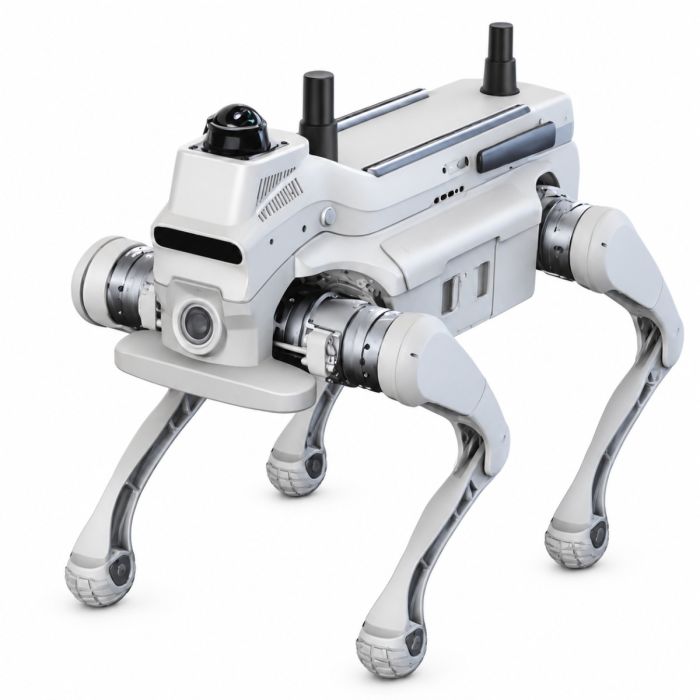
Genisom L1 EDU Quadruped Robot
In stock
- BRAND:
- GENISOM
- MODEL:
- L1 EDU
- ORIGIN:
- China
- AVAILABILITY:
- SUBJECT TO AVAILABILITY
- SKU:
- Genisom-L1-EDU
Genisom L1 EDU Quadruped Robot
Competition arenas are unforgiving to research robots. A navigation stack that behaves well in a familiar laboratory must hold together on unfamiliar ground, against the clock and under the eyes of judges. At IROS 2025, the team from the University of Manchester took first place in the Quadruped Robot Challenge with the Genisom L1 EDU Quadruped Robot, a legged platform that GENISOM designs for research and secondary development. It pairs NVIDIA Jetson Orin NX computing with a Livox Mid-360 lidar, RealSense depth cameras, GNSS positioning and 5G connectivity, so that work on SLAM, autonomous navigation and embodied AI can begin on a robot that already perceives its surroundings in three complementary ways.
Robots Middle East sells the Genisom L1 EDU Quadruped Robot and supplies it to universities, research laboratories, technical colleges and development teams across the Middle East. Robots Middle East prepares each quotation, arranges delivery to the customer's site and remains the point of contact for support once the robot is in service, so that institutions in the region deal with a single supplier from the first enquiry onwards.
Background
GENISOM AI and its full-stack approach
GENISOM AI is a Beijing-based company that describes itself as a full-stack embodied AI business. It develops and manufactures quadruped robots, humanoid robots, robotic joint modules and the embodied intelligence technologies that bind them together. That breadth matters to a research buyer: a manufacturer that builds its own joints, its own legged platforms and its own control software has every layer of the machine under one roof, which tends to make the platform more coherent when researchers begin to modify it. The L1 family is the company's compact quadruped line, and the sources name four versions within it: the Genisom L1, the Genisom L1 EDU, the Genisom L1-W and the Genisom L1 Maker. Further details of the family are available on the GENISOM AI GangBeng L1 Series Bionic Quadruped Robot page.
A research platform with triple perception
The L1 EDU is the version that GENISOM positions as a research and secondary-development platform. Its defining feature is a highly integrated design in which a 3D laser radar, a depth camera, a GNSS satellite positioning module and a 5G communication module are all built in. Together they fuse visible light, depth vision and laser point cloud data into triple perception. Behind the sensors sits an NVIDIA Orin NX module providing up to 100 TOPS of computing power, enough headroom for the perception and planning workloads that modern robotics research places on board rather than offloading to a remote workstation. The platform supports SLAM, 3D mapping and open-source development, which is precisely the toolset that university groups and independent developers rely on.
Technical Specifications
| Specification | Genisom L1 | Genisom L1 EDU |
|---|---|---|
| Computing platform | — | NVIDIA Orin NX (Jetson Orin NX), up to 100 TOPS |
| Lidar | — | Built-in 3D laser radar, Livox Mid-360 |
| Depth vision | — | Built-in depth camera, RealSense |
| Satellite positioning | — | Built-in GNSS module |
| Communication | — | Built-in 5G module |
| Perception | — | Fusion of visible light, depth vision and laser point cloud |
| Software support | — | SLAM, 3D mapping, open-source development |
| Joint modules | 12 fully self-developed high power density joint modules | — |
| Peak torque | 48N·m | — |
| Protection level | IP54 | — |
| Operating temperature | 0-40℃ | — |
| Motion control | Built-in AI reinforcement learning algorithm | — |
| Hardware interfaces | Ethernet, USB 3.0/2.0, 24V/12V power supply, etc. | — |
| SDK | Motion interface, video stream interface, status interface; full software SDK openness | — |
| Expansion modules | High-performance computing cards, perception modules, positioning modules, 4G modules, long-range image transmission modules, etc. | — |
| Target tracking | High-definition camera with AI monocular vision perception model | — |
Specifications are as published by the manufacturer and are confirmed against the datasheet at quotation. The manufacturer has not published the dimensions, the weight, battery life or maximum speed of the EDU version, the battery capacity, the package contents, the remote controller or the software and operating system details; Robots Middle East confirms these at quotation.
How does the L1 EDU differ from the standard Genisom L1?
The two versions are described with different emphases, and it is worth reading them side by side. For the Genisom L1, the specification centres on mechanics and environment: twelve self-developed joint modules, a peak torque of 48N·m, IP54 protection, an operating range of 0-40℃, reinforcement-learning motion control, an open SDK and a list of modules that can be added later, from computing cards to 4G and long-range image transmission. It is, in other words, a platform that invites the owner to decide what to mount on it.
For the L1 EDU, the specification concentrates instead on what is already integrated: the Orin NX computing module, the Mid-360 lidar, the RealSense depth cameras, GNSS and 5G. The choice between them is therefore a choice about where a project wishes to start. A team that intends to design its own sensor payload may prefer the expandable base platform, whereas a team whose research question begins at perception and navigation gains time by starting with the sensing and computing already in place. Robots Middle East can advise which of the two configurations fits a particular research brief.
Why does triple perception matter for SLAM and navigation research?
Each sensing method has its own blind spots. Lidar point clouds give precise geometry but carry little information about colour or texture; depth cameras provide dense close-range structure but struggle in some lighting conditions; visible-light imagery is rich in semantic detail but offers no direct measure of distance. Research in simultaneous localisation and mapping increasingly depends on fusing these sources, so that one sensor compensates where another falls short. A platform that carries all three, alongside satellite positioning for outdoor reference, allows researchers to compare single-sensor and fused approaches on the same robot and the same terrain. With up to 100 TOPS of computing on board, those fusion pipelines can run on the robot itself, which is closer to how a deployed legged system would eventually operate.
Who is the Genisom L1 EDU Quadruped Robot for?
The platform is intended for universities, laboratories and developers exploring robotics applications, and it suits several distinct groups within that audience. University departments in robotics, computer science and mechanical engineering can use it as a shared research instrument for postgraduate projects in mapping, localisation and legged locomotion. Embodied AI groups gain a physical body for policies that would otherwise remain in simulation. Student competition teams have a clear precedent in the IROS 2025 result. Corporate research and development units can use it to prototype autonomous navigation before committing to a bespoke machine.
Not every buyer needs the integrated research stack. Where a project calls for a quadruped that will be fitted with its own selection of computing and perception modules, the expandable Genisom L1 may be the better starting point. GENISOM also names the L1-W and L1 Maker versions, and Robots Middle East can advise which member of the family matches a given brief. Institutions comparing several legged platforms will find further options in our Research Robots category.
What is the Genisom L1 EDU Quadruped Robot used for?
- SLAM and 3D mapping — building maps of indoor and outdoor spaces from fused lidar, depth and visual data.
- Autonomous navigation — developing and testing path planning and localisation on a legged platform in real terrain.
- Embodied AI research — moving perception and decision-making models from simulation onto a physical robot.
- Robotics competitions — preparing teams for challenges of the kind the platform has already won at IROS 2025.
- Teaching and laboratory courses — giving students hands-on experience with sensors, computing and open-source robotics software.
- Connected outdoor trials — combining GNSS positioning and 5G connectivity for field experiments beyond the laboratory.
Pricing and Availability
The Genisom L1 EDU Quadruped Robot is supplied on quotation, so that the configuration, documentation and support arrangements match the requirements of each institution or project. Delivery, customs clearance and after-sales support are arranged together with the quotation by Robots Middle East. To begin, please share your intended application and any procurement requirements with our team, and a tailored quotation can be requested through the enquiry form available on this page.
Frequently Asked Questions
What computing does the Genisom L1 EDU use?
It is equipped with an NVIDIA Orin NX module that provides up to 100 TOPS of computing power for on-board perception and planning.
Which sensors are built into the L1 EDU?
The L1 EDU integrates a Livox Mid-360 lidar, RealSense depth cameras, a GNSS satellite positioning module and a 5G communication module, fusing visible light, depth vision and laser point cloud perception.
Does the L1 EDU support open-source development?
Yes. The platform supports SLAM, 3D mapping and open-source development, which makes it suitable for universities, laboratories and independent developers.
Has the L1 EDU been used in competition?
A team from the University of Manchester won first place in the IROS 2025 Quadruped Robot Challenge using the Genisom L1 EDU.
Which interfaces and SDK does the standard Genisom L1 offer?
The standard Genisom L1 offers Ethernet, USB 3.0/2.0 and 24V/12V power supply among its hardware interfaces. Its SDK provides motion, video stream and status interfaces with full software SDK openness.
Can the robot be used outdoors?
The standard Genisom L1 carries IP54 protection and operates between 0-40℃, while the EDU adds GNSS positioning and 5G connectivity for field work. Robots Middle East can advise on the right configuration for outdoor projects.
Where can I buy the Genisom L1 EDU Quadruped Robot and what does it cost?
The robot is available from Robots Middle East, which supplies customers across the Middle East. Pricing is provided by individual quotation, which also covers delivery, customs and support.
Summary
A competition podium is a demanding test for any research platform, and the Genisom L1 EDU has already passed one at IROS 2025. What brought it there is the same combination that makes it useful in an ordinary laboratory week: Orin NX computing with up to 100 TOPS, triple perception from lidar, depth and visible light, GNSS and 5G on board, and support for SLAM, 3D mapping and open-source work. For institutions that would rather spend their time on algorithms than on assembling a sensor payload, it offers a direct route from research question to field result. For a configuration, documentation and quotation from Robots Middle East, this page is the starting point.