
BWSENSING High-Precision Modbus Dual Axis Inclinometer (BWS2700)
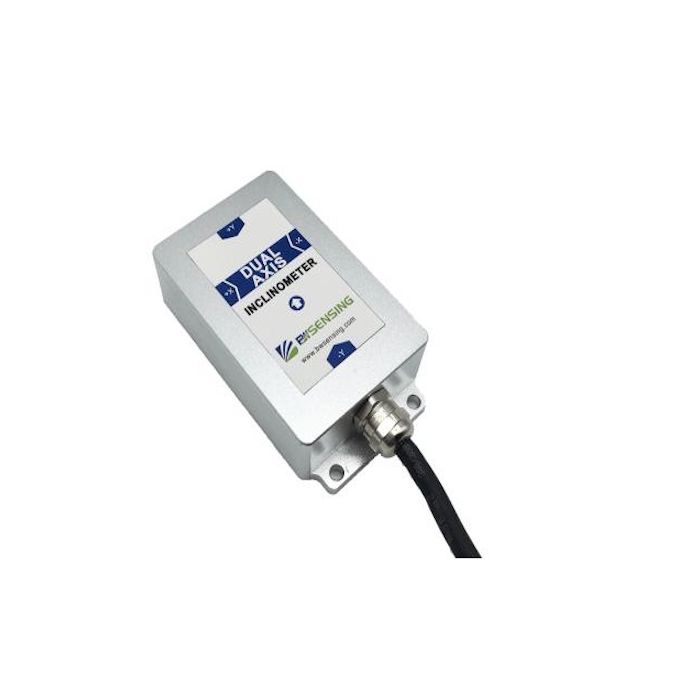
In stock
- BRAND:
- BWSENSING
- PART #:
- BWS2700
- ORIGIN:
- China
- AVAILABILITY:
- SUBJECT TO AVAILABILITY
- SKU:
- BWSENSING-BWS2700
BWSENSING High-Precision Modbus Dual Axis Inclinometer (BWS2700)
Every inclinometer looks impressive on a calibration bench, where the air is still, the temperature never changes and nothing strikes the housing. The real test comes later: a rooftop in high summer, a mast that hums in the wind, a machine frame that takes a knock several times an hour. The BWSENSING High-Precision Modbus Dual Axis Inclinometer (BWS2700) meets that test with more than a headline figure. It offers a maximum accuracy of 0.001° across a ±30° range. It pairs that with a temperature drift of ±0.0007 °/℃ over an operating span of -40 to 85 ℃, an anodised magnesium aluminium alloy shell and an impact resistance of 2000g. It is a sensor specified for the field rather than for the laboratory.
Robots Middle East supplies the BWS2700 to system integrators, engineering consultancies, research institutions and asset operators throughout the Middle East. Robots Middle East prepares each quotation, agrees the correct version and interface with you, and arranges delivery and technical support across the region. We remain your point of contact once the sensor is installed.
Background
Bewis Sensing and the BWS2700
The BWS2700 is a dual-axis, high-precision inclinometer launched by Bewis Sensing, which markets its products under the BWSENSING brand. Within the manufacturer's range it sits at the precision end of the dual-axis family. The company also offers more economical digital inclinometers for projects where the finest resolution is not the deciding factor. The BWS2700 is aimed at installations where the angle itself is the measurement that matters: the reading that triggers an alarm, corrects an alignment or confirms that a structure is behaving as designed.
MEMS sensing with a digital output
The BWS2700 is built on MEMS (micro-electro-mechanical systems) technology. In a MEMS inclinometer, a micro-machined sensing element responds to the direction of gravity. On-board electronics then convert that response into a calibrated angle. Because the BWS2700 delivers its result as a digital output, the angle reaches the controller, logger or PLC as a number rather than as an analogue voltage that must be scaled and protected against noise along the cable. The output frequency is adjustable from 5 to 100Hz, and the baud rate from 2400 to 115200. You can therefore match the data rate to a slow monitoring network or a faster control loop. Serial port debugging software is supplied for the sensor. It connects the inclinometer to a computer and displays the angle, which simplifies commissioning and bench checks before the unit goes on site.
Technical Specifications
| Specification | Value |
|---|---|
| Product type | Dual-axis high-precision inclinometer, MEMS technology, digital output |
| Measurement range | ±30° |
| Maximum accuracy | 0.001° |
| Resolution (completely still) | 0.0005° |
| Zero bias (temperature drift), -40~85℃ | ±0.0007 °/℃ |
| Supply voltage | 9-36VDC |
| Output frequency | 5~ 100Hz adjustable |
| Baud rate | 2400~115200 adjustable |
| Protection level | IP67 (after gluing) |
| Shell material | Magnesium aluminium alloy, anodised |
| Dimensions | L103.8*W55.4*H26(mm) |
| MTBF | ≥90000 h |
| Impact resistance | 2000g,0.5ms,3 times/axis |
| Operating temperature | -40 to 85 ℃ |
| Software | Serial port debugging software for angle display on a computer |
Specifications are as published by the manufacturer and are confirmed against the datasheet at quotation.
The manufacturer has not published the weight, the power consumption in watts, the contents of the box, the Modbus register map or the dynamic accuracy; we confirm these with you at quotation.
Why does temperature drift matter as much as headline accuracy?
A sensor's accuracy figure describes how close its reading can come to the true angle. Temperature drift describes how far that reading wanders as the surroundings heat up or cool down. In a climate where a steel structure can move from a cool dawn to a scorching afternoon within hours, drift can easily matter more than the best-case accuracy. A tilt sensor that is excellent at room temperature but drifts in the sun will report movement that never happened. Worse, it may hide movement that did.
The BWS2700 addresses this directly. Its zero bias is specified at ±0.0007 °/℃ across the full span from -40 to 85 ℃, and the same span is its operating temperature range. This lets an engineer estimate how much of an observed change could come from temperature alone, and plan compensation or alarm thresholds around it. The mechanical specification points the same way. The anodised magnesium aluminium alloy shell, the IP67 protection achieved once the unit is glued, an impact resistance of 2000g at 0.5ms for three times per axis, and an MTBF of at least 90000 hours all describe a sensor built to stay in service rather than to be replaced each season. The IP67 rating depends on the gluing step, so installers should plan the sealing of the housing and cable entry as part of the installation itself.
Which BWS2700 version should I choose?
The sources name three output variants: BWS2700-30-485, BWS2700-30-232 and BWS2700-30-TTL. The suffix indicates the serial interface: RS-485 suits longer cable runs and networks of several sensors, RS-232 suits a direct link to a single host, and TTL suits connection straight to a microcontroller or embedded board. The manufacturer also names ±5°, ±15° and ±30° measurement range options. The ±30° range gives more headroom for structures or machines that may tilt substantially. A narrower range may suit a surface that should remain almost level. Robots Middle East agrees the range and interface that fit your installation with you while preparing the quotation.
Who is the BWS2700 for?
The BWS2700 is aimed at buyers for whom a tilt reading is a decision-making value rather than a rough indication. Structural and geotechnical monitoring teams will value the fine resolution and the published temperature drift when tracking slow settlement in bridges, towers, retaining walls and foundations. Integrators of antenna, satellite and solar tracking systems can use the dual-axis digital output to hold a mount on its intended attitude. Machine builders and robotics engineers can feed the angle straight into a control loop, with the adjustable output frequency matched to the loop. Universities and research laboratories will find the debugging software convenient for experiments and teaching.
Not every project needs this level of precision. Where cost per measurement point outweighs the finest resolution, the manufacturer's economical line may be the better fit. Options include the BWSENSING Cost-Effective Dual-Axis Digital Output With Modbus Inclinometer (BWN427) and, where one axis is enough, the BWSENSING Cost-Effective Single-Axis Digital Output With Modbus Inclinometer (BWM417). The full choice is set out under BWSensing and in our wider Sensors category. Robots Middle East will gladly compare the options against your requirements.
What is the BWS2700 used for?
- Structural health monitoring: tracking gradual tilt in bridges, towers, high-rise buildings and retaining structures.
- Antenna and satellite dish alignment: confirming and holding the elevation and roll of a mount after installation.
- Solar tracking: reporting the angle of tracker rows so the controller can keep the panels on their intended path.
- Platform and machine levelling: giving a levelling system a digital reference on two axes at once.
- Robotics and mobile platforms: supplying attitude data to a controller for stability checks and orientation logic.
- Construction and lifting equipment: monitoring the inclination of booms, masts and chassis for safety interlocks.
Pricing and Availability
Robots Middle East supplies the BWS2700 on quotation, so that the version, measurement range and interface are agreed before an order is placed. Send us your application, the range you need and the interface your controller expects, and we will prepare a quotation for your project. Delivery, customs clearance and technical support are arranged together with the quotation. To begin, use the quotation request available on this page.
Frequently Asked Questions
What is the measurement range of the BWS2700?
The BWS2700 measures over a range of ±30° on two axes. The manufacturer also names ±5° and ±15° range options.
How accurate is the BWS2700?
Its maximum accuracy is 0.001°, and its resolution is 0.0005° when the sensor is completely still.
Is the BWS2700 suitable for outdoor use?
It carries an IP67 protection level once it has been glued, operates from -40 to 85 ℃ and has an anodised magnesium aluminium alloy shell. Please plan the sealing step as part of your installation.
What power supply does the sensor need?
The BWS2700 accepts a wide input voltage of 9-36VDC, which suits a broad range of industrial and vehicle supplies.
Which interfaces are available?
The named versions are BWS2700-30-485, BWS2700-30-232 and BWS2700-30-TTL. The baud rate is adjustable from 2400 to 115200, and the output frequency from 5 to 100Hz.
Is software provided for setup?
Yes. Serial port debugging software connects the inclinometer to a computer and displays the angle, which is useful for commissioning and testing.
Where can I buy the BWS2700 and what does it cost?
You can buy the BWS2700 from Robots Middle East, which supplies it across the Middle East. Pricing depends on the version and configuration, so please request a quotation through this page.
Summary
Precision on the bench is easy to claim; precision on a hot rooftop, a vibrating mast or a working machine is harder to deliver. The BWS2700 combines a maximum accuracy of 0.001° across ±30° with published temperature drift, a wide operating temperature range, an IP67 rating after gluing, strong impact resistance and a long MTBF. Its configurable digital output and supplied debugging software ease integration into monitoring networks and control systems alike. For organisations in the Middle East that need a tilt reading they can act on, quoted, delivered and supported by Robots Middle East, this page is the starting point.