
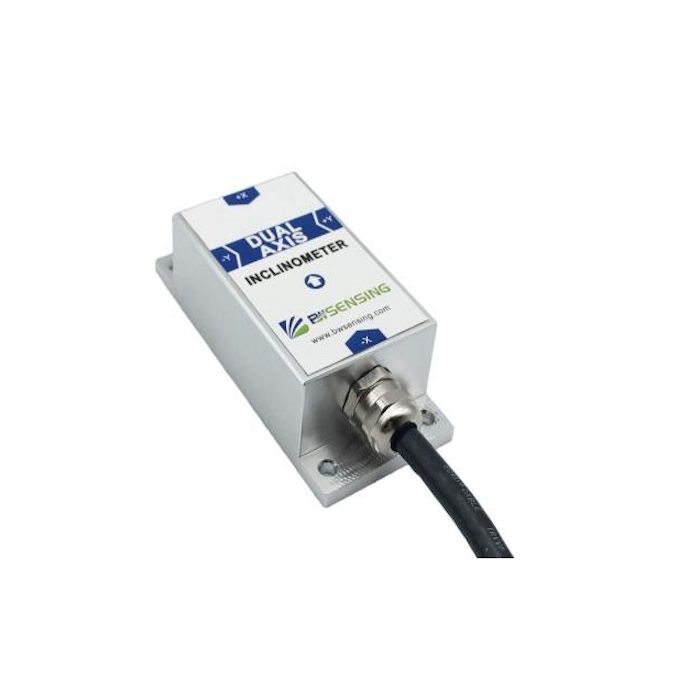
BWSENSING Cost-Effective Dual-Axis Digital Output With Modbus Inclinometer (BWN427)
In stock
- BRAND:
- BWSENSING
- PART #:
- BWN427
- ORIGIN:
- China
- AVAILABILITY:
- SUBJECT TO AVAILABILITY
- SKU:
- BWSENSING-BWN427
BWSENSING Cost-Effective Dual-Axis Digital Output With Modbus Inclinometer (BWN427)
A spirit level gives its answer to whoever is standing beside it. A control system on the far side of a site needs the same answer as a value it can poll, log and act on, hour after hour, in sun, dust and rain. The BWSENSING Cost-Effective Dual-Axis Digital Output With Modbus Inclinometer (BWN427) provides exactly that. It measures inclination on two axes and reports the result over a Modbus serial link, inside a compact sealed housing intended for permanent installation rather than occasional checks.
Robots Middle East supplies the BWN427 to integrators, engineering contractors, research groups and operators across the Middle East. Robots Middle East prepares the quotation, helps you select the output version that suits your installation, arranges delivery to your site and provides technical support during integration and commissioning.
Background
BEWIS Sensing Technology and the BWSENSING range
The BWN427 carries the BWSENSING name and was designed by BEWIS Sensing Technology LLC as a low-cost, small inclinometer with Modbus protocol output. It belongs to a wider family of BWSENSING tilt sensors that covers single-axis and dual-axis designs, digital and analogue outputs, and several bus protocols. You can browse the whole family in the BWSensing category. Within that family, the BWN427 is the dual-axis model that combines an industrial serial interface with the Modbus protocol. It is aimed at projects where many sensors must report into one controller without bespoke parsing code.
MEMS sensing with built-in compensation
Inside the housing, the BWN427 uses a high-precision MEMS accelerometer. The accelerometer is paired with a high-resolution differential converter stage, and the electronics run built-in automatic compensation and filtering algorithms. MEMS sensing has become the standard approach for industrial inclinometers because it is solid-state, compact and tolerant of vibration and shock, and the BWN427 follows that approach. The onboard compensation and filtering are what turn a raw acceleration signal into a stable angle reading. The sensor therefore delivers processed angles rather than leaving the host system to clean up noisy data.
Technical Specifications
| Specification | Value |
|---|---|
| Product type | Low cost and small Modbus protocol output double-axes inclinometer |
| Measurement axes | Dual axis inclination measurement |
| Range | ±90° |
| Resolution | 0.01° |
| Highest accuracy | 0.02° |
| Output mode | RS232/RS485/TTL optional |
| Protocol | Modbus |
| Output frequency | 5-100Hz adjustable, up to 100 Hz |
| Power supply | 9-36V |
| Protection level | IP67 |
| Dimensions | L90*W40.5*H26(mm) |
| Sensing technology | High-precision MEMS accelerometer, high-resolution differential converter, built-in automatic compensation and filtering algorithms |
| Mean time between failures (MTBF) | ≥90000 h |
| Impact resistance | 2000g,0.5ms,3 times/axis |
| Insulation resistance | ≥100 MΩ |
| Installation | Four M4 screws |
| Shell material | Magnesium aluminum alloy oxidation |
| Connector | Metal Joint(Cable 1.5m) |
| Software | Serial port debugging software for displaying the angle on a computer |
Specifications as published by the manufacturer; confirmed against the datasheet at quotation.
The manufacturer has not published the weight, cable length options beyond the standard cable, power consumption in watts or the supported baud rates; these are confirmed at quotation.
What does Modbus output change for system integrators?
Many inclinometers send their readings in a manufacturer-specific frame. Each new sensor type then means writing and maintaining another parser on the host side. The BWN427 avoids this by using Modbus, a register-based protocol that PLCs, RTUs, SCADA platforms and data loggers already understand. The angle readings become registers that the existing master polls in the same way as a flow meter or a temperature transmitter. Engineers who already run Modbus networks can usually bring the sensor into an existing project with configuration work rather than development work.
The adjustable output frequency of 5-100Hz adds further flexibility. A structural monitoring station that logs slow movement has no need for a fast update rate and can poll gently. A machine that is levelling a platform in real time can ask for readings much more often. Because compensation and filtering run inside the sensor, the values the host receives are already conditioned, which keeps the controller logic simple.
For bench work, the serial port debugging software connects the inclinometer to a computer and displays the angle. This lets an engineer check mounting orientation, zero positions and wiring before the sensor goes into the field. In practice, this short step at the workbench often prevents a return visit to a mast or a remote enclosure.
Which BWN427 version should I choose: RS485, RS232 or TTL?
The BWN427 is offered as BWN427 RS485, BWN427 RS232 and BWN427 TTL. The choice between versions comes down to the electrical interface your system expects.
BWN427 RS485 is the usual choice for industrial installations. RS485 is a differential, multi-drop bus suited to longer cable runs and electrically noisy environments, and it is the most common physical layer for Modbus RTU networks. Where several inclinometers share one bus back to a controller, this is generally the version to specify.
BWN427 RS232 suits point-to-point connections, such as a sensor wired directly to an industrial PC, a data logger or a test station with a serial port.
BWN427 TTL is intended for embedded designs. Here the inclinometer connects straight to a microcontroller or single-board computer inside the host equipment, with no external transceiver.
If you are unsure which interface your controller provides, Robots Middle East will help you identify the right version for your system.
Who is the BWN427 for?
The BWN427 is aimed at buyers who need dependable two-axis angle data at a sensible project cost, delivered in a form their automation already speaks. Systems integrators building monitoring networks for towers, slopes, foundations or industrial structures will value the Modbus output and the IP67 protection level. Machine builders and OEMs fitting tilt feedback into platforms, booms or mobile equipment benefit from the 9-36V supply range, which fits common vehicle and industrial power rails. They also benefit from the four-screw mounting and the shock tolerance.
Renewable-energy contractors working on solar trackers, and teams installing satellite dishes or antenna mounts, need angle feedback that will survive years outdoors, which the IP67 rating and the magnesium-aluminium alloy shell are designed to provide. Universities and robotics laboratories will find the TTL version straightforward to connect to development boards. The debugging software also makes it useful for teaching and prototyping.
Some projects only need to measure tilt about one axis. For those, the BWSENSING Cost-Effective Single-Axis Digital Output With Modbus Inclinometer (BWM417) is the single-axis Modbus model in the same range and is worth comparing. Other tilt and position sensors are listed in the Sensors category.
What is the BWN427 used for?
- Tower and mast monitoring: tracking gradual lean in telecom towers, lighting masts and wind measurement masts so that maintenance can be planned before problems develop.
- Solar tracker feedback: reporting panel angle to the tracker controller so that the array follows the sun as intended.
- Antenna and satellite dish alignment: checking elevation and level on dish and antenna mounts during installation and over their service life.
- Structural health monitoring: logging settlement and deformation of bridges, retaining walls, buildings and foundations.
- Machinery and platform levelling: giving cranes, aerial work platforms, drilling rigs and outriggers a live level reference.
- Robotics and mobile platforms: supplying pitch and roll data to robot chassis, AGVs and test rigs for attitude awareness and safety interlocks.
Pricing and Availability
Robots Middle East supplies the BWN427 on a quotation basis. This lets us agree the output version, quantity and any project-specific requirements with you before you commit. Delivery, customs and technical support are arranged together with the quotation, so you receive one clear proposal covering the whole supply. To begin, send us your project details and preferred interface; the quotation request is available on this page.
Frequently Asked Questions
What measurement range does the BWN427 cover?
The BWN427 measures inclination over a range of ±90° on both of its axes. It has a resolution of 0.01° and a highest accuracy of 0.02°.
Which communication protocol does it use?
The BWN427 uses the Modbus protocol. It is available with an RS485, RS232 or TTL physical interface, depending on the version you order.
Can the BWN427 be installed outdoors?
Yes. The BWN427 carries an IP67 protection level and is housed in a magnesium-aluminium alloy oxidation shell with a metal connector, which makes it suitable for permanent outdoor installation.
What power supply does it require?
The BWN427 accepts a supply of 9-36V, which suits common industrial and vehicle power rails.
How is the sensor mounted?
The BWN427 is fixed with four M4 screws. It measures L90*W40.5*H26(mm) and is supplied with a metal joint connector and a 1.5m cable.
How can I check the sensor before installing it?
The supporting serial port debugging software connects the BWN427 to a computer and displays the measured angle. This allows wiring and orientation to be checked on the bench before the sensor goes into the field.
Where can I buy the BWN427 and what does it cost?
You can buy the BWN427 from Robots Middle East, which supplies it across the Middle East. Pricing depends on the version, quantity and delivery requirements, so please request a quotation on this page and we will reply with a complete proposal.
Summary
A spirit level serves the person holding it. The BWN427 serves the system that has to keep watching long after everyone has left the site. It combines two-axis MEMS sensing, internal compensation and filtering, Modbus output and an IP67 alloy housing, so tilt arrives at your controller as a clean, pollable value. RS485, RS232 and TTL versions cover industrial buses, direct PC links and embedded boards. Robots Middle East handles the quotation, delivery and support across the region. For anyone who needs angle data delivered reliably to a controller rather than read off by eye, this page is the starting point.