
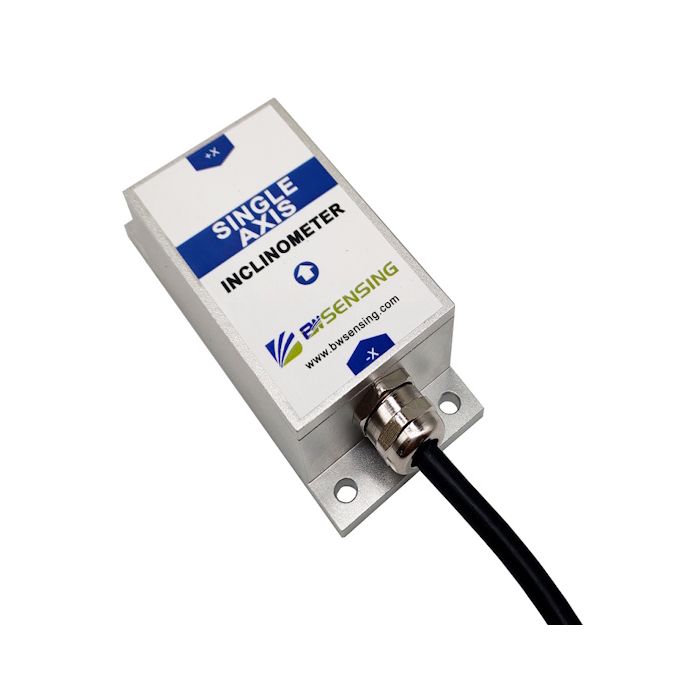
BWSENSING Cost-Effective Single-Axis Digital Output With Modbus Inclinometer (BWM417)
In stock
- BRAND:
- BWSENSING
- PART #:
- BWM417
- ORIGIN:
- China
- AVAILABILITY:
- SUBJECT TO AVAILABILITY
- SKU:
- BWSENSING-BWM417
BWSENSING Cost-Effective Single-Axis Digital Output With Modbus Inclinometer (BWM417)
A thousandth of a degree is far too small for the eye to see, yet a full turn of the circle is large enough to describe a machine lying on its side. Most tilt sensors are built for one of those extremes. The BWSENSING Cost-Effective Single-Axis Digital Output With Modbus Inclinometer (BWM417) is designed to cover both: it reads inclination across ±180° and resolves it to 0.001°. It sends the result as a digital signal, so a controller, logger or PLC can use it without an analogue conversion stage in between.
Robots Middle East sells the BWM417 and supplies it to industrial, energy, infrastructure and research customers throughout the Middle East. Our team prepares each quotation, helps you select the interface version that matches your control system, and arranges delivery and after-sales support for projects across the region.
Background
Wuxi Bewis Sensing Technology and the BWSENSING range
BWSENSING is the brand of Wuxi Bewis Sensing Technology LLC, based in Wuxi City, Jiangsu Province, China. The company builds inertial and inclination sensors, and its catalogue contains a broad family of tilt sensors. These differ mainly in the number of axes measured and the output they provide. You can browse the full family on our BWSensing page, and the wider selection of measurement hardware in our Sensors category.
A digital, one-plane sensor in the cost-effective line
Within that catalogue, the BWM417 belongs to the cost-effective series. It is a single-axis instrument with digital output, and its name refers to Modbus. That places it among sensors intended for integration into networked control and monitoring systems, rather than among analogue tilt switches. It measures inclination in one plane only. That is the right choice wherever the motion or deformation of interest happens about a single pivot, such as a boom rising, a panel row rotating or a mast leaning. The sensor comes in three versions, BWM417-180-485, BWM417-180-232 and BWM417-180-TTL. The suffix of each code identifies its output interface.
Technical Specifications
| Specification | Value |
|---|---|
| Measurement range | ±180° |
| Highest accuracy | 0.01° |
| Resolution | 0.001° |
| Output interface | RS232/RS485/TTL optional |
| Output frequency | 5-100Hz adjustable, up to 100 |
| Power supply | 9-35V |
| Protection level | IP67 |
| Impact resistance | 2000g, 0.5ms, 3 times/axis |
| Dimensions | L90*W40.5*H26 (mm) |
| Manufacturer | Wuxi Bewis Sensing Technology LLC, Wuxi City, Jiangsu Province, China |
Specifications are given as published by the manufacturer and are confirmed against the datasheet at quotation.
The manufacturer has not published the weight, the baud rate options, the package contents or the data register map; we confirm these with you at quotation.
What does the choice of RS485, RS232 or TTL mean for integration?
The three versions of the BWM417 share the same measurement range, resolution and housing. What separates them is how the reading leaves the sensor, and that choice is best made before ordering rather than on site.
RS485 is the usual choice for industrial installations. It is a differential bus, well suited to longer cable runs and to environments with electrical noise, and it is the interface most commonly used for Modbus networks in plant and infrastructure monitoring. Where a sensor must report to a PLC or a remote data logger some distance away, the BWM417-180-485 is normally the natural candidate. RS232 suits shorter, point-to-point connections, such as a sensor wired directly to an industrial computer, a legacy controller or a test bench. TTL-level serial output suits embedded work, where the sensor connects directly to a microcontroller or a single-board computer inside a robot, a vehicle or a prototype instrument.
The adjustable output frequency, from 5Hz up to 100Hz, adds a second integration lever. A slow rate keeps traffic light on a shared bus and suits long-term structural observation. A faster rate gives a control loop fresher data when it needs to respond to motion. We recommend that integrators discuss their Modbus polling plan with us when requesting a quotation, so that your software team is prepared before the hardware arrives.
How does the BWM417 compare with the dual-axis and CAN models?
The most important question is how many planes you need to observe. A single-axis sensor gives you a clean, unambiguous reading of one angle. That simplifies both installation and software when the application really does move about one axis. Where pitch and roll must be tracked together, as on a platform that can tilt in any direction, a dual-axis model avoids the need for two separate sensors. The BWSENSING Cost-Effective Dual-Axis Digital Output With Modbus Inclinometer (BWN427) is the closest two-axis counterpart in name and purpose.
The second question is the bus. The BWM417 speaks serial. Machines built around a CAN network, which is common in mobile and vehicle-mounted equipment, are better served by the BWSENSING Cost-Effective Single-Axis CAN Output Inclinometer (BWM415). That model keeps the single-axis concept but changes the output. Our engineers will gladly help you compare the models when you ask for a quotation.
Who is the BWM417 for?
The BWM417 suits system integrators and automation engineers who need an absolute tilt reading in one plane, delivered digitally to a controller they already run. The full ±180° range matters to them because the sensor keeps reporting even if the mounted object rotates far beyond its normal working angle. The 0.001° resolution matters because small, slow changes can be detected long before they become visible.
Asset owners in energy and infrastructure form a second group. Solar developers, telecommunications operators and civil engineering consultancies often need long-term records of how a structure or a tracker row is positioned. A sealed IP67 housing and a wide 9-35V supply range help such sensors run unattended from the power systems typically found on site.
Machine builders and robotics developers form a third group. They value the TTL version for direct embedded connection and the impact resistance rating of 2000g, 0.5ms, 3 times/axis for equipment that is moved, transported or knocked. Teams who need two axes at once will find the BWSENSING Cost-Effective Dual-Axis Inclinometer (BWM427) and the other dual-axis models more suitable. Teams working on a CAN bus should look first at the BWM415.
What is the BWM417 used for?
- Solar tracker positioning – reporting the rotation angle of a panel row so that the tracker controller can align it accurately.
- Tower and mast monitoring – recording the lean of telecommunications, power or lighting structures over months and years.
- Boom and arm angle measurement – giving cranes, aerial platforms and lifting equipment a digital reading of boom elevation.
- Structural health monitoring – detecting slow rotation in bridges, retaining walls, slopes and building elements.
- Machine levelling and automation – feeding a PLC with the inclination it needs to level a platform or control an actuator.
- Robotics and instrumentation – supplying embedded controllers and survey or test instruments with a precise one-plane attitude signal.
Pricing and Availability
Robots Middle East supplies the BWM417 on a quotation basis. This allows us to confirm the correct interface version and the quantity before you commit. Please tell us which version you need, whether that is BWM417-180-485, BWM417-180-232 or BWM417-180-TTL, and describe the controller it will connect to. Our team will prepare a formal offer. Delivery, customs clearance and technical support are arranged together with the quotation. To begin, please use the quotation request available on this page.
Frequently Asked Questions
What measurement range does the BWM417 cover?
The BWM417 measures inclination across ±180° in a single axis. Its resolution is 0.001° and its highest accuracy is 0.01°.
Which output interfaces are available?
The output is RS232, RS485 or TTL, selected by version: BWM417-180-232, BWM417-180-485 or BWM417-180-TTL. Please choose the version that matches the serial port of your controller.
Can the output rate be changed?
Yes. The output frequency is adjustable from 5Hz up to 100Hz, so you can balance bus load against how quickly fresh readings arrive.
Is the sensor suitable for outdoor installation?
The housing carries an IP67 protection level, and the sensor is rated for impact resistance of 2000g, 0.5ms, 3 times/axis. Please let us know the conditions at your site when requesting a quotation, so that we can advise on installation.
What power supply does it require?
The BWM417 accepts a power supply of 9-35V. This range covers the DC voltages commonly available in industrial cabinets and vehicle systems.
How large is the sensor?
The BWM417 measures L90*W40.5*H26 (mm). Its compact body suits mounting on tracker rows, masts, booms and machine frames.
Where can I buy the BWM417 and what does it cost?
You can buy the BWM417 from Robots Middle East, which supplies it across the Middle East. Pricing depends on the version and the quantity, so please request a quotation and our team will reply with a formal offer.
Summary
The BWM417 brings together two scales that rarely share one housing: a full ±180° span and a resolution of 0.001°. It delivers both as a digital signal over RS485, RS232 or TTL, at a rate you can set between 5Hz and 100Hz. A sealed IP67 enclosure, a 9-35V supply range and a compact L90*W40.5*H26 (mm) body make it practical for structures, trackers and machines that move about one axis. Where two axes or a CAN bus are required, the sibling models in the BWSENSING range are the better fit. For a one-plane digital tilt measurement that a controller can use directly, this page is the starting point.