
BWSENSING Dual Axis Wireless NB-Iot Inclinometer (NB-WM410)
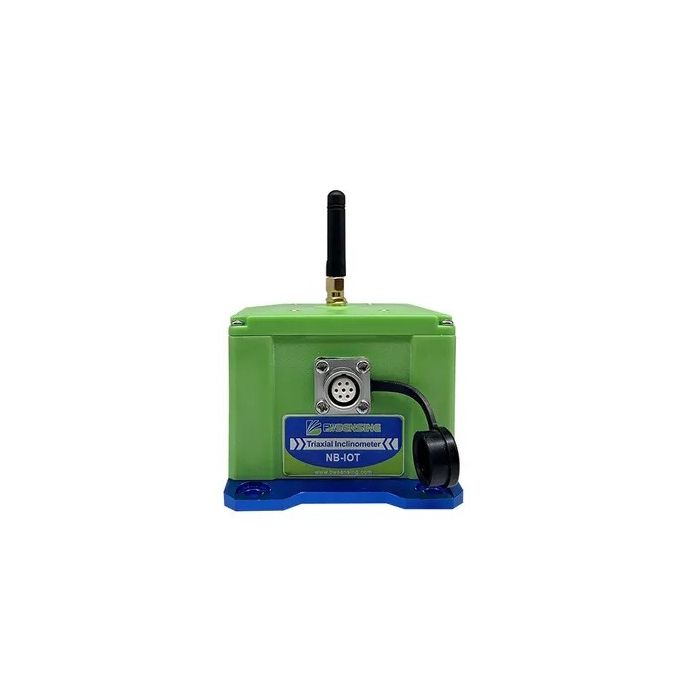
In stock
- BRAND:
- BWSENSING
- PART #:
- NB-WM410
- ORIGIN:
- China
- AVAILABILITY:
- SUBJECT TO AVAILABILITY
- SKU:
- BWSENSING-NB-WM410
BWSENSING Dual Axis Wireless NB-Iot Inclinometer (NB-WM410)
Structures seldom fail without warning. A retaining wall, a pylon base or a cut slope usually leans first, by fractions of a degree that no inspector can see and no tape measure can catch, and the value of a monitoring programme lies in noticing that lean while it is still small. The BWSENSING Dual Axis Wireless NB-Iot Inclinometer (NB-WM410) is designed for exactly that kind of patient watching. It resolves tilt to 0.0007° on two axes, recharges itself from sunlight and sends its readings over NB-IoT or 2G-GSM, so that a slow drift becomes a visible trend on a screen rather than an unwelcome discovery on site.
Robots Middle East supplies the NB-WM410 to engineering consultancies, contractors, asset owners and research groups across the Middle East. Our team prepares each quotation against the requirements of the project, arranges delivery to site or office, and provides support from initial configuration through to the point at which every sensor is reporting reliably into the monitoring platform.
Background
Bewis Sensing Technology and the BWSENSING brand
The NB-WM410 is manufactured by Bewis Sensing Technology LLC, a company established in 2010 that describes itself as an innovative and fast-growing business. Its roots are academic: the company was born in the Institute of Microelectronics (IME) of Peking University, a background that explains its concentration on sensing hardware rather than on general electronics. From 2019, BWSENSING has been approved as the company's global brand, and it is under that name that its inclinometers, including the wired digital models and the wireless NB-IoT series, are now offered internationally. The wider range is collected in our BWSensing category.
A tilt sensor that brings its own network
The NB-WM410/WS2000 series is a high-accuracy wireless tilt sensor that supports two network modes, NB-IoT and GSM. That combination is the heart of the product. Narrowband IoT is a cellular technology intended for small, infrequent data packets and low power consumption, which suits a sensor whose job is to report an angle at intervals rather than to stream data continuously. GSM provides a second route on networks where NB-IoT is not yet available. Add solar charging and a monitoring cloud system, and the sensor no longer depends on a cable run, a mains supply or a local data logger, which are often the most expensive and fragile parts of a conventional installation.
Technical Specifications
| Specification | Value |
|---|---|
| Model | NB-WM410 |
| Axes / type | Dual Axis wireless NB-IoT |
| Accuracy | 0.01° |
| Resolution | 0.0007° |
| Charging | Solar charging |
| Network | NB-IoT and 2G-GSM |
| Max transmission distance | No limit |
| Cloud system | Customizable Monitoring Cloud System |
| Manufacturer | Bewis Sensing Technology LLC |
Specifications as published by the manufacturer; they are confirmed against the datasheet at quotation.
The manufacturer has not published the measuring range, dimensions, weight, IP rating, operating temperature, battery capacity, power supply, package contents, output frequency or zero temperature drift; these are all confirmed at quotation.
What makes the NB-WM410 different from a cabled inclinometer?
A conventional digital inclinometer is only one part of a measuring chain. It needs a cable to carry power in and data out, a logger or controller to collect the readings, a power source for that logger, and usually a modem to send the results onwards. On a building site with a site office next door, that chain is manageable. On a highway embankment, a desert pipeline route or a transmission tower some distance from the nearest road, each link adds cost, installation time and another point of failure.
The NB-WM410 folds that chain into the sensor itself. Solar charging takes the place of the external supply, NB-IoT and 2G-GSM take the place of the cable and modem, and the Customizable Monitoring Cloud System takes the place of the local logger. Because readings travel over the cellular network rather than along a wire, there is no limit on transmission distance: the engineer reviewing the data can be in the next building or in another country. The practical condition is network coverage at the point of installation, which is worth checking before sensors are ordered for a remote site.
None of this comes at the expense of measurement quality. An accuracy of 0.01° and a resolution of 0.0007° place the NB-WM410 firmly in the category of instruments for deformation monitoring, where the aim is to detect small, gradual changes over weeks and months rather than large movements in seconds.
How does the NB-WM410 relate to the NB-WS2000?
The NB-WM410 and the NB-WS2000 belong to one series of high-accuracy wireless tilt sensors supporting NB-IoT and GSM. The figures on this page, however, belong to the NB-WM410 alone, and they should not be read across to its sibling. If your project calls for the NB-WS2000, or you wish to compare the two, Robots Middle East will set out the differences between the models for you.
Who is the BWSENSING NB-WM410 for?
Geotechnical consultants are the most natural users: teams responsible for slopes, cuttings, embankments and retaining structures, who need long-term tilt records without sending a technician to download data. Structural engineers monitoring buildings next to deep excavations or tunnelling works form a second group, as do the owners and operators of linear infrastructure such as roads, railways, pipelines and power lines, whose assets stretch across distances that make cabling impractical. Telecommunications and utility companies with towers and masts in exposed locations will find the self-powered, cellular design equally relevant.
Contractors working under monitoring obligations in a construction contract can deploy the sensor quickly and remove it when the work is finished, while universities and research institutes may use it for field studies where a fully wireless instrument simplifies the experimental set-up.
Where the sensor will sit beside an existing control system, data logger or PLC, and a cable is already available, a wired instrument may be the more economical choice. The BWSENSING range includes digital-output models such as the BWSENSING Cost-Effective Dual-Axis Digital Output With Modbus Inclinometer (BWN427), the BWSENSING Cost-Effective Dual-Axis Inclinometer (BWM427) and the BWSENSING Cost-Effective Digital Dual-Axis Inclinometer (BWM466), and our wider Sensors category covers further options. Our team will gladly advise which approach suits a given site.
What is the BWSENSING NB-WM410 used for?
- Slope and embankment monitoring — tracking gradual movement in cuttings, embankments and natural slopes along roads and railways.
- Retaining walls and excavations — recording the inclination of walls and shoring during and after deep excavation work.
- Towers and masts — following the verticality of telecommunications, lighting and transmission structures in exposed or remote locations.
- Buildings near construction works — documenting tilt in neighbouring structures while tunnelling or foundation work proceeds nearby.
- Bridges and viaducts — observing the behaviour of piers, abutments and decks as part of a structural health monitoring programme.
- Heritage and ageing structures — keeping a discreet, long-term watch on historic buildings and older assets without wiring them for power.
Pricing and Availability
Robots Middle East supplies the NB-WM410 on a quotation basis, so that each offer reflects the number of sensors, the network arrangements and the support your project requires. When you request a quotation, it helps to tell us where the sensors will be installed, how many monitoring points you plan, and whether the readings need to reach an existing platform. Delivery, customs clearance and technical support are arranged together with the quotation. The quotation request form for the BWSENSING Dual Axis Wireless NB-Iot Inclinometer (NB-WM410) is available on this page.
Frequently Asked Questions
What accuracy and resolution does the NB-WM410 offer?
The NB-WM410 has an accuracy of 0.01° and a resolution of 0.0007°. These figures suit deformation monitoring, where small and gradual changes in tilt must be recorded over long periods.
Which networks does the sensor use to send its data?
The NB-WM410 reports over NB-IoT and 2G-GSM. Having two network modes gives more flexibility in regions where NB-IoT coverage is still being rolled out.
How is the NB-WM410 powered?
The sensor uses solar charging, which removes the need for a mains supply at the monitoring point. This makes it well suited to remote sites far from any electrical infrastructure.
Is there a limit on how far the data can travel?
There is no limit on transmission distance, because the readings travel over the cellular network rather than along a cable. What matters in practice is network coverage at the installation site.
Where are the readings viewed?
Readings are delivered to the Customizable Monitoring Cloud System, from which engineers can review the tilt data remotely. Our team can discuss integration with your existing monitoring arrangements when preparing the quotation.
Who manufactures the NB-WM410?
The NB-WM410 is made by Bewis Sensing Technology LLC, a company established in 2010 that was born in the Institute of Microelectronics of Peking University. Its products have been sold under the BWSENSING global brand since 2019.
Where can I buy the BWSENSING Dual Axis Wireless NB-Iot Inclinometer (NB-WM410) and what does it cost?
You can buy the NB-WM410 from Robots Middle East, which supplies it across the Middle East. The cost depends on quantity and project requirements, so please request a quotation from this page.
Summary
A lean that begins as a few thousandths of a degree is the earliest warning most structures ever give, and the NB-WM410 is built to catch it and pass it on without anyone having to stand beside the structure. Its 0.01° accuracy and 0.0007° resolution handle the measuring, solar charging handles the power, NB-IoT and 2G-GSM handle the distance, and the monitoring cloud system turns individual readings into a trend an engineer can act upon. Developed by Bewis Sensing Technology, a company with roots in Peking University's Institute of Microelectronics, it brings laboratory-grade sensing to places that cables do not reach, and Robots Middle East will work through the remaining details for your site. For any project that needs to watch a structure quietly over time, this page is the starting point.