
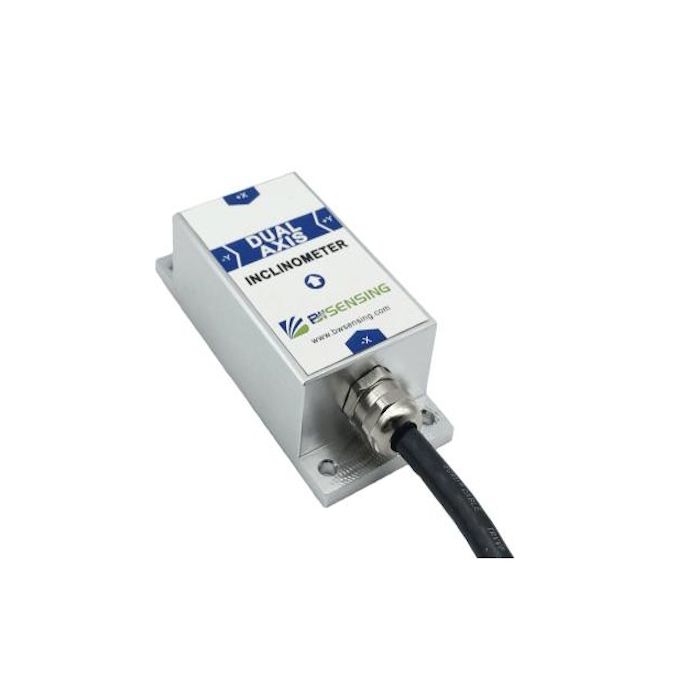
BWSENSING Cost-Effective Dual-Axis Inclinometer (BWM427)
In stock
- BRAND:
- BWSENSING
- PART #:
- BWM427
- ORIGIN:
- China
- AVAILABILITY:
- SUBJECT TO AVAILABILITY
- SKU:
- BWSENSING-BWM427
BWSENSING Cost-Effective Dual-Axis Inclinometer (BWM427)
Every engineering budget has a line where the sensor is chosen, and it is often the line where precision is quietly given up to keep the project affordable. The BWSENSING Cost-Effective Dual-Axis Inclinometer (BWM427) argues that the trade need not be made. It reads tilt on two axes to a resolution of 0.001° and an accuracy of 0.01°, delivers the result as a digital signal and sits in an IP67 housing measuring L90*W40.5*H26 (mm). For a system that needs dozens of measurement points rather than one showcase instrument, that combination changes the arithmetic of the whole design.
Robots Middle East supplies the BWM427 to system integrators, contractors, research groups and plant operators across the Middle East. The team at Robots Middle East prepares quotations for single units and project quantities, helps match the output version to the controller already on site, and supports the sensor after it has been delivered and installed.
Background
BWSENSING and its inclinometer family
BWSENSING builds a wide range of inclination sensors, and the BWM427 belongs to its cost-effective series, which spans single-axis and dual-axis designs with a variety of output schemes. The full line-up can be browsed on the BWSensing brand page. Seen within that family, the BWM427 has a clear role: a dual-axis sensor offered with a choice of serial interfaces, positioned for deployments in which the cost of each unit matters as much as the quality of each reading. That positioning is what makes it attractive for distributed monitoring, where the number of sensors multiplies quickly.
MEMS sensing and the static gravity field
The BWM427 uses MEMS technology with digital output. It measures the change of the static gravitational field and converts it into an angle change, so the sensor needs no external reference: wherever it is mounted, gravity provides the baseline. Because the conversion to an angle happens inside the sensor, the host receives finished angle values rather than a raw analogue signal that must be filtered and scaled. The product can be installed horizontally or vertically, although vertical installation requires customisation, which is worth raising at the quotation stage if the mounting surface is a wall or a mast rather than a deck or a base plate.
Technical Specifications
| Specification | Value |
|---|---|
| Versions | BWM427-88-232; BWM427-88-485; BWM427-88-TTL |
| Sensing technology | MEMS, digital output |
| Measurement range (manufacturer product page) | ±90° |
| Measuring range (technical manual, BWM427-88) | ±88° |
| Resolution (completely still) | 0.001° |
| Accuracy (room temperature) | 0.01° |
| Zero bias (-40~85℃) | ±0.005 °/℃ |
| Cross axis error (-40~85℃) | 0.01° |
| Output frequency | 5-100Hz adjustable, up to 100 Hz |
| Output interface | RS232/RS485/TTL optional |
| Power supply voltage (min / typical / max) | 9 / 12 / 35 V |
| Working current, no load (min / typical / max) | 20 / 30 / 40 mA |
| Operating temperature (min / typical / max) | -40 / 25 / 85 ℃ |
| Storage temperature (min / typical / max) | -55 / 25 / 100 ℃ |
| Protection level | IP67 |
| MTBF | ≥90000h |
| Insulation resistance | ≥100 MΩ |
| Dimensions | L90*W40.5*H26 (mm) |
| Installation | Horizontal or vertical (vertical installation requires customisation) |
Specifications are as published by the manufacturer and are confirmed against the datasheet at quotation.
The manufacturer has not published the package contents, the weight with connector, detailed shock and vibration ratings, or the operating systems supported by the debug software; these are confirmed at quotation.
How precise is the BWM427 when the temperature swings?
Two figures are often confused on inclinometer datasheets, and the BWM427 publishes both. Resolution, 0.001° when the sensor is completely still, is the smallest change the sensor can register. Accuracy, 0.01° at room temperature, describes how close the reported angle is to the true angle. A monitoring system that watches for slow drift in a structure benefits from the fine resolution; a levelling system that must reach a target angle depends on the accuracy.
Temperature is where many low-cost sensors lose their composure, and here the datasheet is specific. The zero bias is ±0.005 °/℃ across -40~85℃, and the cross axis error is 0.01° over the same span, which means that a tilt on one axis has very little influence on the reading of the other even as conditions change. The operating range of -40 to 85 ℃ covers both cold-climate projects and equipment mounted on sun-exposed steel, a common situation for rooftop and desert installations in the region.
One point deserves attention before ordering. The manufacturer's product page gives a measurement range of ±90°, while the technical manual for the BWM427-88 states a measuring range of ±88°. The version codes carry the -88 designation, in line with the figure given in the technical manual.
Which output version suits my controller: RS232, RS485 or TTL?
The BWM427 is offered as BWM427-88-232, BWM427-88-485 and BWM427-88-TTL, and the choice depends on the system the sensor reports to. RS485 is the usual choice in industrial plant, because its differential signalling tolerates long cable runs and electrically noisy surroundings, and it allows several devices to share one bus. RS232 suits a direct, point-to-point connection to a computer, data logger or older controller over a short distance. TTL is intended for board-level integration, where the sensor talks straight to a microcontroller inside an embedded product.
Whichever interface is selected, the output frequency is adjustable from 5 to 100 Hz, so a structural monitor can report slowly to save bandwidth while a tracking or levelling loop can be fed at the full rate. The supply accepts 9 to 35 V, with 12 V as the typical value, and the no-load working current is 30 mA typical, which keeps the power budget modest on battery-backed or solar-powered stations.
Who is the BWM427 for?
The sensor is aimed at engineers who need many reliable angle readings without paying instrument-grade prices for each point. Integrators of photovoltaic tracking systems are a natural fit, as are firms that monitor telecom and power towers, bridges, retaining walls and other structures for deformation. Manufacturers of lifting equipment and mobile platforms can use it for inclination control, while surveying teams and makers of medical instruments can build it into equipment where a compact, sealed angle reference is required.
Some projects are better served by a neighbouring model. Where the control system expects the Modbus protocol, the BWSENSING Cost-Effective Dual-Axis Digital Output With Modbus Inclinometer (BWN427) is designed with that protocol in mind. Where only one axis is needed and the machine runs on a CAN bus, the BWSENSING Cost-Effective Single-Axis CAN Output Inclinometer (BWM415) is the more direct match. Buyers comparing other measurement technologies can find the wider range in the Sensors category.
What is the BWM427 used for?
- Industrial automatic levelling – feeding a controller the two-axis angle it needs to bring a platform or machine base to level.
- Photovoltaic automatic tracking – reporting panel angle so a tracker can follow the sun across the day.
- Tower tilt monitoring – watching lattice and monopole towers for slow lean caused by wind, settlement or loading.
- Structural deformation monitoring – recording small angular changes in bridges, walls and buildings over long periods.
- Lifting equipment inclination control – supplying cranes and aerial platforms with the tilt data used by safety and control systems.
- Surveying, mapping and medical instruments – providing a compact, sealed angle reference inside precision equipment.
Pricing and Availability
Robots Middle East quotes the BWM427 on request, so the price reflects the output version, the quantity and any customisation such as vertical installation. Delivery, customs and support are arranged with the quotation. Please state the interface you need, the number of units and the application, and the team will prepare an offer for the matching version together with its documentation. The quotation request is available on this page.
Frequently Asked Questions
What does dual-axis mean for this inclinometer?
The BWM427 measures inclination on two axes at the same time, so a single sensor reports tilt in both directions of a surface. This avoids mounting two single-axis sensors at right angles to one another.
Which output interfaces are available?
The output is RS232, RS485 or TTL, chosen when ordering through the versions BWM427-88-232, BWM427-88-485 and BWM427-88-TTL. The output frequency is adjustable from 5 to 100 Hz.
Can the sensor be mounted vertically?
Yes, but vertical installation requires customisation. Horizontal installation is the standard configuration.
Is the BWM427 suitable for outdoor installations?
The housing carries an IP67 protection level, and the operating temperature range is -40 to 85 ℃. That makes it a candidate for exposed sites such as solar fields, towers and construction equipment.
What power supply does it need?
The sensor accepts 9 to 35 V, with 12 V as the typical supply. The working current without load is 20 to 40 mA, 30 mA typical.
What is included in the package?
Ask Robots Middle East for the contents of your chosen version when you request a quotation. The offer lists what is supplied with the sensor.
Where can I buy the BWSENSING Cost-Effective Dual-Axis Inclinometer (BWM427) and what does it cost?
Robots Middle East supplies the BWM427 across the Middle East and prices it by quotation, according to version and quantity. Request a quotation on this page to receive a tailored offer.
Summary
The BWM427 answers the question that shapes most monitoring and levelling budgets: how much precision can be kept when the sensor must be bought in quantity? Its answer is a resolution of 0.001°, an accuracy of 0.01°, low drift across -40~85℃, an IP67 housing and a choice of RS232, RS485 or TTL output, all in a compact MEMS package. For integrators who would rather not choose between an affordable sensor and a trustworthy one, it removes the compromise at the budget line. To match the right version to your controller and receive a quotation from Robots Middle East, this page is the starting point.