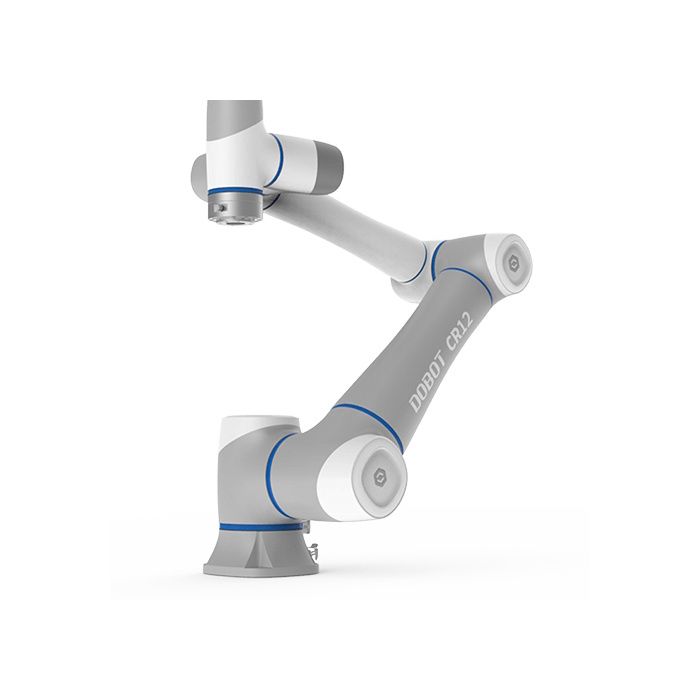
Dobot CRA Collaborative Robot (CR12A)
In stock
- BRAND:
- DOBOT
- PART #:
- 1200000190
- ORIGIN:
- China
- AVAILABILITY:
- SUBJECT TO AVAILABILITY
- SKU:
- Dobot-CR12A
Dobot CRA Collaborative Robot (CR12A)
A collaborative robot is judged in the moment nobody planned for: a power cut halfway through a lift, an operator stepping into the cell, or a part held at full reach when a shift changes. The Dobot CRA Collaborative Robot (CR12A) is engineered for those moments as much as for routine cycles. It pairs a 12kg payload and a 1200mm working radius with a stand-alone safety controller and an electromagnetic brake that engages within 18 ms. The result is an arm that can take on substantial handling work while remaining predictable around the people who share its floor space.
Robots Middle East supplies the Dobot CRA Collaborative Robot (CR12A) to manufacturers, integrators, research institutions and training centres across the Middle East. Robots Middle East prepares each quotation, arranges delivery to the project site and remains the point of contact for technical support after installation, so that buyers in the region deal with a single partner from the first enquiry to commissioning.
Background
Dobot and the CRA series
DOBOT develops robotic arms that range from educational and desktop systems to industrial collaborative robots, and its range sits alongside the other brands listed in our Dobot category. The CRA series is the company's line of collaborative arms for production environments. The sources name a family of versions — CR3A, CR5A, CR7A, CR6AL, CR10A, CR12A, CR16A, CR16AL, CR20A and CR30A — that share a common architecture while differing in payload and reach. The CR12A occupies the upper middle of that family: heavier duty than the compact models, yet still a six-axis collaborative arm intended to work in shared spaces rather than behind a fence.
Safety architecture and calibration
Two pieces of technology define the character of the CR12A. The first is its safety system: a stand-alone safety controller rated PLd Cat.3 with more than 20 safety functions, and certification of the CRA series to ISO 13849-1, ISO 10218-1 and ISO/TS 15066 — the standards that govern functional safety of control systems, the safety of industrial robots, and the specific requirements for collaborative operation. The second is calibration. Each robot is calibrated with a laser calibration system, giving an absolute positioning accuracy of under 0.4 mm. Absolute accuracy matters when programs are generated offline or transferred between cells, because the arm must reach a coordinate it has never been taught by hand.
Technical Specifications
| Specification | Value |
|---|---|
| Payload | 12kg |
| Maximum working radius | 1200mm |
| Repeatability | ±0.03mm |
| Absolute positioning accuracy | Under 0.4 mm |
| Maximum TCP speed | 2m/s |
| Joint speed J4/J5/J6 | 223°/s |
| Weight | 39.5 kg |
| Power consumption | 350W |
| Cable length to control box | 5m |
| Noise | ≤ 70 dB |
| Materials | Aluminium alloy, ABS plastic |
| Installation orientation | Any angle |
| Digital I/O | 24 DI and DO interfaces, PNP and NPN switching |
| Communication | Modbus TCP/RTU, EtherNet/IP, PROFINET |
| Safety controller | Stand-alone, PLd Cat.3, 20+ safety functions |
| Certifications | ISO 13849-1, ISO 10218-1, ISO/TS 15066 |
| Electromagnetic brake | Engages within 18 ms on power outage; holds position within 1 mm |
| Programming software | DobotStudio Pro with Blockly and LUA script programming |
Specifications are as published by the manufacturer and are confirmed against the datasheet at quotation.
The manufacturer has not published the payload-to-reach curve, the joint torque, the controller dimensions, the base footprint, the permissible ambient humidity or the service life; these are confirmed at quotation.
What happens when the CR12A loses power?
This is one of the most practical questions a buyer can ask, and the answer is specific. In the event of an unexpected power outage, the CR12A engages its electromagnetic brake within 18 ms and holds its position within 1 mm. For a cell handling heavy or fragile parts, that behaviour prevents a held workpiece from dropping into fixtures, conveyors or machine tools, and it protects the arm's own tooling from impact.
The brake is one layer of a broader approach. The stand-alone PLd Cat.3 safety controller runs independently of the motion controller, so its safety functions are not dependent on the application program behaving correctly. Combined with certification to ISO 10218-1 and ISO/TS 15066, this gives integrators a documented basis for the risk assessment that every collaborative installation requires. Certification of the robot does not certify the finished cell — the gripper, the workpiece and the layout must still be assessed — but it removes a significant part of the work from the integrator's desk.
How does the CR12A fit into an existing production line?
Integration is often where a robot project gains or loses time, and the CR12A is equipped generously in this respect. It provides 24 DI and DO interfaces with both PNP and NPN switching, which allows it to connect directly to sensors, valves and machine signals regardless of the wiring convention used in the plant. On the network side, it supports Modbus TCP/RTU, EtherNet/IP and PROFINET, the fieldbus protocols most commonly found in factories that run PLC-controlled lines.
Mechanically, the arm can be installed at any angle, so floor, wall and ceiling mounting are all options when floor space is limited or when the arm must reach into a machine from above. A 5m cable to the control box gives flexibility in placing the controller away from the working area. Programming is handled in DobotStudio Pro: operators new to robotics can build routines with Blockly's graphical blocks, while experienced developers can write LUA scripts for complex logic and advanced applications. That combination lets a plant start simply and grow its programs as in-house skills develop.
Who is the Dobot CRA Collaborative Robot (CR12A) for?
The CR12A suits manufacturers who need a collaborative arm with more payload and reach than a compact cobot offers, but who still want operators to work alongside it. Typical buyers include metalworking and plastics plants automating machine loading, packaging and logistics operations handling cartons, and electronics or automotive suppliers with assembly stations that change product frequently.
System integrators are a second important group: the fieldbus support, the generous I/O and the documented safety certifications shorten the engineering effort for each cell they build. Universities, technical colleges and research laboratories form a third group, using the arm's graphical and script-based programming to teach automation at more than one level of difficulty.
Not every task calls for this version. Lighter, more compact work may be better served by a smaller model in the CRA family, while heavier loads may call for a larger one. Robots Middle East can advise on which version suits a given application, and the wider range is available in our Cobots category.
What is the Dobot CRA Collaborative Robot (CR12A) used for?
- Machine tending — loading and unloading CNC machines, presses and injection moulding machines, with mounting at any angle to suit the machine layout.
- Palletising and depalletising — stacking cartons and bags at the end of a line, where reach and payload both matter.
- Pick and place — moving parts between conveyors, trays and fixtures with consistent repeatability.
- Assembly — inserting, fastening and fitting components at stations shared with human operators.
- Inspection and testing — presenting parts to cameras or test equipment, or carrying a sensor around a workpiece.
- Education and research — teaching robot programming from Blockly through to LUA scripting in laboratories and training centres.
Pricing and Availability
The price of the CR12A depends on the configuration, the end-of-arm tooling and the scope of integration support a project requires, so Robots Middle East provides it by individual quotation. Delivery, customs clearance and technical support are arranged together with the quotation. To begin, please share a brief description of your application, the parts to be handled and the intended installation site, and our team will respond with a tailored proposal. A quotation for the Dobot CRA Collaborative Robot (CR12A) can be requested using the form available on this page.
Frequently Asked Questions
What payload can the CR12A handle?
The CR12A has a payload of 12kg. Robots Middle East can review the combined weight of your gripper and parts against your application when preparing the quotation.
How far can the CR12A reach?
Its maximum working radius is 1200mm. Because it can be installed at any angle, that reach can be oriented from the floor, a wall or the ceiling.
Is the CR12A safe to operate alongside people?
The CRA series is certified to ISO 13849-1, ISO 10218-1 and ISO/TS 15066, and the arm uses a stand-alone PLd Cat.3 safety controller with more than 20 safety functions. A risk assessment of the complete cell, including tooling and workpieces, is still required for each installation.
How accurate is the CR12A?
It offers a repeatability of ±0.03mm, and laser calibration gives each robot an absolute positioning accuracy of under 0.4 mm.
Which industrial networks does it support?
The CR12A supports Modbus TCP/RTU, EtherNet/IP and PROFINET. It also provides 24 DI and DO interfaces with PNP and NPN switching.
Do I need programming experience to use it?
No. DobotStudio Pro offers Blockly graphical programming for newcomers, as well as LUA scripting for developers who need more advanced control.
Where can I buy the Dobot CRA Collaborative Robot (CR12A) and what does it cost?
You can buy it from Robots Middle East, which supplies the CR12A across the Middle East. The cost depends on configuration and project scope, so it is provided by quotation on request.
Summary
A collaborative robot earns trust through its behaviour when conditions are least favourable, and the Dobot CRA Collaborative Robot (CR12A) is built with that in mind. Its brake holds the arm within 1 mm moments after a power loss, its independent PLd Cat.3 safety controller supervises every movement, and its certifications give integrators firm ground for their risk assessments. Around that safety core sit the working qualities a production line needs: a 12kg payload, a 1200mm working radius, ±0.03mm repeatability, mounting at any angle, extensive I/O and the fieldbus protocols found in modern plants. For manufacturers, integrators and educators across the region who want substantial capability without giving up shared workspaces, and who value a single supplier for quotation, delivery and support, this page is the starting point.