Dobot CRA Collaborative Robot (CR16A)
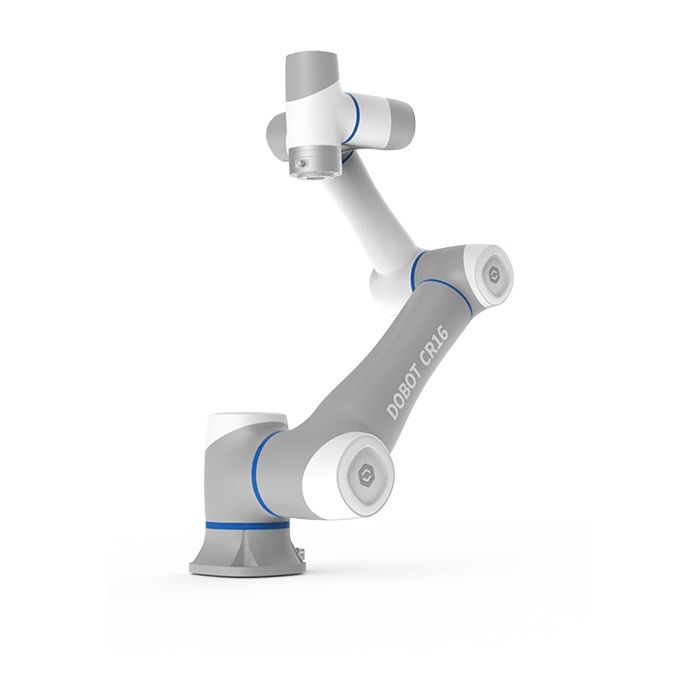
In stock
- BRAND:
- DOBOT
- PART #:
- 1200000191
- ORIGIN:
- China
- AVAILABILITY:
- SUBJECT TO AVAILABILITY
- SKU:
- Dobot-CR16A
Dobot CRA Collaborative Robot (CR16A)
A production cell is not truly tested during a busy shift but in the instant after the power fails, when a heavy tool hangs above a part, a fixture or a person's hands. The Dobot CRA Collaborative Robot (CR16A) is designed with that instant in mind. Its electromagnetic brake catches the arm, its safety credentials come from recognised international standards, and its tool interface allows more than one end tool to share the wrist. That combination makes it a considered choice for heavier collaborative work, where strength alone is not enough and the behaviour of the arm when something goes wrong matters as much as its performance when everything goes right.
Robots Middle East sells the Dobot CRA Collaborative Robot (CR16A) and supplies it to manufacturers, integrators, logistics operators and research institutions across the Middle East. Robots Middle East prepares each quotation to match the intended application, arranges delivery to your site and provides support once the arm is in service, so your project has one point of contact from the first enquiry to commissioning.
Background
DOBOT and the CRA series
DOBOT develops collaborative robots for industry, education and research, and its range now extends from desktop arms to humanoid and legged platforms, which can be explored in the Dobot category. The CRA series is the company's line of industrial collaborative arms intended for shared workspaces. The series has been certified to ISO 13849-1, ISO 10218-1 and ISO/TS 15066, the standards that address safety-related control systems, industrial robot safety and collaborative operation respectively. Every CRA arm is calibrated with a laser calibration system, giving an absolute positioning accuracy of under 0.4 mm, and the series is programmed in DobotStudio Pro, which offers both Blockly graphical programming and LUA script programming.
Dual-channel tooling and brake protection
Within the series, the CR16A occupies the heavy-duty position, pairing a 16 kg maximum payload with a 1000 mm working radius. Two design choices define its character. The first is a dual-channel end effector design that connects directly to multiple end tools, which simplifies cells where a gripper and a second device must work from the same wrist. The second is electromagnetic brake protection: across the CRA series the brake engages within 18 ms of an unexpected power outage and holds position within 1 mm, reducing the distance an end tool drops and protecting equipment and products from damage.
Technical Specifications
| Specification | Value |
|---|---|
| Maximum payload | 16 kg |
| Working radius | 1000 mm |
| Weight | 40 kg |
| Repeatability | ±0.03 mm |
| Absolute positioning accuracy (CRA series) | Under 0.4 mm |
| Maximum linear speed | 2 m/s |
| Maximum joint speed | J1 / J2 150° /s; J3 180° /s; J4 / J5 / J6 223° /s |
| Range of motion | J1/J2/J4/J5/J6 ±360°; J3 ±160° |
| End-effector I/O ports | 2 x AI, 2 x DO, 2 x DI (multiplexed with RS485) |
| Digital I/O | 24 digital IO ports, PNP and NPN switching |
| Communication protocols | Profinet, Ethernet/IP |
| IP rating | IP54 (robot body and control box) |
| Noise | ≤ 70 dB |
| Working environment | 0° ~ 50° C |
| Power | 350W |
| Installation orientation | Any angle |
| Cable length to controller | 5 m |
| Materials | Aluminium alloy, ABS plastic |
| Brake response (CRA series) | Engages within 18 ms; position retention within 1 mm |
| Safety certifications (CRA series) | ISO 13849-1, ISO 10218-1, ISO/TS 15066 |
| Software (CRA series) | DobotStudio Pro, Blockly and LUA script programming |
| Editions | AC Edition (Standard), DC Edition (Mobile) |
Specifications are as published by the manufacturer and are confirmed against the datasheet at quotation.
The manufacturer has not published the control box dimensions, the control box weight, the flange tool I/O voltage, the rated supply voltage or the contents of the box; these are confirmed at quotation.
What happens to the CR16A when the power fails?
With a 16 kg payload, an uncontrolled drop is not a minor inconvenience. A falling gripper loaded with a part can damage the workpiece, the fixture below it or the conveyor it serves, and in a collaborative cell it can come close to an operator. The CR16A answers this with electromagnetic brake protection that reduces the end tool drop distance at power failure. Across the CRA series, the brake engages within 18 ms of an unexpected outage and holds position within 1 mm.
For the planner, this changes the conversation about recovery. An arm that remains where it stopped can usually be restarted from a known position rather than being cleared, re-taught or inspected for collision damage. That matters on sites where supply interruptions are a practical consideration, and it matters wherever expensive parts are carried above other expensive equipment. The brake does not replace a risk assessment, which every collaborative installation still requires, but it gives that assessment a firmer starting point, alongside the series certifications to ISO 13849-1, ISO 10218-1 and ISO/TS 15066.
Protection against the environment supports the same aim. The robot body and the control box are both rated IP54, the arm operates in a working environment of 0° ~ 50° C, and noise is stated at ≤ 70 dB, figures that help when the cell sits on an open shop floor rather than in a clean room.
How does the CR16A connect to an existing production line?
An arm earns its place on a line through the signals it exchanges with everything around it. The CR16A supports Profinet and Ethernet/IP communication protocols and connects with a PLC, so it can take its place in an existing control architecture rather than demanding a new one. Its 24 digital IO ports support switching between PNP and NPN, which removes a frequent source of friction when sensors and actuators from different suppliers must be wired to the same controller.
At the wrist, the end-effector ports provide 2 x AI, 2 x DO and 2 x DI, with the digital inputs multiplexed with RS485 for tools that communicate serially. Combined with the dual-channel end effector design, this allows multiple end tools to be connected directly, for instance a gripper together with a sensing device, without external adaptors. The 5 m cable to the controller gives reasonable freedom in placing the control box, and installation is permitted at any angle, so floor, wall and inverted mounting can all be considered at the layout stage.
Programming follows the same principle of meeting users where they are. In DobotStudio Pro, Blockly lets technicians assemble routines graphically, while LUA script programming gives experienced developers the means to build intricate programs and manage advanced applications.
Who is the Dobot CRA Collaborative Robot (CR16A) for?
The CR16A is aimed first at manufacturers who need to move heavier parts than lighter collaborative arms handle, but who wish to keep people working close to the cell. The manufacturer names the automotive, home appliances, logistics and metal processing industries as its natural territory, and the 16 kg payload with a 1000 mm reach suits the components, cartons and fixtures typical of those sectors.
System integrators form a second group. The Profinet and Ethernet/IP support, the PNP and NPN switching and the dual-channel tool interface reduce the custom engineering needed to fit the arm into a client's existing equipment. A third group comprises training centres, universities and research laboratories that want an industrial-class collaborative arm programmable both graphically and in script.
The choice of edition depends on how the arm will be powered and deployed. The AC Edition is the standard version, while the DC Edition carries the Mobile designation; Robots Middle East confirms which edition suits your power arrangement and installation at quotation. The sources also name a CR16AL variant, for which no separate figures are given here; its specifications are confirmed on request. Buyers comparing other collaborative arms can browse the wider Cobots category.
What is the Dobot CRA Collaborative Robot (CR16A) used for?
- Heavy-duty picking — lifting substantial parts from bins, conveyors or fixtures within a 1000 mm reach.
- Packing — placing products into cartons and cases at the end of a line, beside human packers.
- Palletising — building stable pallet loads of boxes and goods in logistics and manufacturing areas.
- Welding — carrying welding tools along programmed paths with ±0.03 mm repeatability.
- Automotive and home appliance production — handling the heavier components typical of these industries in shared workspaces.
- Logistics and metal processing — applying picking, packing and palletising to warehouse flows and metalworking cells.
Pricing and Availability
Robots Middle East supplies the Dobot CRA Collaborative Robot (CR16A) on a quotation basis, so the offer reflects the edition, the end tools and the integration your application requires. Please share your payload, reach, mounting and communication requirements, and the Robots Middle East team will prepare a proposal accordingly. Delivery, customs clearance and after-sales support are arranged together with the quotation. To begin, the quotation request form is available on this page.
Frequently Asked Questions
What is the maximum payload of the CR16A?
The CR16A has a maximum payload of 16 kg and a working radius of 1000 mm.
Is the CR16A safe to operate alongside people?
The CRA series has been certified to ISO 13849-1, ISO 10218-1 and ISO/TS 15066. As with any collaborative installation, a risk assessment of the specific cell is still required.
What happens if the power supply is interrupted?
The electromagnetic brake reduces the end tool drop distance at power failure. Across the CRA series it engages within 18 ms and holds position within 1 mm.
Which industrial protocols does the CR16A support?
It supports Profinet and Ethernet/IP and connects with a PLC. It also offers 24 digital IO ports with PNP and NPN switching.
How is the CR16A programmed?
The CRA series uses DobotStudio Pro, which provides Blockly graphical programming and LUA script programming for more advanced applications.
What is the difference between the AC Edition and the DC Edition?
The AC Edition is the standard version, while the DC Edition is designated Mobile. Robots Middle East confirms which edition fits your power supply and deployment when preparing the quotation.
Where can I buy the Dobot CRA Collaborative Robot (CR16A) and what does it cost?
You can buy it from Robots Middle East, which supplies the arm across the Middle East. The cost depends on the edition, tooling and integration, so it is set out in a tailored quotation that you can request on this page.
Summary
The Dobot CRA Collaborative Robot (CR16A) is best judged by how it behaves when conditions are least forgiving. A brake that catches the arm within milliseconds, series certification to recognised safety standards and IP54 protection address the moment when power fails or the floor turns dusty, while the 16 kg payload, 1000 mm reach, ±0.03 mm repeatability and support for Profinet, Ethernet/IP and multiple end tools address the long hours of ordinary production. For heavier collaborative picking, packing, palletising and welding across the Middle East, supplied, delivered and supported by Robots Middle East, this page is the starting point.