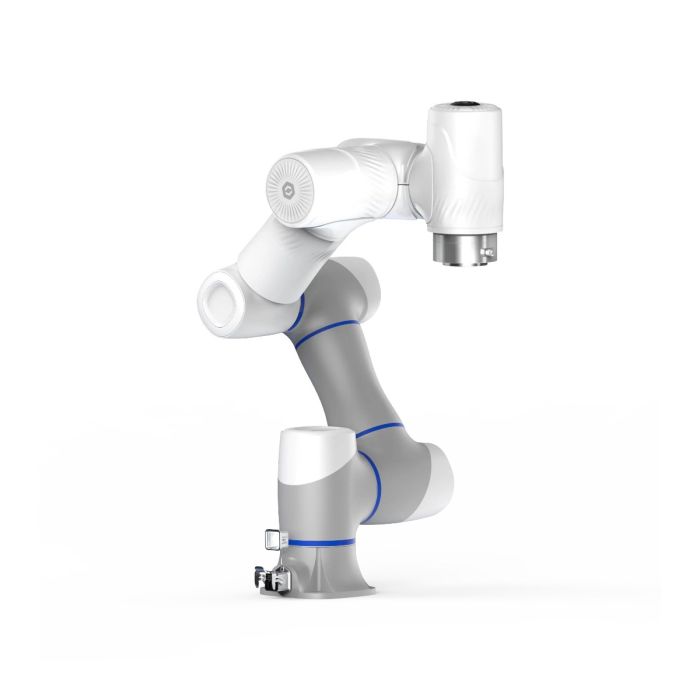
Dobot CRA Collaborative Robot (CR3A)
In stock
- BRAND:
- DOBOT
- PART #:
- 1200000186
- ORIGIN:
- China
- AVAILABILITY:
- SUBJECT TO AVAILABILITY
- SKU:
- Dobot-CR3A
Dobot CRA Collaborative Robot (CR3A)
Light-payload cobots are usually compared on what they can lift and how far they can reach. A more revealing question, particularly in workshops where summer heat and airborne dust are part of the working day, is what conditions a robot can be left to work in. The Dobot CRA Collaborative Robot (CR3A) gives a clear answer: its robot body and control box are both rated IP54, and its working environment is specified from 0 to 50 °C. Within that envelope, a compact frame carries up to 3 kg across a 620 mm working radius. It is a small arm that deserves to be judged by where it can operate as much as by what it can handle.
Robots Middle East supplies the CR3A to manufacturers, system integrators, universities and research groups across the Middle East. Our team prepares each quotation, coordinates delivery and customs clearance to your site, and provides technical support once the robot is installed. Every robot therefore arrives with the edition, accessories and documentation your project actually calls for.
Background
DOBOT and the path to industrial cobots
DOBOT is a Chinese robotics manufacturer that first became widely known for desktop robotic arms used in education and light prototyping. It later extended its range into collaborative robots for industrial production. The company's catalogue now spans several cobot families as well as newer humanoid and legged platforms, all of which you can explore in our Dobot range. The CRA series belongs to the industrial cobot line. These robots are designed to share a workspace with people, subject to the risk assessment that every collaborative cell requires.
Where the CR3A fits in the CRA series
Within the CRA series, the CR3A is the model built around a 3 kg maximum payload and a 620 mm working radius, which places it firmly in bench-scale work. Two design choices define its character. The first is the dual-channel end effector design, which DOBOT describes as an industry first and which allows the arm to connect directly to multiple end tools. The second is support for the Profinet and Ethernet/IP communication protocols, so that the robot connects with a PLC as part of an existing control architecture. Together with 24 digital IO ports that support both PNP and NPN switching, these features show that the CR3A was conceived to join a production line rather than to stand alone on a bench.
Technical Specifications
| Specification | Value |
|---|---|
| Maximum payload | 3 kg |
| Working radius | 620 mm |
| Maximum linear speed | 2 m/s |
| Repeatability | ±0.02 mm |
| IP rating | IP54 (robot body and control box) |
| Power | 120W |
| Working environment temperature | 0 ~ 50 °C |
| Cable length to controller | 5 m |
| Materials | Aluminium alloy, ABS plastic |
| Digital I/O | 24 digital IO ports with PNP and NPN switching support |
| Industrial communication protocols | Profinet, Ethernet/IP |
| End effector design | Dual-channel end effector design |
| Editions | AC Edition (Standard), DC Edition (Mobile) |
Specifications are as published by the manufacturer and are confirmed against the datasheet at quotation. The manufacturer has not published the tool flange dimensions, the base footprint, or the dimensions and weight of the controller; these are confirmed at quotation.
What does the dual-channel end effector design change for tooling?
On many small arms, tooling is where the project schedule slips. A gripper needs power and signals, a vacuum generator needs its own control, and a sensor mounted near the wrist needs yet another connection. Every extra cable routed along the arm is something to dress, protect and eventually replace. The CR3A's dual-channel end effector design addresses this at the wrist itself, allowing the arm to connect directly to multiple end tools.
In practice, this gives an integrator more freedom when choosing how a cell is equipped. A task that combines gripping with sensing, or that changes between two tool types, can be planned around the connections already provided at the end of the arm. Behind the arm, the 24 digital IO ports with PNP and NPN switching support mean that peripheral devices can be connected regardless of which switching convention they use. That is a real advantage in plants where equipment from different suppliers has accumulated over the years. The Profinet and Ethernet/IP protocols then take the robot one step further, into the PLC that coordinates the line. For you, the result is a robot whose integration effort is concentrated in the application rather than spread across adapters and workarounds.
Should I choose the AC Edition or the DC Edition of the CR3A?
The sources name two editions: the AC Edition, designated Standard, and the DC Edition, designated Mobile. The AC Edition is the natural choice for a fixed installation on a bench, a pedestal or a machine frame, supplied from the facility's mains. The DC Edition's designation points to deployments in which the arm draws its power from a DC source, which is how robots mounted on mobile platforms are generally supplied.
The published sources do not set out separate figures for each edition, so the specifications above are given for the CR3A as a whole. If your project involves mounting the arm on an autonomous mobile robot or another battery-powered base, tell us when requesting your quotation. Robots Middle East will confirm the edition-specific details, including the power interface, before the order is placed.
Who is the Dobot CRA Collaborative Robot (CR3A) for?
The CR3A suits small and medium-sized manufacturers taking their first step into automation. Its payload and reach match the components handled in electronics, light assembly, consumer goods and packaging, and its PLC connectivity means it can join an existing line without reengineering the controls. System integrators will value the dual-channel end effector design and the flexible digital IO, which shorten the work of fitting tools and peripherals. Integrators building cells for clients across the region will also appreciate the IP54 rating of both the arm and the control box.
Universities, technical colleges and research laboratories form a second group. A compact cobot with industrial communication protocols allows students to learn on the same interfaces they will meet in industry. For teams building mobile manipulation systems, where the arm is to ride on a wheeled base, the DC Edition (Mobile) is the version to discuss with us. If your task calls for a heavier payload or a longer reach, our wider Cobots category is the place to compare alternatives.
What is the Dobot CRA Collaborative Robot (CR3A) used for?
- Machine tending: loading and unloading light parts at CNC machines, presses and test rigs, coordinated with the machine through the PLC.
- Pick and place: moving small components between trays, conveyors and fixtures in repetitive cycles.
- Small-part assembly: inserting, fitting and fastening components where consistent positioning matters.
- Inspection and testing: presenting parts to cameras or test equipment, with results passed back to the line controller.
- Packaging and kitting: placing products into boxes, blister packs or kits at the end of a production line.
- Education and research: teaching robot programming and industrial integration in universities, training centres and laboratories.
Pricing and Availability
Robots Middle East does not publish a fixed price for the CR3A, because each order depends on the edition, the end tooling, the configuration and the services your project requires. Please request a quotation and describe the task, the edition you prefer and the installation site, and our team will reply with a written offer tailored to your requirements. Delivery, customs clearance and technical support are arranged together with your quotation. To begin, please use the quotation request available on this page.
Frequently Asked Questions
What is the maximum payload of the CR3A?
The CR3A has a maximum payload of 3 kg and a working radius of 620 mm. Please remember that the weight of the end tool counts towards the payload when you plan an application.
How precise and how fast is the CR3A?
The arm has a repeatability of ±0.02 mm and a maximum linear speed of 2 m/s. Cycle times in a collaborative cell also depend on the speed limits set during the risk assessment.
Can the CR3A operate in dusty or warm environments?
The robot body and the control box are both rated IP54, and the working environment is specified from 0 to 50 °C. We recommend reviewing the conditions of your specific site with our team before installation.
Will the CR3A connect to my PLC and existing equipment?
The CR3A supports the Profinet and Ethernet/IP communication protocols for connection with a PLC. It also has 24 digital IO ports with PNP and NPN switching support for sensors and peripheral devices.
What is the difference between the AC Edition and the DC Edition?
The AC Edition is the Standard version for fixed installations, while the DC Edition is designated Mobile. Edition-specific details are confirmed by Robots Middle East at quotation.
How far from the robot can the controller be placed?
The cable length to the controller is 5 m, which should be taken into account when planning the layout of your cell.
Where can I buy the Dobot CRA Collaborative Robot (CR3A) and what does it cost?
You can buy the CR3A from Robots Middle East, which supplies it across the Middle East. The cost depends on the edition and configuration you choose, so please request a quotation from this page and we will prepare a written offer.
Summary
A small cobot earns its place on the floor not only through what it lifts but through the conditions it tolerates and the systems it connects to. The Dobot CRA Collaborative Robot (CR3A) combines a 3 kg payload, a 620 mm working radius and a repeatability of ±0.02 mm with IP54 protection for both arm and control box and a working environment from 0 to 50 °C. Its dual-channel end effector design, 24 digital IO ports and support for Profinet and Ethernet/IP make it a robot planned for integration from the outset. The choice between the AC Edition and the DC Edition then aligns it with either a fixed cell or a mobile platform. Robots Middle East quotes, delivers and supports the CR3A across the region, and for any project that begins with this arm, this page is the starting point.